



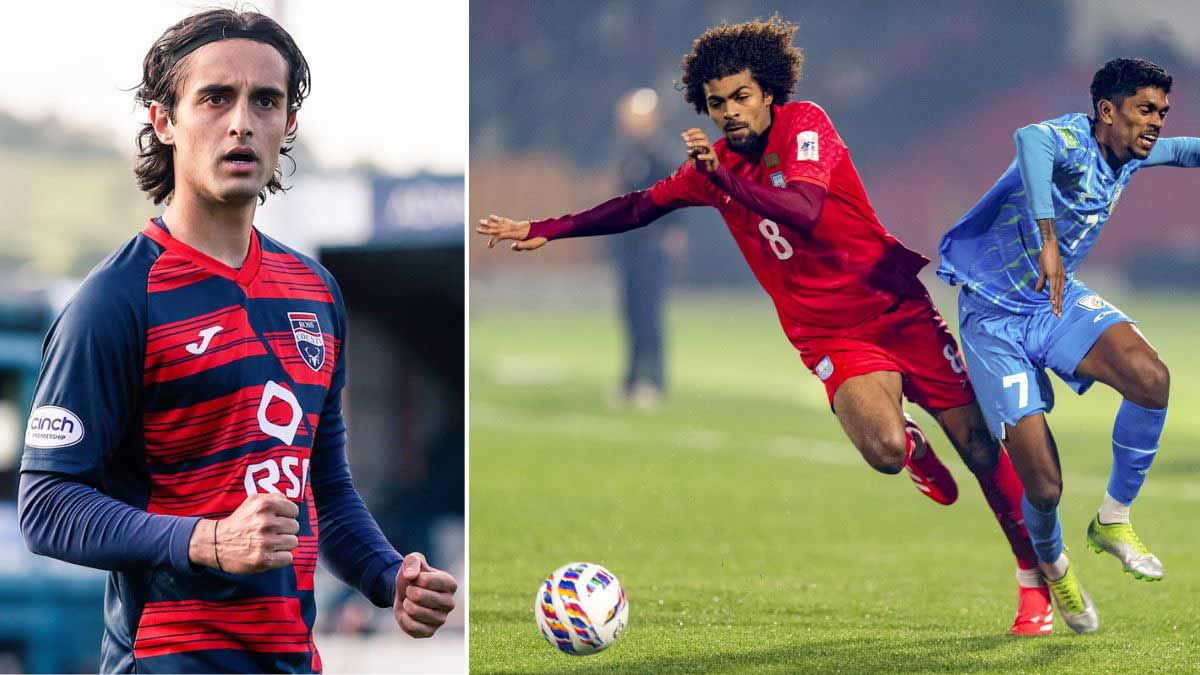
The India-Bangladesh match in Shillong in the AFC Asian Cup qualifying tournament should have been a straightforward affair—the hosts were 59 places above the visitors in the FIFA rankings. But, it was complicated by the presence of a combative and technically adept player in the Bangladesh midfield. On the night, Hamza Choudhury, 27, became the highest profile footballer to play for a South Asian country and helped his team secure a 0-0 draw. India, long the dominant force in the SAFF, has a lot of introspection to do.
Why is it that we have not had our Hamza Choudhury yet? Especially when many more players of Indian origin have made it in top-level football. For instance, Vikas Dhorasoo won the French league twice and was runner-up in both the 2005 UEFA Champions League and the 2006 World Cup. Neil Taylor (son of Shibani Chakraborty, who is a Bengali), played for Aston Villa and Swansea City in the Premier League and was a semifinalist at Euro 2016 with Wales. Harmeet Singh, the “Norwegian Iniesta”, and Luciano Narsingh, who made the Dutch squad for Euro 2012, both 34, are still active.
Another 34-year-old, seasoned centre-back Danny Batth, who is of Punjabi descent, has expressed his desire to play for India and is still, in fact, eligible to turn out for the Blue Tigers, never having got near the English team.
Even now, Batth, who plays for Blackburn Rovers in the competitive English second division and is closing in on 500 appearances in the English Football League system, would be a valuable short-term addition to the Indian national team. But, this cannot happen because Indian laws do not allow dual citizenship. So, players of Indian origin need to become Indian citizens if they aspire to play for India. This is an issue because acquiring Indian citizenship could prevent these players from being eligible to get work permits to play in Europe, which has the world’s best ecosystem for pro football, because of India’s low FIFA ranking—Indian talisman Sunil Chhetri was denied a work permit to play in England for the same reason.
So, the only practical way to get overseas citizens of India or persons of Indian origin to play for the Indian national team is to modify the law. While China naturalises foreigners (Norwegians, Gabonese, English, Portuguese, Brazilian and Peruvian, so far, to let them play for their national team—Serginho being the latest ‘Chinese’ player), India has consistently denied that opportunity to players who are naturally eligible to play for it according to FIFA criteria.
There are tremendous opportunities in the world of PIO players and India must adapt to take advantage of it. Here is a look at three players who can bring immense value to the Indian national football team:
Dilan Markanday
The 23-year-old winger is a graduate of the Tottenham Hotspur academy. He made his senior debut for the club in October 2021 in a UEFA Europa Conference League tie. He has since moved on to Blackburn and is currently on loan at Leyton Orient in the English third division. He has so far played 55 times in the EFL system, scoring nine goals and assisting four. The pacey left-footer is unlikely to ever get near the England team, so his best bet of international football would be India.
Yan Dhanda
The 26-year-old attacking midfielder came through the youth academy of West Bromwich Albion and Liverpool. He made his senior debut for Swansea in the English second division and spent four seasons with the club playing 63 times, scoring five goals and assisting eight. He has become more established in senior football since moving to Scotland, playing 107 times in three seasons, including the ongoing season, and contributing to 33 goals (14 scored and 19 assisted). A former England U-17 international who was highly rated as a youth player, he has so far failed to live up to those expectations. However, he can become an instant hit in the Indian team. He has also openly expressed his desire to play for India.
Manprit Sarkaria
The 28-year-old has already played once for the Austrian national team, in 2023. So, any change of allegiance would probably have to go through a FIFA player’s status committee. It helps that he played in a qualifying match and not a tournament. But, any additional effort required would be well worth it. Just the prospect of a footballer who was good enough to make a Ralf Ragnick team, donning the Indian jersey is exciting enough. Additionally, Sarkaria has a wealth of experience, having played 139 games in the Austrian Bundesliga, scoring 36 goals and assisting 28. He won the league in 2023-24 and the national cup in 2022-23 and 2023-24. He was also in the league’s team of the year in 2021-22. He missed a year of football with a broken ankle, but is fit now. Good news? The left-footer is a striker—a position India sorely needs to fill. Bad news? He recently moved to China; so the Chinese could naturalise him, too.
The goalless draw sparked the debate yet again over the inclusion of Overseas Citizen of India (OCI) and Person of Indian Origin (PIO) footballers in the national team, especially after Dhanda and Batth posted emojis in response to an AIFF Instagram post on the India-Bangladesh match result.
