




-
Gartner has identified the ten top strategic trends that corporates must contend with, in the coming year. We have tried to explain them in simpler terms
Tech industry barometer Gartner has identified the Technology Top Ten that will be key to success for enterprises. You don't have to be a hardcore tech-driven business to be impacted. In fact the writing on the wall says every business, in lesser or greater measure will become a digitally driven business in this era of Cloud and Internet.
The tech ten fall into three categories: The first three are about intelligent systems and Artificial Intelligence. Software will increasingly have the ability to 'learn on the job'. The next three concern the collision between the physical and digital universe. The last four concentrate on the services which will exploit the digital and intelligent tools that make up the first six.
According to Gartner, what it sees as a strategic technology is something that is beginning to break out of its shell now and will reach tipping point or a critical mass, five years from today
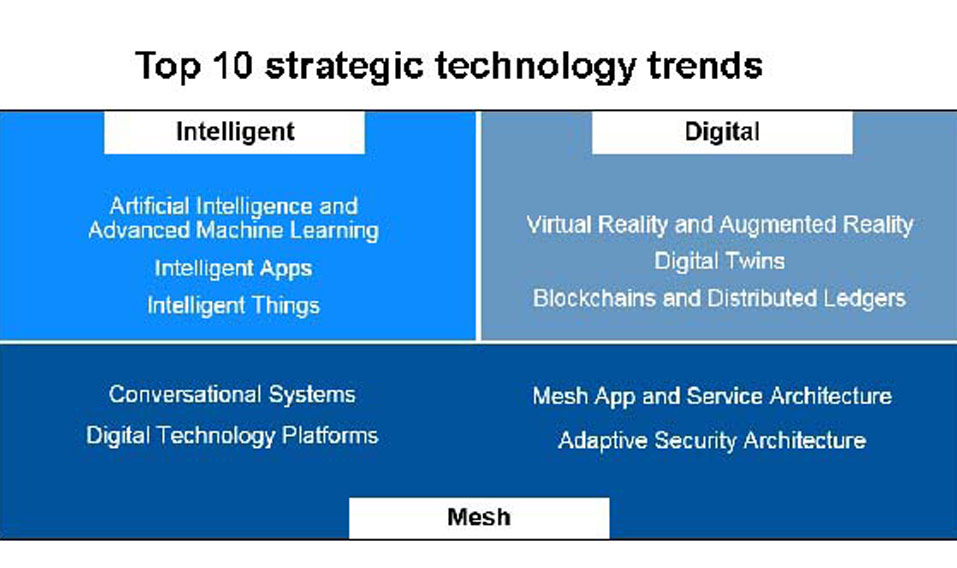
Top 10 strategic technology trends for 2017 are:
1. AI and Advanced Machine Learning
Artificial intelligence (AI) and advanced machine learning (ML) include deep learning, neural networks and natural-language processing. Today they take the form of rules that drive any process. Tomorrow they will morph into smart machines that are seemingly "intelligent."
2. Intelligent Apps
Intelligent apps such as Virtual Private Assistants like the iiPhone's Siri or Microsoft Windows' Cortana perform some of the functions of a human assistant making everyday tasks easier by prioritizing emails, for example and its users more effective, by pointing out what actions are most important). Newer intelligent apps such as virtual customer assistants (VCAs) are more specialized for tasks in areas such as sales and customer service. Get set to see a revolution in the workplace with such apps.
3. Intelligent Things
Intelligent things refer to physical things that exploit applied AI and machine learning to deliver advanced behaviors and interact more naturally with their surroundings and with people. Examples are drones, autonomous (self drive) vehicles and smart appliances
4. Virtual and Augmented Reality
Immersive technologies, such as virtual reality (VR) and augmented reality (AR), transform the way individuals interact with one another and with software systems. VR and AR will merge to form a more seamless system of devices delivering a flow of information that comes to the user through personalized apps and services. This will come through things like mobile, wearable technologies and Internet of Things (IoT). Rooms and spaces will become active partners of the people in them.
5. Digital Twin
A digital twin is a rather tough concept to understand: a dynamic software model of a physical thing . Within three to five years, hundreds of millions of things will be represented by digital twins. For example if an equipment you own gets bad, it can be repaired by working on a software version or twin. They are saying digital twins will eventually become proxies for traditional people skills and monitoring devices and controls like pressure gauges, valves etc.
6. Blockchain and Distributed Ledgers
Blockchain is somkething familiar to everyone who has used bitcoins -- though they may not know it! It is a type of distributed ledger in which transactions (in bitcoin or other tokens) are sequentially grouped into blocks. Each block is chained to the previous block and recorded across a network, using secret coding.
While the current hype of Blockchain is mainly in financial services, there are many possible applications including music distribution, identity verification, title registry etc.
7. Conversational Systems
The current focus for conversational interfaces is focused on chatbots and microphone-enabled devices (e.g., speakers, smartphones, tablets, PCs, automobiles). However, in future a 'digital mesh' will embrace people, social communities, governments and businesses. The device mesh will move beyond the traditional desktop computer and mobile devices to encompass the full range of endpoints with which humans might interact.
8. Mesh App and Service Architecture
In the mesh app and service architecture (MASA), mobile apps, web apps, desktop apps and IoT apps link to a broad mesh of back-end services to create what to users will simply look like an "application."
9. Digital Technology Platforms
Digital technology platforms will provide the future basic building blocks for a digital business. Gartner has identified the five major focal points— information systems, customer experience, analytics and intelligence, the IoT, and business ecosystems. Every organization will have some mix of these five digital technology platforms. They will be the basic building blocks for a digital business tomorrow.
10. Adaptive Security Architecture
The digital mesh and other digital technology platforms will only make for an ever-more-complex world for security. IoT is a new frontier and may end up creating new vulnerability areas and often requiring new remediation tools and processes.