



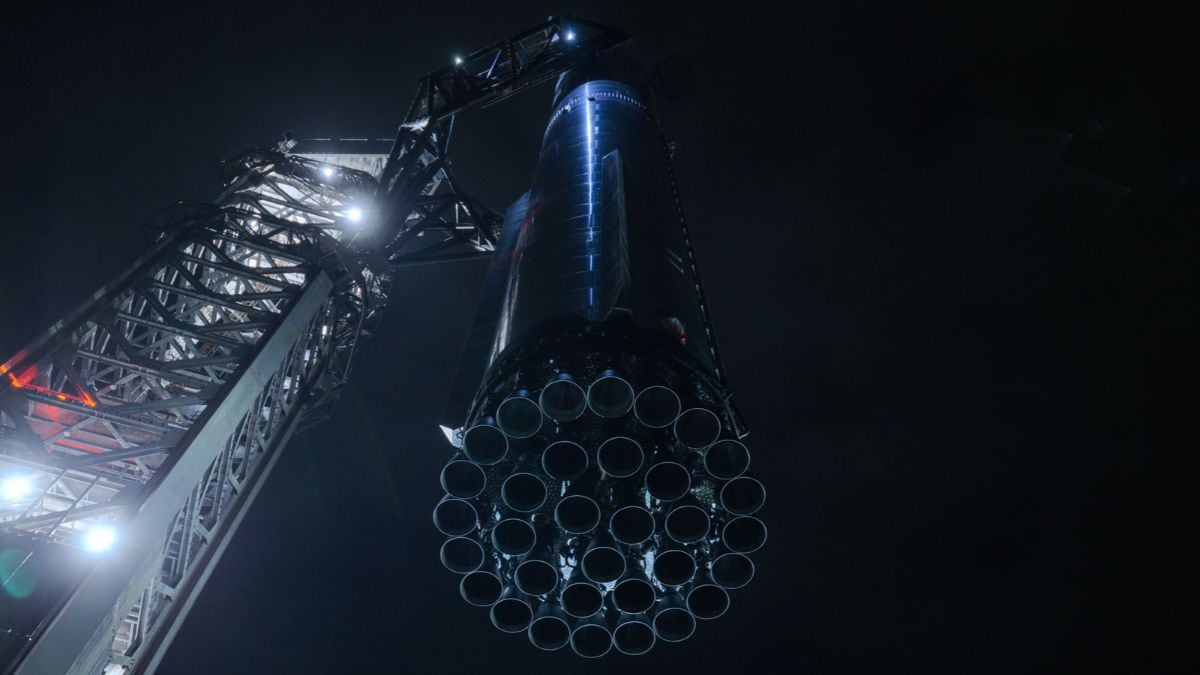
SpaceX is preparing to attempt something never achieved before. It wants to send a spacecraft into orbit around Earth and safely bring back both parts of the rocket that carried it. Starship Flight 15 is scheduled to lift off from Starbase, Texas, on Friday, November 13, at 5.45pm EST (10.45pm GMT), which is 4.15am on Saturday, November 14, in India. The launch window lasts 75 minutes. The date still depends on good weather and permission from US aviation authorities. No astronauts will be aboard, as this is an uncrewed test flight.
Starship has two parts. The lower part, called the Super Heavy booster, is the giant rocket that lifts everything off the ground. The upper part, usually just called Ship, is the spacecraft that continues into space. On this flight, SpaceX will try to catch both. The booster should return within minutes. Ship will spend most of a day circling Earth before returning to the same tower.
The flight plan
The vehicles are Booster 22 and Ship 42, both from the newest and largest version of Starship. They will launch from Starbase's second launch pad, which has never caught a rocket.
The booster's job is short. After separating from Ship, it will turn around, start its engines again and fly back. Instead of landing on the ground, it will slowly descend between two giant metal arms attached to the launch tower. These arms, nicknamed "chopsticks", will close around the rocket and hold it in place. This is planned for about six minutes and 35 seconds after liftoff.
Ship has a longer day. It is expected to climb to about 275 kilometres above Earth and release 26 new Starlink V3 internet satellites. It will then travel around Earth about 14 times. Roughly 21 and a half hours after launch, it will fire its engines to leave orbit and begin returning to Earth. It will come back through the air surrounding our planet over the Pacific Ocean and glide toward Texas. The planned catch comes about 22 hours and 32 minutes after liftoff.
The hard part
“SpaceX has caught a Super Heavy booster three times, on Flights 5, 7 and 8. It has never tried to catch Ship, and that task is much harder. A booster turns back while it is still fairly slow and low. Ship returns from orbit at enormous speed, so it must survive far greater heat and slow down far more before reaching the tower. The route home is another difficulty. To reach Starbase, Ship must fly over populated parts of northern Mexico and southern Texas,” explained space analyst Girish Linganna.
SpaceX has therefore prepared several safety options. Ship will first follow a path that brings it down safely by itself, and will enter orbit only if controllers judge it healthy. If trouble appears later, it can end the flight early over emergency ocean areas near Hawaii or Chile. If either catch is cancelled, the booster or Ship can come down in the Gulf of Mexico instead. On Flight 6, automatic safety checks cancelled a booster catch.
Recent history also suggests caution. Flight 14, on September 28, was the first Starship to reach orbit, and it successfully released all 26 of its satellites. But one engine shut down early, so SpaceX ended the mission after about 3 hours and 9 minutes instead of the planned ten hours. Elon Musk has said catching Ship is only "more likely than not."
Why it matters
“Most rockets today, including SpaceX's own Falcon 9, can recover the lower part at best. The upper part is thrown away on every flight. Starship is designed so that both parts can be used again and again, which should make space travel far cheaper. This matters beyond satellites. NASA plans to land astronauts on the Moon using a version of Starship. That vehicle must be refuelled in space, which requires many tanker flights in quick succession,” added Linganna.
Catching a rocket is one achievement; flying it again is another. Friday's launch could also be postponed, or a catch cancelled for safety. But if the tower's arms close around Ship on Saturday afternoon, Texas time, SpaceX will have achieved the first recovery of both stages of an orbital rocket in a single mission, bringing fully reusable rockets much closer to reality.
