



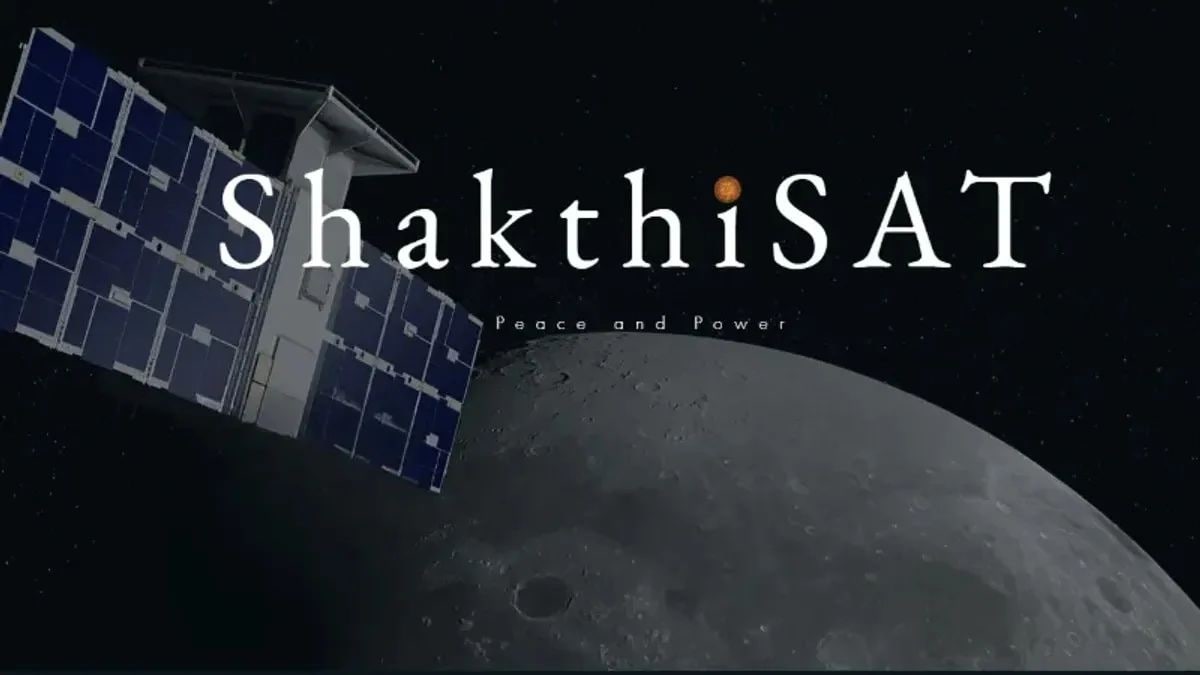
They say that every great mission begins with a dream, and Mission ShakthiSAT is a dream that has brought thousands of girl children from 108 countries together with one shared aspiration—to reach for the Moon.
What makes this mission truly special is not just its global reach, but the effort taken to make science accessible to every child. Educational materials were translated into Portuguese, Spanish, French, and other languages, ensuring that language would never become a barrier to learning.
Following the completion of Phase 1, one girl student was chosen from each of the countries and brought to India for the next stage of the mission.
Interestingly, Mission ShakthiSAT created a sort of a world record for educating the most number of girls in space education in multiple languages such as Portuguese, Spanish, French, and English. The next chapter of Mission ShakthiSAT unfolded at the Gautam Buddha University, Greater Noida, in August 2026, bringing together students, educators, scientists, engineers, and international technical mentors.
“We had sought the support of ISRO scientists, former ISRO experts, IN-SPACe representatives, and international mentors, to teach the students ... spacecraft design, structural engineering, thermal systems, attitude and orbit control, electrical power systems, RF communications, reliability engineering, and satellite integration,” remarked Srimathy Kesan, the founder of SpaceKidz India Limited and also the main force behind this mission.
The girls worked towards building the engineering model and understanding the process of developing, assembling, integrating, and testing satellite systems.
“The technical programme was strengthened by the contribution of educators, scientists, and engineers from across the world,” added Kesan.
International mentors included Marks Lisnanskis from Latvia; Kishan Thodkar from Switzerland; Sam Richards from the United Kingdom; Jeremy Bajado and Frank Fitzgerald S. Batin from the Philippines; Sana Syed from Australian Astronomical Optics, Macquarie University, Australia; Kateryna Andrych from Ukraine; Maggie Barron and Jaiden Branton from the United States and Mayar Wael Maher Fahim from Egypt and Elizangela de Macedo Brito from Brazil.
In addition to these experts, ISRO scientists and technical experts delivered lectures and practical sessions that gave the students an understanding of the real engineering challenges involved in building a spacecraft.
The fundamentals of the Satellite Technology Education programme brought a range of ISRO experts to the mission, including B.N. Ramakrishna, former Director, ISTRAC, ISRO, who delivered a lecture on Spacecraft Mission Planning and Operations.
Ramanagouda V. Nadagouda, Distinguished Scientist and Associate Director, URSC, ISRO, covered Spacecraft Configuration, Design and Realization Aspects.
P. Subba Rao, Former Group Director, Structural Technology Group, URSC, ISRO, introduced Spacecraft Structural Design, Manufacturing and Facilities.
Besides this, Aditya R., former ISRO scientist, addressed a session on Spacecraft Attitude and Orbit Control Systems, while A. Venkateswarlu, former scientist at the URSC, ISRO, guided participants through spacecraft subsystems, hardware, and payload systems.
As part of the mission, IN-SPACe conducted an examination and awarded certificates to the students. The top scores were bagged by student from Burkino Faso, Bolivia.
Mission ShakthiSAT has seven payloads, each developed with a distinct scientific purpose with active contribution from international collaborators.
The Linden, associated with SMW Engineering in Latvia, demonstrates the mechanical integration of coated structural metal components. Rayman Sail, from the Egyptian Space Agency, Egypt, focuses on an end-of-life deorbit mechanism—an important concept in responsible space operations. ASPIRE, from the University of South Alabama in the USA, explores space debris and non-Earth imaging.
The Malya, from Australian Astronomical Optics at the Macquarie University, Australia, carries an infrared camera. The Edelweiss, from 2H5 in Switzerland, aims to validate the radiation tolerance of a graphene Hall sensor and demonstrate submicrotesla magnetic field measurement accuracy in orbit.
LUZINHA's Backpack, from Indiana Aerospace University in the Philippines, features an inertial measurement unit (IMU), while Meenal, developed by Space Kidz India, carries an Earth Observation Camera.
All of these payloads were worked on by the students, giving them the confidence to work on hardcore deep space missions in the future.
This mission is a prelude to the Moon mission planned later this year, aboard ISRO's Small Satellite Launch Vehicle (SSLV).
Interestingly, PM Narendra Modi had also acknowledged and appreciated Mission ShakthiSAT in his last Mann Ki Baat as well.
