



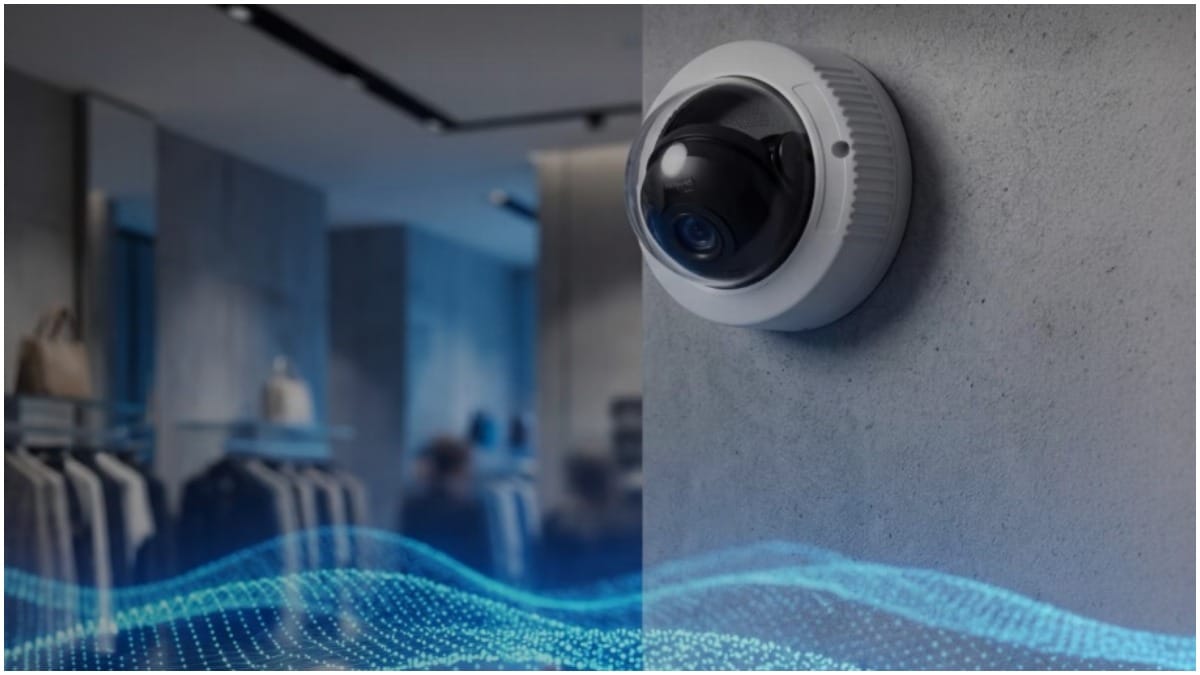
Today, the simplest way to think about video surveillance is that the world has spent the last twenty years putting up "eyes" in them but without brains. Most security cameras are completely passive – as they stream raw videos onto a hard drive, and the recorded footage is seen only after something has gone wrong: a break-in, a fire, an industrial accident or a perimeter breach. California-headquartered AI video security and intelligence company Lumana is aiming to turn those passive cameras into continuously learning, real-time AI agents.
Such a transformation has huge market potential in India as well as in the Middle East, which have a large deployment of passive video surveillance cameras.
“Architecturally, we do this through a hybrid-cloud model, which solves the biggest bottleneck in video technology: bandwidth. Streaming dozens or hundreds of high-definition video feeds directly to the cloud 24/7 is impractical and not realistic as it chokes enterprise networks, incurs massive cloud compute and storage bills, and creates latency that makes real-time response impossible,” explained Ofir Mulla, CTO of Lumana.
Lumana's AI video security platform transforms existing IP cameras from passive recording devices into AI agents that can monitor and alert for specific events and surface operational insights that accelerate investigations. “The platform is built around VIA-1, which is Lumana’s proprietary video intelligence model that continually learns from each environment it is deployed to monitor,” Mulla told THE WEEK.
How does this platform work?
The platform’s distributed hybrid-cloud architecture processes video analysis locally on-premises to drastically reduce bandwidth consumption, eliminate latency and ensure strict data privacy, while leveraging the cloud for advanced analysis of incidents flagged for review, remote management and updates. The technology is camera agnostic and is currently deployed across retail, manufacturing, higher education, healthcare, sports venues and Fortune 500 enterprises around the world.
“There is no need to touch the existing cameras at all. That eliminates the costly 'rip-and-replace' of cabling, hardware, and existing infrastructure. The vast majority of surveillance cameras installed across enterprises, factories and commercial sites over the past decade are IP cameras that speak universal industry protocols - primarily RTSP or ONVIF. As long as a camera can output a standard digital video feed over a local network, it is compatible with the Lumana platform,” added Mulla.
Lumana’s platform connects a compact, edge-computing appliance, Lumana Core, to the customer's existing local network. The device automatically discovers the cameras already on that network, ingests their video feeds, and runs our VIA-1 AI model on them in real time.
So a five- or ten-year-old camera that previously did nothing more than write passive video to a recorder overnight gains computer-vision capabilities: perimeter protection, object recognition, anomaly detection and natural language search. So the camera remains the lens, and the brain is provided by Lumana.
“Once connected to the Lumana platform, those previously passive cameras transform from mute digital recorders into proactive security guards and operational sensors,” said Mulla.
Legacy systems, according to Mulla, rely on generic motion detection that cannot distinguish between routine and abnormal movement, which creates a flood of false-positive alerts and results in alert fatigue. He explained that VIA-1 resolves this by continually learning the visual baseline and normal activity patterns of each specific environment. Instead of reacting to simple pixel changes, it understands context, objects and human behaviour. This allows it to accurately identify meaningful real-world events in real time, including perimeter breaches, after-hours loitering and unauthorised access into restricted zones. Security teams are notified the moment an event occurs, allowing immediate intervention rather than post-incident regret,” said Mulla.
Once deployed, this system has natural-language forensic search. Historically, investigating an incident meant security personnel had to spend hours manually scrubbing through video timelines across multiple feeds. With the Lumana platform, teams can search video archives using plain language, exactly like searching the web. For example, an investigator can type 'person in a yellow safety vest carrying a backpack near loading dock 3 between 2 AM and 4 AM' and the relevant clips surface within seconds across hundreds of cameras.
Passive cameras also have operational intelligence beyond physical security. “The same cameras used for physical security become tools for operational efficiency and workplace compliance. In manufacturing and logistics, this means monitoring safety compliance like hard-hat requirements, verifying procedural adherence and flagging production-line bottlenecks or quality-control anomalies. In retail and commercial spaces, the Lumana platform provides analytics for foot-traffic flow and dwell times. Ultimately, surveillance transitions from a passive forensic archive into an active operational intelligence layer, converting physical security from a reactive cost centre into an engine for enterprise risk prevention and productivity,” said Mulla.
Public sector enterprises in India and the Middle East have both invested heavily in cameras for transportation, safe-city and critical-infrastructure programs. The problem with the current situation is that human monitoring cannot scale to the number of feeds already deployed. Teams are overwhelmed by raw footage. After the deployment of this technology, large enterprises have full data control as video processing happens locally on-premises, so sensitive footage stays inside the agency’s own network and under its own jurisdiction. That matters for governments and other public sector enterprises in regulated industries with strict data-residency requirements.
Besides, large enterprises cannot remove thousands of cameras and need to upgrade them. After deploying Lumana, their existing camera fleet becomes an active intelligence layer rather than a passive archive. The deployment of this technology is also fast and can be done in a matter of a few days.
There is no physical work on the camera—no ladders, no rewiring, no retrofits. The Lumana Core appliance plugs into the local network, discovers the IP cameras already on it over standard protocols and starts ingesting their feeds. From there, applying VIA-1 to a camera is a software step and not a hardware project. What actually determines the timeline is the environment. The model learns the normal patterns of each site, so alert quality improves over the first days as it builds that baseline. The cameras deliver value from day one, and they get increasingly sharper with time.
“For an organisation with hundreds of cameras, the shift is from a multi-month infrastructure overhaul to a deployment measured in days. The cameras stay and the intelligence arrives,” said Mulla.
“Unlike software AI that processes text or code in a data centre, Physical AI must perceive, reason about and interact with the physical world. Having deployed spatial vision systems across millions of laptops, drones and autonomous robots worldwide, we designed Lumana with a deep understanding of how visual intelligence must perform under real-world constraints: limited bandwidth, edge-computing limits and complex physical environments,” observed Mulla.
