



The AI war is getting interesting-er. Right after the global scare that Anthropic’s Mythos sparked — we had none other than Finance Minister Nirmala Sitharaman sounding the alarm, with even an expert committee headed by the SBI chairman set up to monitor it, it is now the turn of the Real McCoy of artificial intelligence (AI), ChatGPT parent OpenAI to stake its own claim to the throne.
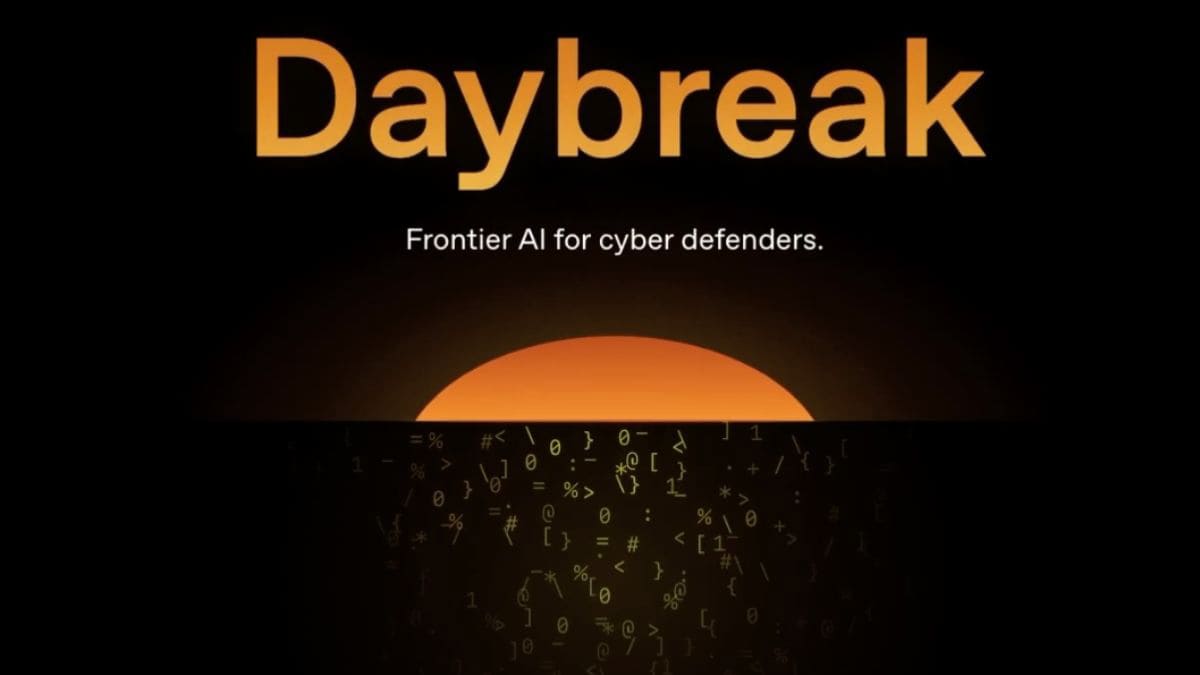
Sam Altman’s company has just announced Daybreak, what the OpenAI CEO called the company’s “effort to accelerate cyber defense and continuously secure software.”
“AI is already good and about to get super good at cybersecurity,” Altman said, “We’d like to start working with as many companies as possible now to help them continuously secure themselves.”
Daybreak is a multi-pronged AI cyber security tool that will automatically protect and secure code continously, doing live threat modelling. Daybreak combines OpenAI's GPT-5.5 family models with Codex's Agentic coding capabilities.
This launch comes just weeks after OpenAI’s main rival Anthropic (launched by a former OpenAI research head Dario Amodei who fell out with Altman before launching this rival startup) came out with Mythos, a similar cybersecurity AI platform that had set off alarm bells ringing for its ability to act independently not just to defend, but also to discover cyber vulnerabilities without prompt and act on it by its accordance — a scenario many compared to sci-fi scary scenarios of the machines becoming sentient and taking over the world.
Maybe the proof of the pudding is in the eating, and it might still take some time before Daybreak’s mettle is tested out in real world conditions. As J.P. Mishra, founder of the Hyderabad-based cybersecurity company Deep Algorithms, put it, “Cybersecurity is clearly moving toward an AI-versus-AI environment. Attackers are already using generative AI for adaptive malware, highly targeted phishing and faster vulnerability discovery. Defensive AI can stay ahead only when it is backed by strong context, reliable telemetry and continuous governance.”
For OpenAI, it is important for Daybreak to be seen as having all the good features of Mythos and none of the side effects that sparked off a scare recently. “AI can now help defenders reason across codebases, identify subtle vulnerabilities, validate fixes, analyse unfamiliar systems, and move from discovery to remediation faster,” said a note issued by OpenAI, adding, “Because those same capabilities can be misused, Daybreak pairs expanded defensive capability with trust, verification, proportional safeguards, and accountability.”
It does seem to have an edge, going by Mumbai-based global cybersecurity solutions provider Sequretek’s co-founder & CEO Pankit Desai, “Anthropic’s Mythos and Microsoft MDASH are doing similar things: mapping vulnerabilities in your existing environment. (But) what makes Daybreak worth watching is that it embeds itself in the DevOps cycle. You are building resilience by design, securing the codebase from day one rather than patching after the fact.”
“That shift matters — moving away from monthly, quarterly, or six-monthly patching cycles toward continuous embedded scanning, identifying weaknesses, patching them, and producing audit evidence in real time,” he added.
The arrival of Daybreak could well be a milestone, as the intense rivalry in launching such pathbreaking new products only stands testament to the revolution of AI going forward unbridled. “AI-driven defence will not remove cyberattacks altogether, but it can change the economics of cybersecurity,” added Mishra, summing up the significance of this new product, “By automating response and strengthening systems in real time, organisations can move from constant catch-up to stronger resilience against increasingly automated attackers.
