



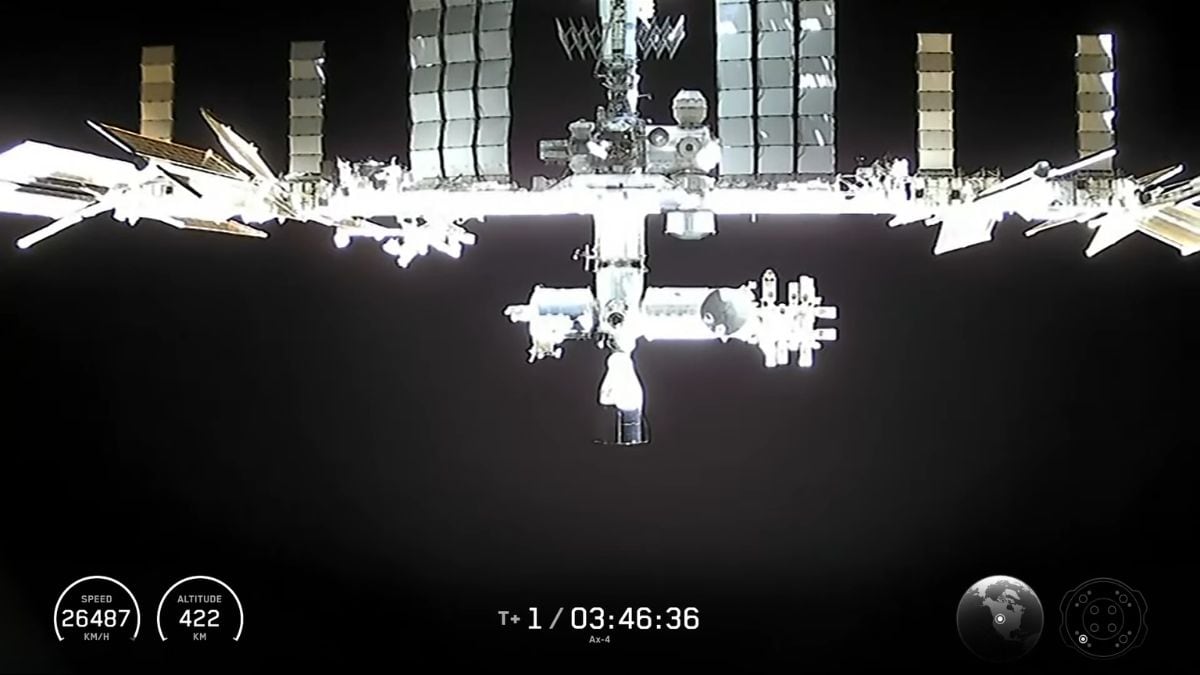
Picture this: A white-and-orange capsule with the Indian tricolour painted on it is floating silently in space, 400 kilometres above Earth. It is slowly, carefully moving towards the International Space Station — a giant laboratory the size of a football field that has been orbiting our planet since 1998.
India and America are seriously talking about sending an uncrewed Gaganyaan module to dock with the ISS. The module will not carry any human but just instruments and cargo. Docking simply means joining two spacecraft together in space, like connecting two coaches of a train, except this train is travelling at 28,000 kilometres per hour and there is no room for even a small mistake. ISRO and NASA are working on this together as equal partners, which itself is a big deal because America does not partner with just anyone in space.
The proposal, if realised, would mark India’s first autonomous rendezvous and docking with an operational international space station and significantly elevate the country’s human spaceflight roadmap from short-duration orbital missions to sustained space infrastructure capability. The initiative builds upon expanding cooperation between the Indian Space Research Organisation (ISRO) and the National Aeronautics and Space Administration (NASA), particularly after the 2023 India-US Strategic Framework for Human Spaceflight Cooperation. The collaboration gained momentum with India’s participation in Axiom Mission 4, which includes Indian astronaut Shubhanshu Shukla flying to the ISS to conduct microgravity experiments and operational training directly benefiting the Gaganyaan program.
“The proposal, if realised, would mark India’s first autonomous rendezvous and docking with an operational international space station and significantly elevate the country’s human spaceflight roadmap from short-duration orbital missions to sustained space infrastructure capability,” explained Srimathy Kesan, the founder and CEO of SpaceKidz India Limited.
Without mastering docking and proximity operations, a country cannot independently build or sustain an orbital station. “This becomes particularly important for India’s planned Bharatiya Antariksh Station (BAS), a modular Indian space station targeted for initial module launches in the early 2030s and full operational capability by 2035. BAS is envisioned as a 20-tonne class space station operating in Low Earth Orbit,” added Kesan.
Gaganyaan was approved in 2018 with a budget of approximately Rs 10,000 crore and represents India’s first indigenous human spaceflight mission. The program aims to send three astronauts to Low Earth Orbit (LEO) at about 400 km altitude for three to seven days aboard the human-rated LVM3 (HLVM3). The 5.3-tonne Crew Module is designed for habitation, re-entry, and splashdown, while the Service Module provides propulsion, power, and orbital maneuvering capability.
Now, why does this uncrewed docking matter so much? Think of it as a practice exam before the final board exam. India's big goal is to have its own space station — called Bharatiya Antariksh Station — ready by 2035. “To build and run a space station, you must first master the skill of docking spacecraft perfectly. ISRO already practised this with its SpaDeX satellites in 2024 and 2025, where two small Indian satellites successfully docked with each other in orbit. But docking with the ISS the most complex object ever built and placed in space is a completely different level of challenge and confidence-builder,” remarked space analyst Girish Linganna.
It also keeps Gaganyaan's own schedule moving forward without delay. The first uncrewed Gaganyaan flight, called G1, is planned for March 2026. It will carry Vyommitra — a half-humanoid robot whose name literally means "space friend" — who will sit inside the capsule, check cabin conditions, talk to ground control, and prove that the spacecraft is safe enough for real human beings. But the mission does not end in space. After completing its work in orbit, the capsule will re-enter Earth's atmosphere at scorching speeds, glowing like a fireball in the sky, before slowing down with parachutes and splashing into the Bay of Bengal. That splashdown is perhaps the most thrilling part of the whole mission — India's own capsule coming back home to Indian waters, proving the full circle of a crewed spaceflight is possible. Imagine a calm, sensor-filled robot floating inside an Indian spacecraft, quietly sending data back home that will one day protect the lives of Indian astronauts. After two more such uncrewed test flights, the actual crewed mission with Indian astronauts called gaganyatris is planned for 2027.
Uncrewed module has earlier also docked with the ISS before. “Russia sends cargo ships called Progress regularly. SpaceX's Dragon, Japan's HTV, and Europe's ATV have all docked with the ISS carrying food, equipment, and supplies. What makes India's attempt special is that no country building its very first crewed spacecraft has ever tested its capabilities by docking with the world's most important space laboratory. It is like a first-year boxer stepping into the ring with a world champion not to fight, but to learn by being there,” added Linganna.
If successfully executed, an uncrewed Gaganyaan docking with the ISS would position India among the limited group of nations capable of autonomous human-rated docking operations. It would bridge India’s near-term human spaceflight goals with its long-term Bharatiya Antariksh Station ambitions, marking the evolution from launch capability to sustained orbital infrastructure competence.
