



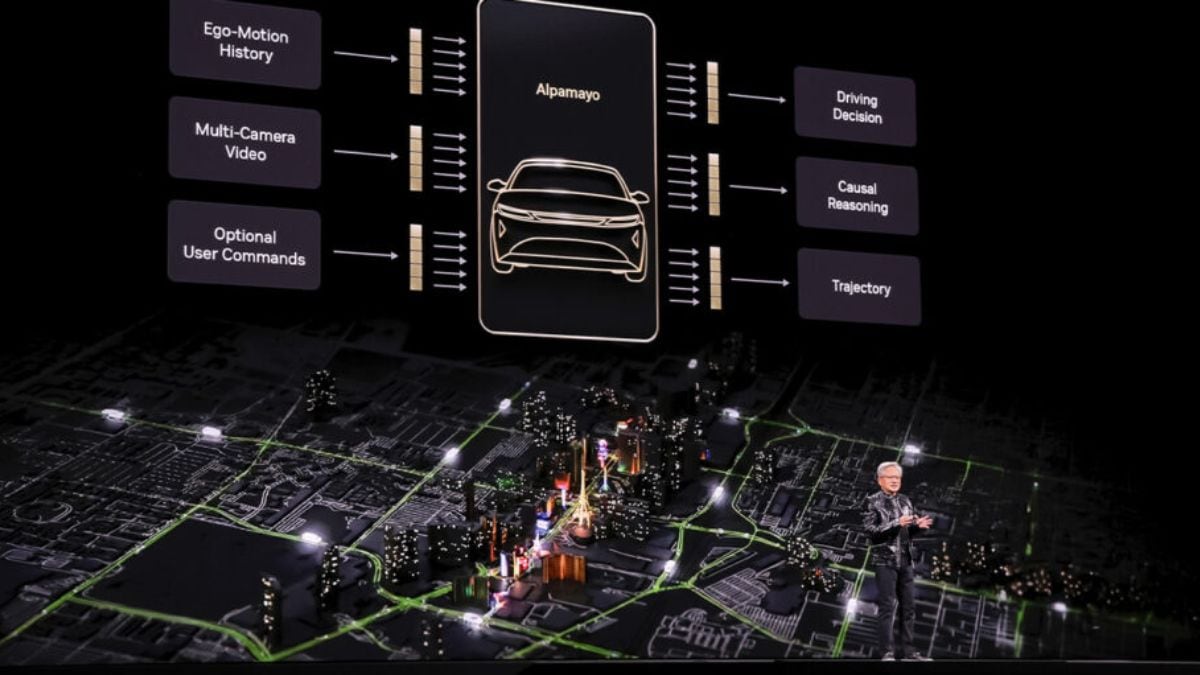
Nvidia unveiled Alpamayo, a new “open” AI platform designed to help self‑driving cars “think” more like human drivers, in one of the biggest autonomous vehicle announcements at CES 2026.
The world’s most valued hardware-to-AI giant said the platform could make future cars safer and better at handling unusual situations on real roads.
“Not only does [Alpamayo] take sensor input and activate the steering wheel, brakes and acceleration, it also reasons about what action it is about to take,” Nvidia CEO Jensen Huang said.
What is Alpamayo?
Alpamayo is not a single chip or car, but a family of open‑source AI models, simulation tools and driving datasets aimed at autonomous vehicles.
At its core is Alpamayo 1, which Nvidia calls a “vision‑language‑action” (VLA) model that can take in camera feeds and other sensor data, understand the scene, reason step‑by‑step about what might happen next, and then suggest safe driving actions.
Nvidia described the new platform as a tool to bring “reasoning” to self‑driving cars, so that a vehicle can, for example, see a ball rolling onto the road and infer that a child may follow, then slow down and prepare to stop.
Along with the AI model, Nvidia is releasing AlpaSim, an open simulation framework that lets developers recreate realistic traffic, weather and sensor conditions to test their systems at scale, plus large “Physical AI” open datasets with more than 1,700 hours of driving across many cities and conditions.
Nvidia said that the resources were available on open platforms like GitHub and Hugging Face, meaning carmakers, suppliers and startups can fine‑tune Alpamayo for their own vehicles rather than starting from scratch.
The company stressed that Alpamayo was meant to act as a “teacher” model in the cloud, with smaller versions eventually running in the car’s central computer alongside Nvidia’s existing DRIVE hardware and safety stack.
Global firms such as Mercedes‑Benz would be among the first to adopt Alpamayo, with the AI‑driving system expected on the new CLA in the US later this year. But for India, it would depend on how quickly global OEMs bring these platforms to their local line‑ups and how local regulations around autonomous and advanced driver‑assistance systems evolve.
“Our vision is that, someday, every single car, every single truck will be autonomous, and we’re working toward that future,” added Huang.
