



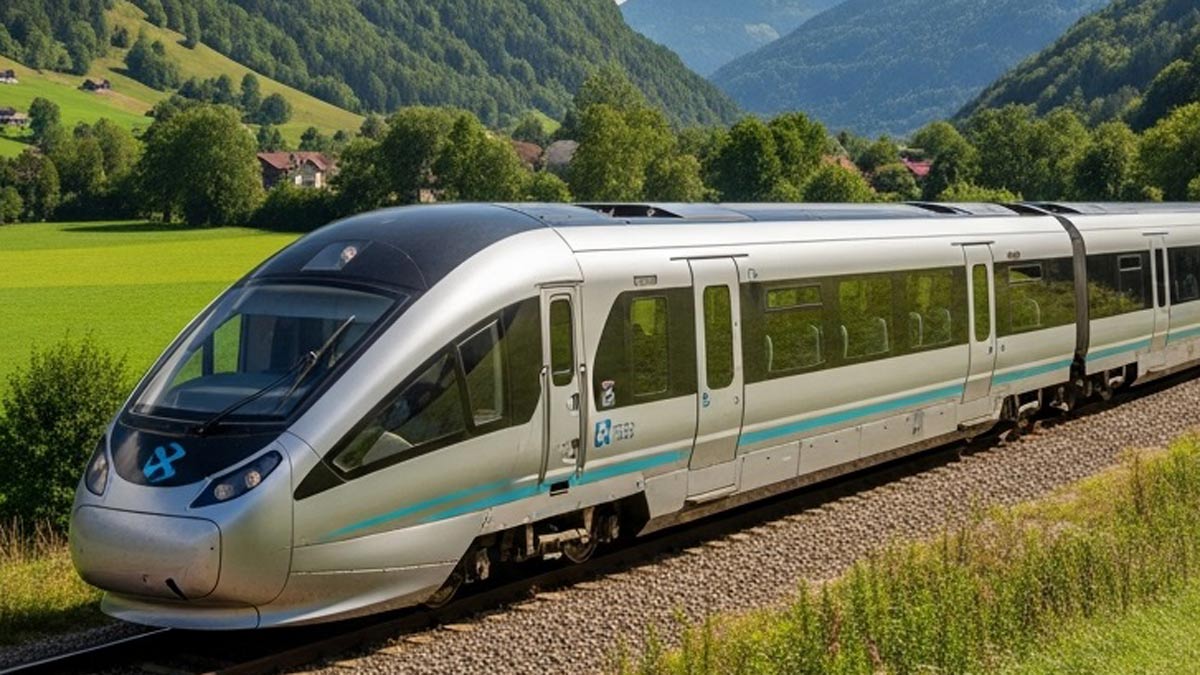
The Indian Railways is set to officially unveil the country’s first-ever hydrogen-powered train in Haryana on Republic Day. The pilot project has entered the final stages as it nears its launch. The train will be a landmark achievement in the green transportation in India, and will reduce the dependency of Indian Railways on diesel.
The 90-kilometer Jind-Sonipat section in Haryana, where the trail will have its first run, has six stops along the way. Preparations for the launch are in full swing by the Indian Railways, Research Designs and Standards Organisation (RDSO), and Spanish partner Green H.
The journey takes one hour, with ticket prices expected to be between ₹5 and ₹25.
It is the world’s longest hydrogen train with eight passenger cars and two driver cars, having 1200 horsepower each. The train also sets a record for passenger capacity, accommodating over 2600 passengers.
As per a Haryana government statement, uninterrupted power supply has been ensured for the hydrogen plant at Jind, which is to fuel the train’s operations. With a massive storage capacity of 3,000 kilograms, the plant is being built at an estimated cost of ₹120 crore, over 2000 square meters. The water needed to work the plant comes from rainwater collected on station rooftops.
Haryana Chief Secretary Anurag Rastogi reviewed the project with officials from Dakshin Haryana Bijli Vitran Nigam (South Haryana Electricity Board) to secure backup arrangements and quick-response mechanisms.
The train was built at the Integral Coach Factory in Chennai and is designed in a metro-style layout, with doors that close fully before departure to enhance passenger safety. The coaches were then shipped to Shakur Basti (North Delhi) for phased induction.
The train creates hydrogen from water using electrochemical technology, allowing it to travel at speeds up to 150 km/h. Around 900 grams of hydrogen (produced from approx. 9 litres of water) can run the train for one kilometre. The lithium-ion batteries charged by fuel cells produce energy by mixing hydrogen and oxygen. Onboard systems like ACs, fans, lighting, passenger displays and automated doors are powered by the 3,750 amps of DC electricity produced by fuel cells.
Hydrogen-powered engines produce only water and steam, which greatly lower air pollution.
India plans to operate 35 hydrogen trains, under the ‘Hydrogen for Heritage’ mission by IROAF (Indian Railways Organisation of Alternative Fuels), to meet its zero-carbon goals.
