



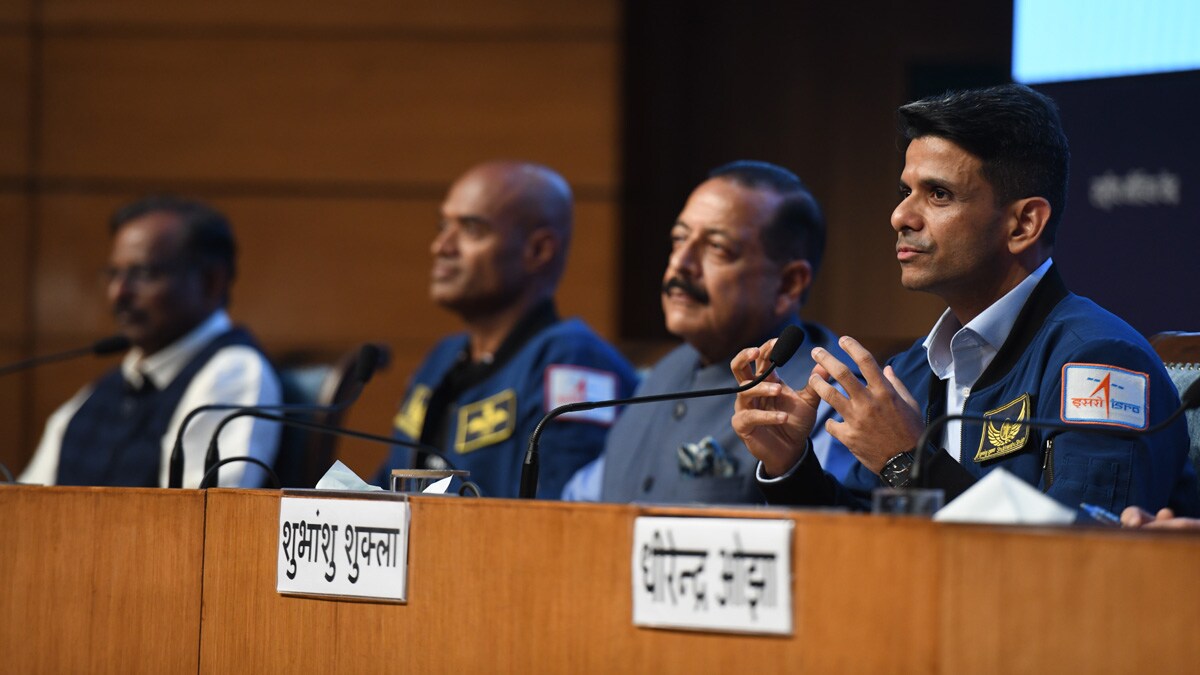
It may sound surprising to many, but it is not difficult to stay in space for long duration, according to Indian astronaut Shubhanshu Shukla. Replying to a question by THE WEEK, at a media briefing in New Delhi, Shukla said that though there are effects on one’s body when one stays in space for long durations, it is not difficult to do so.
“I was prepared for any kind of extensions that I may get in space,” said Shukla, who was part of the recent successful Axiom-4 Mission to the International Space Station. “The initial periods are challenging for the body to adapt. Training prepares you well but obviously there are times when things can go wrong. In case anything goes wrong, a huge team is there to support you. I was, and I am, and I would be prepared for any such contingencies that may arise during any such missions.”
During his first interaction with the media in India, Shukla said he felt emotional when he saw the country for the first time from space. “It was one of the most beautiful sights I have ever seen in life.” He said that he also realised the power of scientific temper when he saw the excitement among children across the country during interactions. “There was this question that how does one become an astronaut. So, kids want to become astronauts and the good thing is that ISRO and India are ready with the rockets and the launches. We have the capability to make this dream a reality very soon.”
Shukla also said that no matter how much training one does, when one sits in the rocket and the engines ignite, it is a special feeling. “I was actually running behind the rocket for the first few seconds. It took me some time to catch up. From that moment until the time we splashed down, the experience was unbelievable.”
He said that he would like to thank the people and the Indian government, and also the ISRO for enabling the entire mission, and his colleagues at ISRO who worked hard to successfully execute it. He also thanked the researchers who enabled the experiments for the Axiom-4 Mission.
“I would also like to thank everyone who helped bring this mission to the population of our country, making it accessible for everyone to view it. In the end, I would like to thank each and every citizen of this country who behaved in a way that made it feel like they actually owned this mission. I truly felt that this was a mission for the entire nation,” Shukla said.
Gaganyaan mission’s first uncrewed mission will launched by December this year. “The first uncrewed mission, G1, is going to be lifted off by this year's end, maybe close to December. Vyommitra, the half-humanoid, is going to fly in it,” said ISRO Chairman V. Narayanan at the briefing.
He lauded Shukla’s accomplishment and also said that the ISRO made several achievements in the last four months. He added that the entire ISRO programme is a teamwork of 20,000 employees, 450 industrial partners and 300 academia partners. He further said that the Aditya L-1 mission has released 13 terabit data and the recently launched NASA ISRO Synthetic Aperture Radar Satellite (NISAR) satellite is working well.
