



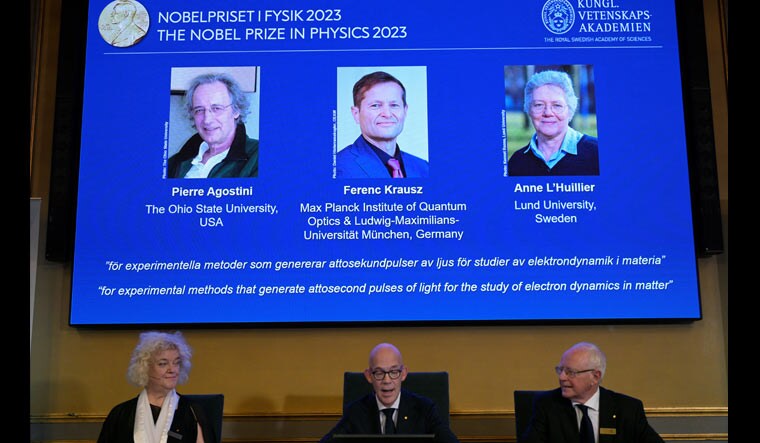
Pierre Agostini, Ferenc Krausz, and Anne L'Huillier were honoured with the 2023 Nobel Prize in Physics for their groundbreaking work in generating attosecond pulses of light to study electron dynamics in matter, as announced by the Royal Swedish Academy of Sciences. This prestigious award, now valued at 11 million Swedish crowns (approximately $1 million), recognises their exceptional contributions to the field of experimental physics.
This marks the second Nobel Prize awarded this year, following the recognition of Hungarian scientist Katalin Kariko and her U.S. colleague Drew Weissman for their pivotal discoveries in mRNA molecules that laid the foundation for COVID-19 vaccines in the field of medicine.
The Nobel Prizes, established through the will of the inventor and industrialist Alfred Nobel, have been celebrated since 1901, with only occasional interruptions. They stand as the pinnacle of achievement in science, literature, and peace, garnering worldwide recognition.
Although the Peace Prize often captures significant attention, the Nobel Prize in Physics has frequently been the focal point, with luminaries like Albert Einstein and groundbreaking scientific achievements that have reshaped our understanding of the universe.
In the previous year, Alain Aspect, John Clauser, and Anton Zeilinger were honoured for their work on quantum entanglement, a phenomenon where particles remain interconnected regardless of the distance separating them. This concept, once famously dubbed "spooky action at a distance" by Einstein himself, continues to challenge our fundamental understanding of physics.
The announcement of Nobel Prizes occurs consecutively over the early days of October, with upcoming announcements for achievements in chemistry, literature, peace, and economics, the latter being a later addition to the original Nobel Prize categories.
