



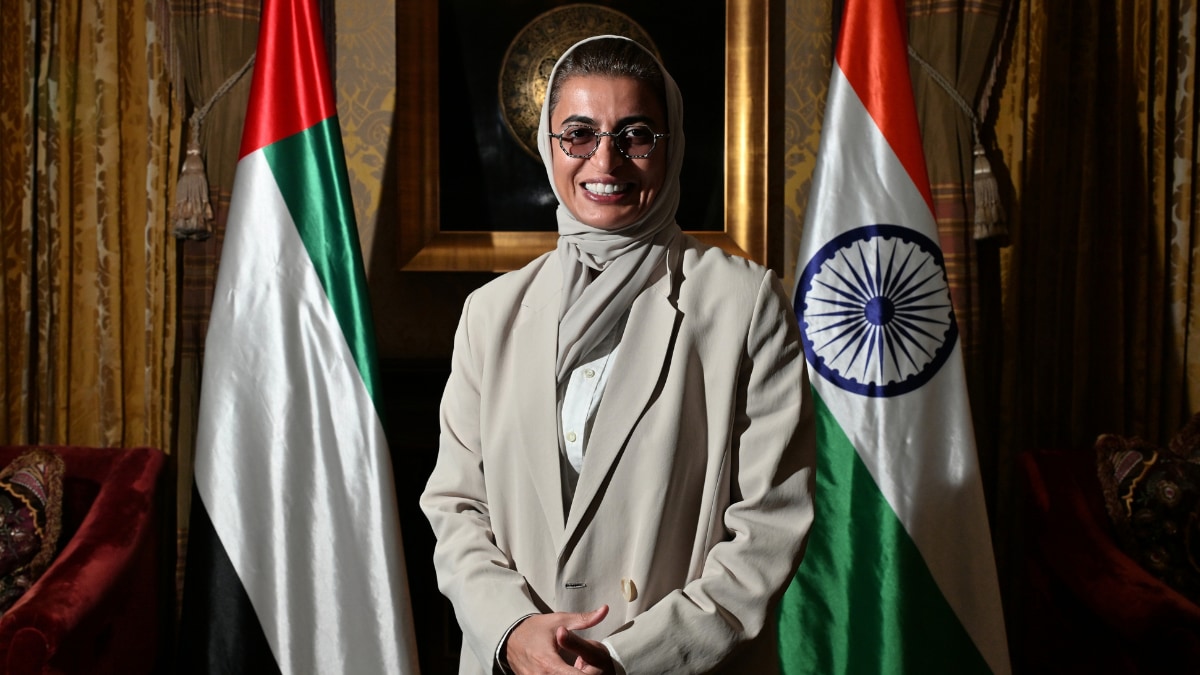
Even as the flourishing free trade deal and the legacy of people-to-people ties still go strong, India and the United Arab Emirates (UAE) are not ready to rest on their laurels.
The latest moves include deepening cultural ties and strengthening cooperation across youth, education, sports, arts, heritage and tourism. THE WEEK caught up with Noura bint Mohamed Al Kaabi, UAE Minister of State to find out more during her recent visit to India. Excerpts:
Q/ Cultural relations, sports, arts etc. are not something that first comes to mind when you think of India-UAE relations. How do you think that can be changed?
A/ I would challenge that premise slightly. Culture may not always dominate the headlines, but it has always been at the heart of the UAE-India relationship.
Trade, investment, energy and aviation are highly visible dimensions of our partnership, but beneath them is something much older and deeply human: generations of movement, exchange, and familiarity between our societies.
The Indian community has been part of life in the UAE for decades, and those connections are reflected in our everyday lives. What we are doing now is giving this dimension of the relationship greater institutional structure.
The Cultural Council brings together institutions working across culture, heritage, youth, sport, archives and tourism, and provides a mechanism for cooperation to continue between official visits.
The economic relationship may be measured in numbers, but the cultural relationship is measured in people. Both are essential to the depth and resilience of the UAE-India partnership.
Q/ What is changing? And could you tell us more about the two major announcements you are making on this visit to India? What does the 'cultural exchange' involve from both sides?
A/ Our understanding of cultural exchange is becoming much broader. It is no longer limited to museums or exhibitions. It can involve writers, athletes, students, artisans, designers, universities, archives and cultural institutions, with different forms of exchange reaching different audiences.
The maritime heritage project is a good example. Indian specialists were in the UAE in August to carry out 3-D scanning of artefacts. The next stages involve replicas, authentication and inspection, and ultimately the loan of original UAE artefacts to India's National Maritime Heritage Complex.
We are also developing the Archives Exhibition, through which our two national archival institutions are working on shared historical material that can be presented together. Some of the newer proposed initiatives remain at different stages and will need to be developed further by the relevant institutions.
For me, cultural exchange is no longer simply about presenting something to one another. It is increasingly about creating together.
An artefact, an archive, an athlete, an artisan or a student can all create a connection. What matters is that institutions and people on both sides are doing the work together.
India and the UAE share a long history of cultural and civilisational connections. How can heritage tourism become a stronger part of the relationship, and what would you like to see more Emiratis discovering in India?
India is not one destination. It offers many different histories and experiences. Delhi, Rajasthan, Kerala, and Gujarat, for example, each provide a very different encounter with India's heritage.
There is considerable potential for Emirati travellers to experience India through its architecture, archaeology, food, crafts and museums, not simply as additions to a conventional itinerary, but as reasons to travel in themselves.
There is also a shared history to discover. For centuries, maritime trade across the Indian Ocean carried pearls, textiles, spices and other goods between the Gulf and India, but it also carried people, ideas and knowledge. The Indian Ocean did not separate us; for centuries, it connected us.
That is one reason the National Maritime Heritage Complex is relevant to us. UAE artefacts can help place the Gulf within the story India is telling about its maritime history. I would also like this curiosity to work in both directions, because there is much more of the UAE for Indian visitors to discover as well.
Q/ India House has emerged as an important platform for showcasing India's culture and heritage in the UAE. What role do you see it playing in deepening cultural engagement between the two countries?
A/ House of India is still being developed, so I would describe it as a project with considerable potential rather than an established platform. The important question is what kind of institution it can become and what distinctive role it can play.
The UAE already has a large and vibrant Indian community and no shortage of Indian cultural events.
House of India can add something different if it develops a sustained programme and creates meaningful connections with institutions, artists, designers, writers and educators. The opportunity is not simply to showcase India, but to create a living cultural platform.
I would also like it to present contemporary India alongside its extraordinary heritage. The two should not be separated. Once the practical work is completed, there will be an opportunity to develop that programme in greater detail.
Q/ The Indian diaspora has been an important part of the UAE's social and cultural landscape for decades. How do you see the contribution of the Indian community to the UAE's cultural life, and how can that contribution be further encouraged?
The Indian community is not simply contributing to the UAE's cultural life; it is part of the UAE's cultural story. That contribution has developed over decades and is visible in food, cinema, education, business, sport and celebrations.
There is also something less visible but equally important: when communities live alongside one another over generations, cultural familiarity develops naturally.
Today, that contribution continues to evolve. Indian artists, designers, writers, entrepreneurs and other creative professionals are participating in a UAE cultural sector that is itself becoming more diverse.
Culture in the UAE is not something produced by one community and observed by another. Increasingly, it reflects the interaction between the many people who live here and what they create together.
Q/ Also, Indian tourists primarily visit Dubai. What are your thoughts on expanding the UAE's socio-cultural and tourism appeal amongst India's outbound travellers?
A/ Dubai is an enormous asset for the UAE and, for many Indian visitors, their first introduction to the country. But it can be the first chapter of their UAE experience rather than the whole story.
There is much more to discover. Abu Dhabi has developed a significant museum and cultural offering. Al Ain provides a very different experience through its heritage and landscape. Sharjah has longstanding institutions in art, publishing and museums, while the northern emirates offer mountains, coastline and outdoor tourism.
There is a particular opportunity with repeat visitors. Distances within the UAE are short enough that travellers do not need to choose between Dubai and the rest of the country. They can experience several dimensions of the UAE in a single journey. We would like visitors who know Dubai well to become equally curious about the rest of the UAE.
Q/ Young people are increasingly at the centre of cultural diplomacy. What opportunities do you see for greater youth exchanges between India and the UAE through education, arts, sport, creative industries or other platforms?
The Youth Exchange Programme is an important starting point, but youth engagement should not sit within a single programme. Young people do not need another forum where they are simply asked to discuss the future. They need meaningful opportunities to help shape it.
That means creating opportunities for them to study, train, compete, create and work alongside people they might otherwise never meet. Sport, universities and the creative industries all give us different ways to bring young people together.
The most meaningful exchange is one that creates a relationship, an idea, a skill or an opportunity that continues after the programme itself has ended.
Q/ Looking beyond the announcements being made during this visit, where would you like to see India-UAE cultural cooperation go over the next five years? What are the areas where you think there is still untapped potential?
A/ Over the next five years, I would like to see us move from exchange towards deeper co-creation. There is already considerable movement between our countries. The next stage is to deepen the relationships between the institutions and people behind that movement.
There is significant potential between museums and archives, universities, sports organisations and the creative industries. I am particularly interested in areas where traditional knowledge can meet contemporary practice, such as craftsmanship and design, or archives and new technology.
I would also like to see more work produced jointly. Not simply an Emirati exhibition travelling to India or an Indian performance coming to the UAE, but artists, researchers, designers and institutions developing work together. Over time, these relationships should become increasingly direct.
The ambition is not simply to have more Emirati culture in India or more Indian culture in the UAE. It is to create things together that neither of us would create alone. That, for me, is where the real potential lies.
