



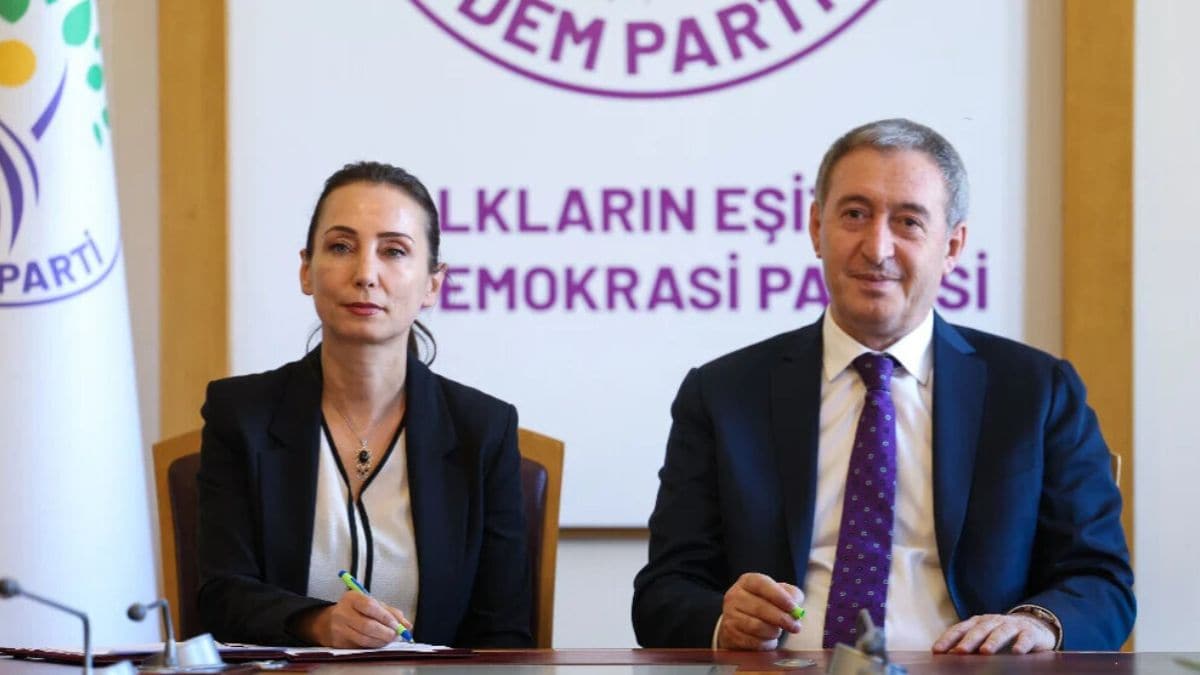
Turkey’s pro-Kurdish force, popularly known as the DEM Party, has been campaigning on Kurdish rights, democracy, decentralisation, gender equality and social justice in the regions of Turkey and parts of West Asia. A pro-Kurdish party in Turkey that emerged from the political tradition of the HDP adopted its present name in October 2023, after contesting the elections in that year as the Green Left Party.
Led by co-chairs Tülay Hatimoğulları and Tuncer Bakırhan, the party in Parliament has 56 deputies, making it the third-largest party by seats as per the present parliamentary distribution in Turkey. Though the party largely emphasises Kurdish rights, decentralisation, local democracy, gender equality, minority rights, social justice and ecology act recently negotiated a resolution of Turkey’s Kurdish issue. The party also advocates participatory decision-making and greater powers for local governments. The DEM party believes that Turkey may not be able to gain anything in the long term from an interventionist foreign policy that prioritises military power over diplomacy. Off late, the party has been advocating for a foreign policy centred on peace and stability in the whole of West Asia.
In a candid interview with The Week, the co-chairs of the DEM Party, Tülay Hatimoğulları and Tuncer Bakırhan, discuss various issues on how Turkey’s government is preparing for a new peace process, the legislative amendments that are likely to be introduced, the PKK laying down its arms and the consequences that led to the peace process, their demands, including the reinstatement of their elected co-mayors and the immediate release of detained politicians, including Abdullah Öcalan.
Excerpts from the interview
1. Turkey appears to be entering another critical phase in the Kurdish question. Do you believe the government is genuinely preparing for a new peace process, or is this primarily a tactical political move?
Tuncer Bakırhan: The current process is unlike previous initiatives launched with the aim of finding a peaceful solution to the Kurdish issue in Turkey. Although this initiative involves the AK Party and MHP coalition—which forms the government, also known as the People’s Alliance—we are talking about a process with strategic objectives in which the state bureaucracy is also significantly involved. It may be said that this process is being approached tactically by the parties belonging to the People’s Alliance. Yet, the Kurdish Movement led by Mr. Abdullah Öcalan, which is in the process of changes with regard to the PKK, and we as the DEM Party, the third-largest party in parliament, are treating this process with the seriousness and historical significance it deserves.
Meanwhile, the state’s senior security bureaucracy is also acting with the seriousness that this critical process demands. We can observe that the leadership of the MHP—known for its extreme Turkish nationalism—which has been opposed to a democratic solution and has been anti-Kurdish since its foundation in 1969, has now made a significant shift in both rhetoric and approach in order to advance the process at this stage. Although our priorities may differ, we can say that, in terms of bringing the war to an end, MHP leaders have also taken strategic ownership of this process. On the other hand, whilst the AK Party—the major partner in the People’s Alliance—may have a tendency to instrumentalise the process for electoral purposes, they are themselves well aware that this is, at its core, a process that transcends party politics. This process is of such importance that it cannot be sacrificed for the sake of any party’s interests, and it marks a historic turning point. We cannot say that, as things stand, there are absolutely no circumstances in which any party might exploit this process for their own narrow interests or approach it in a tactical manner. However, we must also recognise that squandering this process in such a simplistic manner and shirking historical responsibility would entail a heavy price for all parties and all the peoples of the region.
2. If a new peace process is to succeed, what are the non-negotiable guarantees DEM Party would demand from President Erdoğan’s government?
Tülay Hatimoğulları: We are aware of the serious risks involved when, in conflict resolution, the parties draw ‘red lines’ against one another or impose conditions. On the other hand, all parties are aware that normalisation is one of the objective conditions for making progress in the process. Particularly given the direct link between democratisation and a lasting solution, there are certain responsibilities that the state must fulfil without the need for negotiation. The PKK is fulfilling its responsibility by laying down its arms and launching a process of demilitarisation.
The state must also reopen the democratic space that it has been restricting for the past 10 years under the pretext of the war. Peace is not merely a series of unilateral concessions or measures. It is a dynamic that gives rise to and drives multilateral responsibility. We therefore expect practical steps to be taken towards democratisation that address the normal requirements of the process. At this stage, the practice of equating demands for Kurdish identity or the use of the Kurdish language in all spheres with the crime of ‘terrorism’, and of the police raiding homes in the middle of the night based on social media posts, has now run its course. It is now necessary to put in place the requisite legal and administrative measures to ensure these fundamental rights are upheld and that they are no longer open to debate.
3. The removal of elected Kurdish mayors and the appointment of trustees has become one of the biggest points of contention between DEM Party and Ankara. Can there be a credible peace process while elected local governments continue to face such intervention?
Tuncer Bakırhan: Whilst this process is ongoing, we are, at the same time, stating on every platform that the continuation of the anti-democratic policy of appointing trustees creates a contradiction. The insistence on this policy of appointing trustees has played a significant role in the growing scepticism and mistrust within the Kurdish community. As Ms.Hatimoğulları mentioned, there are responsibilities that the state must fulfil. Foremost among these are the reinstatement of our elected co-mayors and the immediate release of detained politicians.
When we meet with our voters, they ask us the same question. They voice their doubts and mistrust, asking: ‘How realistic is it for the peace process to move forward whilst trustees have been appointed?’ As the DEM Party, we demand that the mayors elected by our people be reinstated to their posts immediately and that the pressure exerted by the central government be brought to an end. We hope that the legislative amendments to be introduced in October and November will put a permanent end to this injustice.
To ensure the process continues and is carried out properly, the policy of appointing trustees must now be removed from the arsenal of administrative pressure and consigned to the dustbin of the political arena. Because democracy begins at the local level.
4. DEM Party could potentially become a decisive force in Turkey’s next presidential election. Will you cooperate with the CHP and other opposition forces, or are you prepared to engage with the Erdoğan government if it delivers meaningful democratic and Kurdish reforms?
Tülay Hatimoğulları: The DEM Party aims to build a Turkey where the different peoples can live together in peace, where the justice system operates without interference, and where people can live freely whilst enjoying their individual and collective rights. This is in line with the set of political values the DEM Party represents and defends. We are open to holding coalition talks with any party whose perspective is consistent with ours.
The DEM Party is a political force whose influence is steadily growing. It possesses the experience and capability to play a role not only in parliament but also in government, with a view to building a democratic Turkey. With its policies designed to contribute to greater regional stability across a wide range of areas – from foreign policy to ecology, from social justice to a sustainable economy, and from labour rights to the rule of law – the DEM Party has the potential to make significant contributions to the country’s social harmony and democratic future.
5. What role should Abdullah Öcalan play in any future peace process? Do you believe the government must establish a direct political channel with him for negotiations to have any chance of success?
Tuncer Bakırhan: Öcalan currently holds the position of chief negotiator and representative of the will of the Kurdish people and the movement he founded. He does so both in the eyes of the state and the government. Öcalan is the primary interlocutor in the resolution of the Kurdish issue and is fully authorised to secure a lasting peace. This is because both the organisation he founded 50 years ago and the millions of Kurds point to Öcalan as their representative. Although the state bureaucracy has acknowledged this reality since the 1990s, the political actors of the time sought to ignore it because they were not genuinely in favour of a solution. There is still some resistance to this reality. Yet, the state bureaucracy and political figures within the government now openly acknowledge Öcalan’s fundamental role and influence in their public statements.
It is important to recognise that Öcalan represents a force to be reckoned with. Therefore, the isolation imposed on him must now be lifted in a manner commensurate with this reality. Whilst the state has unlimited access to resources for communication, it is unacceptable that Öcalan—who is the key interlocutor and chief negotiator in the peace process—should have his channels of communication kept to an absolute minimum. In order to achieve social peace, Öcalan must be allowed to meet directly—without intermediaries—not only with state officials but also with all sections of society, particularly politicians, journalists and academics.
6. Turkey is increasingly asserting itself as a regional power. How does DEM Party view Ankara’s policy towards Syria, particularly its approach to the Kurdish-led administration and forces in northeastern Syria?
Tülay Hatimoğulları: The social movements that began in 2011 and came to be known as the ‘Arab Spring’ altered the political balance of power in West Asia. Due to the influence of external intervention, these revolutions were stolen from the people. In particular, the regime changes in Libya and Egypt continue to be a cause of ongoing instability in those countries. The conflicts along the Palestine-Israel front and the resulting civilian casualties continue unabated. In Lebanon, Yemen, Syria, Iraq and Iran, the Shia-aligned political actors are being targeted by the US, Israel and the United Kingdom. Against this backdrop, Turkey is also seeking to expand its sphere of influence, but it remains caught between Israel and Iran. Whilst the Unmanned Aerial Vehicles (UAVs) Turkey produces for military purposes may provide an advantage, as the DEM Party, we maintain that Turkey stands to gain nothing in the long term from an interventionist foreign policy that prioritises military power over diplomacy. We advocate for a foreign policy centred on peace and stability.
Before the fall of the Assad regime, groups such as ISIS and Al-Qaeda carried out mass killings in Syria and Iraq. Alevis and Kurds were under major threat, leading to genocide. Between 2013 and 2019, a relentless war raged between the Syrian Democratic Forces (SDF), led by the Kurds, and ISIS. The SDF lost more than 11,000 fighters during this period. With air support from the US-led International Coalition, ISIS was defeated but not completely eradicated. It is still present, primarily in Syria and Iraq and in the neighbouring countries through its cell structures. It is still fresh in the Kurds’ minds that the Turkish State unfortunately stood by as a mere spectator and classified the SDF as ‘terrorists’, whilst the Kurds paid a heavy price in this life-and-death struggle.
As a result of the advance led by Hay’at Tahrir al-Sham (HTS) – involving thousands of jihadist fighters from various groups – from Idlib, Aleppo and Damascus, the Assad regime was overthrown and replaced by the HTS leader Jolani (now known as Ahmed al-Shara). The US had offered a $10 million bounty for the capture of this jihadist leader. Now, although he did not come to power through elections, al-Shara is recognised by the Trump administration as a legitimate head of state. This new regime in Damascus, which is also supported by Ankara, was forced to reach an agreement with the Kurds in order to gain legitimacy on the international stage. The Kurds, too, were faced with this imposition. At present, there is a forced agreement in place. However, it is difficult to speak of the civil war in Syria coming to an end until a new constitution is drawn up that addresses the demands of the Alevis, Druze and Kurds.
By linking the resolution of the Kurdish issue in Turkey to the position of the Kurds in Syria, Ankara has, in fact, driven the process into a very tight corner. This is because Syria remains a country vulnerable to external intervention and where instability continues to deepen. With Öcalan’s intervention, the crisis has been averted for the time being. However, to ensure that any potential tensions in Syria do not spill over into Turkey, Ankara must now stop viewing Syrian Kurds as a threat and recognise them as regional partners. It is fair to say that labelling the Syrian Kurds as ‘terrorists’ although there has been no threat to Turkey from northeastern Syria to date, has, in fact, primarily benefited ISIS and Al-Qaeda. Following the withdrawal of the SDG from Raqqa—which ISIS had used as its capital—and from the Deir ez-Zor region, the last ISIS stronghold, ISIS cells have begun to re-emerge. This situation poses a threat not only to the Kurds but to the whole world. There is no doubt that the Syrian Kurds, with their secular stance, are the most effective force in the fight against ISIS in the region. Ankara must now make a choice in this regard. Either it will accept the willpower of the Syrian Kurds in the areas they live in, or it will persist with an unstable policy that creates space for organisations such as ISIS and al-Qaeda. This choice is, of course, directly linked to the issue of stability and peace in Turkey.
7. The proposed Mecca Joint Defence Pact could mark a new phase in security cooperation among Muslim-majority countries. Does DEM Party see this as an opportunity for regional collective security, or are you concerned that it could pull Turkey into new military confrontations?
Tuncer Bakırhan: The DEM Party and its predecessor parties have never supported any military or diplomatic initiatives that would increase the risk of war. The Mecca Joint Defence Pact is also not an initiative we support. When it comes before Parliament, we will explain that this pact does not serve regional stability.
Tensions between Pakistan, one of the signatories to this pact, and India flare up from time to time. Both countries possess nuclear weapons. It is therefore necessary to take into account the significant risks posed by military initiatives that can escalate tensions. Assuming that a similar pact can be be formed apart from these countries, we can safely say that no one would stand to gain from such a polarisation.
8. If Turkey assumes military commitments under the Mecca pact, how should Ankara reconcile those obligations with its NATO membership and with DEM Party’s call for diplomacy rather than militarisation of regional conflicts?
Tuncer Bakırhan: NATO, in its current form, is not a mechanism that promotes stability. We have seen examples of this in its inconsistencies during the Russia–Ukraine War and its defeats in Afghanistan. The Turkish government is seeking to forge a number of alliances in order to become a regional power, taking into account the cracks and gaps in the international system. It is not explicitly stated against whom this approach to forming alliances is directed. Nor is there a clear threshold indicating the circumstances under which the parties to this pact would intervene in a potential conflict. Consequently, this flexibility—which does not fully bind the parties—provides no one with complete assurance.
As the DEM Party, we do not support military alliance initiatives for any country. Instead of war-focused alliances, we are in favour of establishing partnerships that promote mutual prosperity. The current situation, in which military spending is rising year on year, is unsustainable. We therefore advocate the establishment of a global alliance governed by universal legal norms, where borders lose their significance and social peace and the justice system flourish. Within the framework of our ‘third way’ policy, we also aim to build a new, multi-dimensional form of internationalist solidarity together with all friendly progressive parties and social movements.
9. With the wars in Gaza, Syria and the wider Middle East reshaping regional alliances, should Turkey position itself primarily as a military power, a diplomatic mediator, or a bridge between the Muslim world and the West?
Tülay Hatimoğulları: As the DEM Party, we understand Turkey as a bridge not only in a geographical sense but also in cultural, social and political terms. We maintain that if a multi-identity country embraces a culture of peaceful coexistence, it can bring stability even beyond its borders. In other words, if Turkey can achieve a situation where it has genuinely and sustainably secured peace within its borders, it will also have attained the maturity to develop a more constructive and solution-oriented approach to crises beyond its borders.
We cannot accept any diplomatic perspective, within a progressive, liberal and secular framework, that prioritises one religion or denomination over another. Nor can we advocate a foreign policy that places one ethnic identity above another.
There is a need for a political perspective that will render military power and armament unnecessary. Of course, there is also a need for comprehensive cooperation against ISIS and similar radical groups. Consequently, international coordination is required to counter any initiative that supports ISIS ideologically or financially. In our view, should a democratised Turkey come into being, it must take the lead in global coordination against such threats. Furthermore, a diplomatic approach that steers clear of any initiatives likely to exacerbate polarisation must be upheld.
10. Looking beyond the next election, what is DEM Party’s ultimate vision for Turkey—a more decentralised and pluralistic republic within the existing constitutional framework, or a fundamental restructuring of the relationship between Ankara and the country’s Kurdish regions?
Tuncer Bakırhan: The DEM Party is a multi-component party. Although Kurds form the majority, it also encompasses Turkish socialist movements, environmentalists, and the labour and women’s movements. In this respect, the DEM Party is, by virtue of its inclusivity, in fact a party for all of Turkey. Contrary to what is often portrayed from the outside, it is not merely a ‘Kurdish party’.
The DEM Party advocates for the establishment of a democratic constitution based on decentralisation, in which all identities are equally represented. On this constitutional basis, the Kurds in Turkey must be able to freely express their identity on an equal footing with Turks and other sections of society. As the Republic of Turkey, founded through a war of independence waged with the joint participation of the peoples of Anatolia and Kurdistan, enters its second century, it will achieve true unity through democracy. Once this is achieved, all identities will be brought together on a legal basis within the common homeland of Turkey.
In other words, there is a need for a new collective agreement between the state and the peoples of Turkey, and the only document capable of meeting this need will be the constitution. A new Turkey can only be built based on a new and democratic constitution. We have done everything in our power to make this a reality, and we will continue to do so.
