



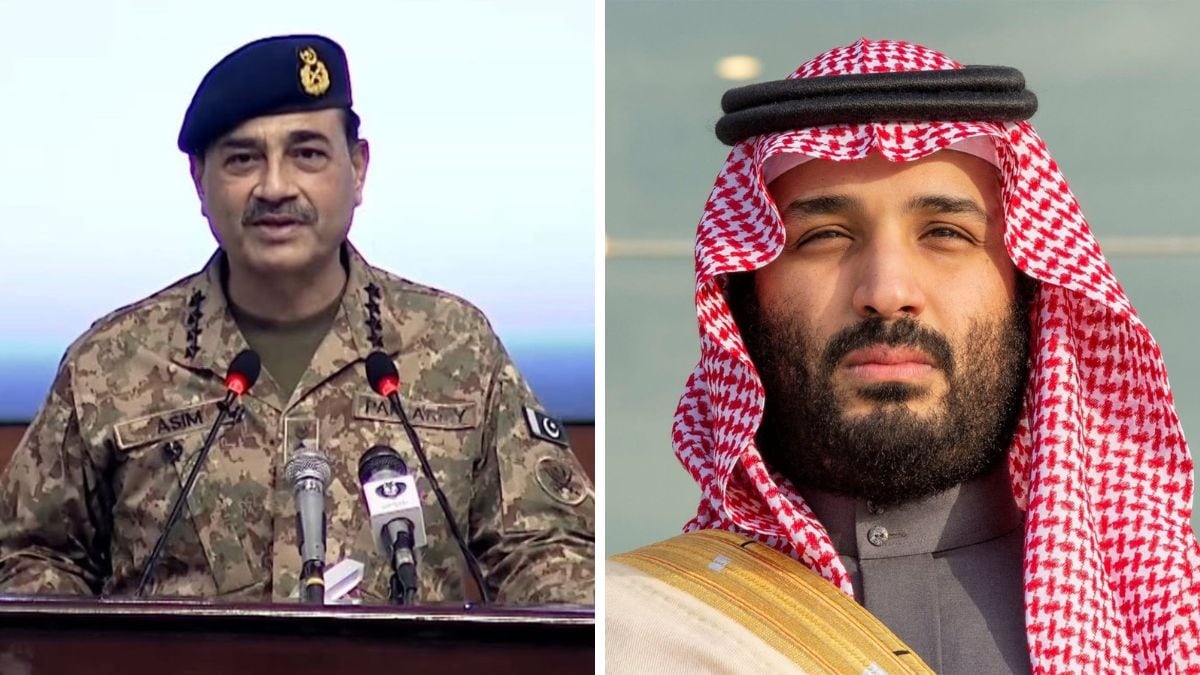
As Saudi Arabia comes under fire from Houthis, with ballistic missiles and drones raining on Saudi cities of Abha, Khamis Mushait and Jazan, questions are being raised about whether this could activate the Mecca Joint Defence Agreement. The pact, signed between Saudi Arabia, Pakistan and Turkey, is a NATO-like arrangement, which stipulates that any armed attack against any one of the three states shall be regarded as an attack against them all.
Speculations about the same came after Pakistan’s Defence Minister Khawaja Asif stated that any attack on Saudi Arabia could activate the pact. “If there is unprovoked aggression, or a spillover of whatever is happening in Yemen into Saudi Arabia, definitely the Mecca agreement will become operational,” he told Pakistani media outlet Geo News on Tuesday night.
He added that there should be doubt about that as the countries were bound by terms and conditions.
As per reports, military officials from Saudi Arabia, Pakistan and Turkey met in Riyadh to coordinate their steps, and agreed that their forces would not enter Yemeni territory and that any military response would be launched exclusively from Saudi territory. Pakistan stressed that the agreement was purely defensive and that its forces would be able to provide technical, ground or air assistance within the kingdom, without participating in operations outside its borders.
Pakistan has also delivered a Saudi warning to Iran to rein in its Yemeni Houthi allies after they stepped up attacks on the kingdom. The warning came after Houthi rebels attacked an air force base and oil infrastructure in Saudi Arabia, wounding 73 people, in one of the worst attacks since February 2026.
Arab media are also discussing the possibility of the pact being activated. Arab News Pakistan, part of the Saudi-owned Arab News Group, reported that the alliance will become operational in the event of aggression against the kingdom. Al Jazeera and CNN Arabic previously reported that the agreement, signed in Mecca on August 7, includes mechanisms for security cooperation, the development of military capabilities, defence industries and the fight against terrorism.
While senior officials in Tehran claimed in response to the Pakistani warning that they do not control the Houthis, Israeli media reports cite intelligence reports that indicated that Iran was the one who directed the latest attacks and even promised additional military and financial assistance.
However, Pakistan soon rushed to confirm that military action against Houthis is not under discussion.
Foreign Office Spokesperson Sajjad Haider Khan termed the reports of Islamabad contemplating action against Houthis as false, adding: “Pakistan has signed the Mecca Joint Defence Agreement, which is a fact, and Pakistan will implement this agreement according to its needs, but as of now, there is no discussion of the kind”. The Foreign Office spokesperson also clarified that "the extension of the Mecca Defence Agreement is not currently under consideration.
"I think it was made clear that this is a defence alliance of countries that believe that the security of the region should be secured primarily through deterrence, and these three countries that are part of the current alliance, namely Pakistan, Turkey and Saudi Arabia, are meeting regularly. They are consulting at various levels and are currently in contact with each other,” he added.
Omar Karim, a Middle East expert at the University of Birmingham in the UK and an associate fellow at the King Faisal Centre for Research and Islamic Studies, believes that the attacks and their intensity show that Saudi Arabia faces a significant threat from the Houthis, who are focused on targeting both civilian and military installations in the southern provinces. "Therefore, a situation arises in which both the Mecca Agreement and the Pakistan-Saudi Mutual Defence Agreement could be activated," he told BBC News Urdu.
Karim said that Pakistan has already deployed its armed forces in Saudi Arabia and 'some of these soldiers are also deployed on the Saudi-Yemen border.' In April, the Saudi Arabian Ministry of Defence announced that a military contingent from Pakistan had arrived at the King Abdulaziz Air Base in the eastern region.
Mehran Kamrafa, a professor at Georgetown University Qatar and director of the research unit at the Arab Centre for Research and Policy Studies, also told BBC News Urdu that there are indications that Saudi Arabia is preparing to attack Yemen, and this will determine whether Pakistani and Turkish soldiers are ready to fight on the Yemeni front.
“What we are seeing is a very clear statement from the Pakistani defence minister, which shows that Pakistan will not be involved in an attack on Yemen by Saudi Arabia that could be considered an act of aggression,” he said.
Kamrafa believes that Pakistan is very cautiously determining its participation under the Mecca Agreement in the context of what the agreement actually means. "This means that if Saudi Arabia attacks or takes military action in Yemen, as in 2015, the Pakistani army, and consequently the Turkish army, will not be involved."
And in his view, 'this is an unambiguous declaration to clearly distance Pakistan from any potential offensive action in Yemen.'
