



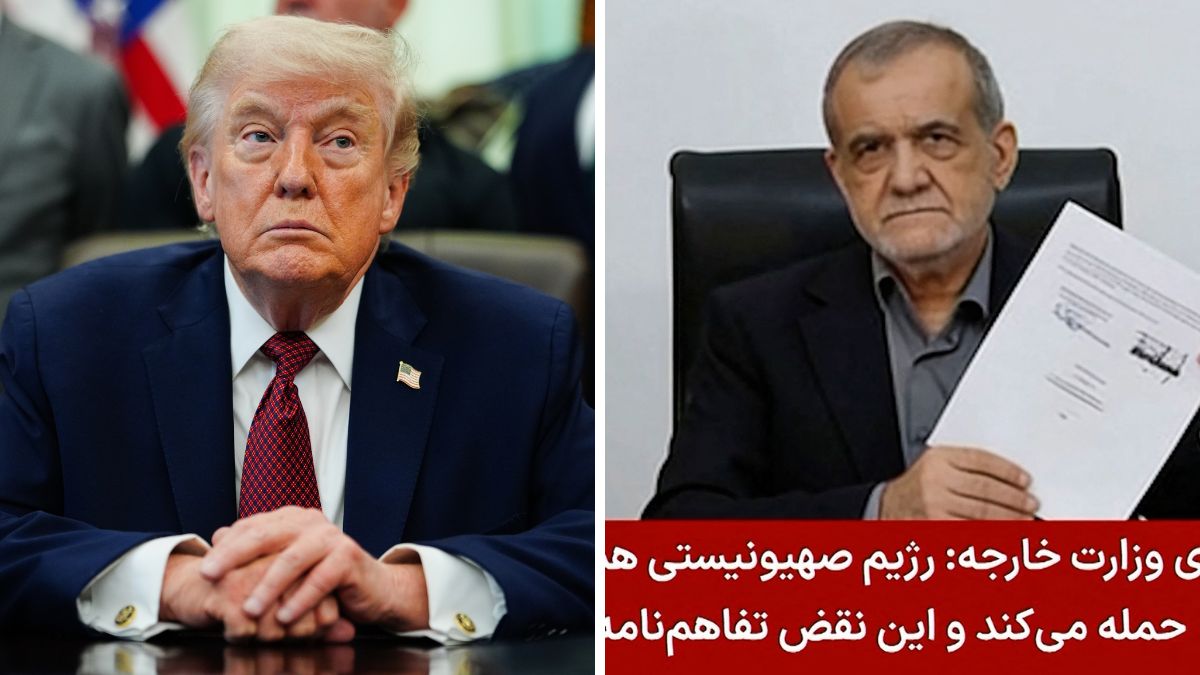
Soon after US President Donald Trump and his Iranian counterpart, Masoud Pezeshkian, signed a Memorandum of Understanding (MoU) aimed at ending the war, the US administration published the official text of the MoU agreed upon in recent days between Washington and Tehran.
The document, entitled the ‘Islamabad Memorandum of Understanding between the United States of America and the Islamic Republic of Iran,’ consists of 14 articles that define the framework for negotiations to reach a final agreement.
They are
1) Cessation of military operations: Both parties and their allies commit to a cessation of military operations on all fronts, including Lebanon, and to refrain from taking any military action against the other party.
2) Respect sovereignty and territorial integrity: The US and Iran undertake to respect each other's sovereignty and territorial integrity, and to refrain from interfering in each other's internal affairs.
3) Final deal in 60 days: The document expects the parties to negotiate to reach a final agreement within a maximum period of 60 days.
4) Lifting the blockade through the Strait of Hormuz: Upon signing the pact, the US will begin to remove its naval blockage against Iran and will fully end the naval blockade within 30 days. During this period, the traffic of vessels will be in proportion to the numbers of pre-war traffic being restored by the Islamic Republic of Iran. The US will also remove its forces from the proximity of Iran within 30 days.
5) Safe passage: In return, Iran pledges to guarantee the safe passage of commercial vessels through the Strait of Hormuz. The traffic of commercial vessels will immediately start and Iran will conduct dialogue with Oman to define the future administration and maritime services in the Strait of Hormuz.
6) On the nuclear issue: The Islamic Republic reaffirmed its commitment not to pursue the development of nuclear weapons. Both sides also agreed to address the fate of Iran's enriched uranium stockpile and other nuclear issues in future negotiations. The document stipulated that the minimum agreed-upon mechanism for neutralising the highly enriched uranium stockpile would involve its dilution within Iran under the supervision of the International Atomic Energy Agency.
7) Economic aspect: The United States, in cooperation with its regional partners, pledges to prepare a plan worth no less than $300 billion for the reconstruction and economic development of Iran.
8) Sanctions and assets: The memorandum refers to the gradual lifting of sanctions, granting licenses for the export of Iranian oil, releasing frozen Iranian assets, and establishing a joint mechanism to monitor the implementation of the agreement.
9) International cover: Based on this document, the final agreement - if reached - must be adopted through a binding resolution from the UN Security Council
10) Status quo: Pending the final deal, the United States of America and the Islamic Republic of Iran agree to maintain the status quo of its nuclear program, and the US will not impose any new sanctions and will not deploy additional forces in the region.
11) Waivers for oil export: The US Department of the Treasury will issue waivers for the export of Iranian crude oil, petroleum products, and derivatives, and all associated services, including banking transactions, insurance, transportation, etc.
12) Executive mechanism: The United States of America and the Islamic Republic of Iran agree that an executive mechanism will be established to monitor the successful implementation of this MOU and the future compliance of the final deal.
13) Final deal: The final deal will be endorsed by a binding UNSC resolution.
14) Negotiations: The US and Iran will start negotiations regarding the final deal exclusively on the other paragraphs.
