



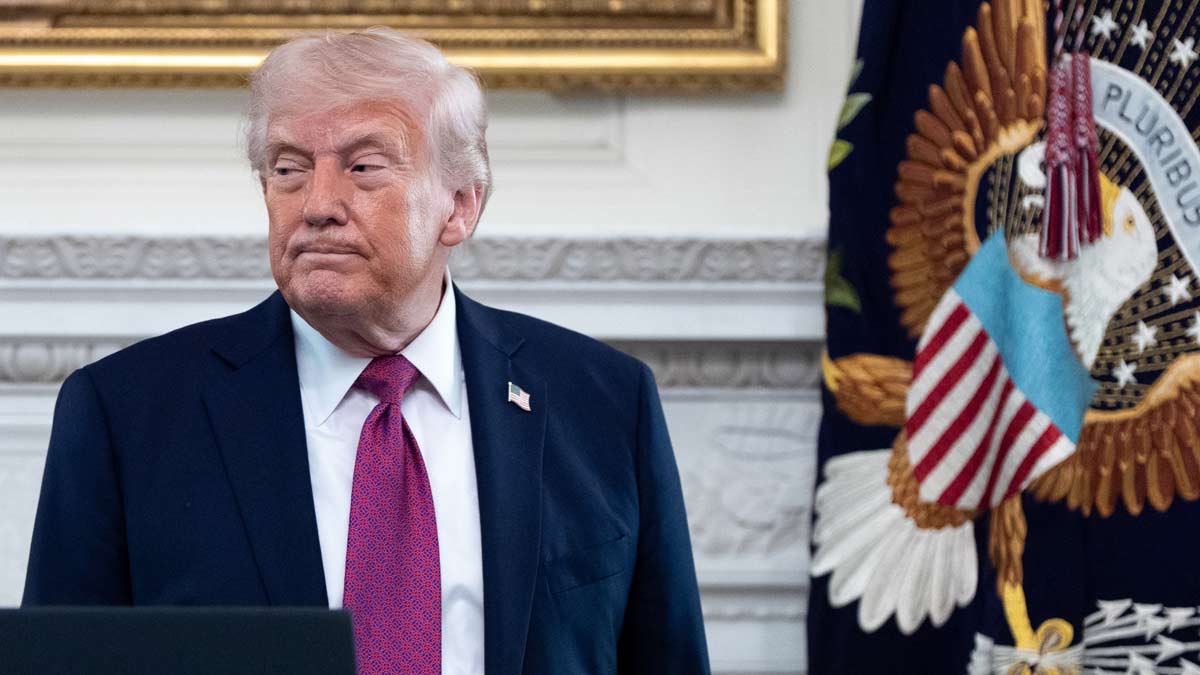
President Donald Trump is said to be dissatisfied with Iran’s latest proposal to reopen the Strait of Hormuz and end the war, as a fragile diplomatic opening risks collapsing once again. Over the weekend, Tehran offered to lift the naval blockade on Iran and its ports, bring the conflict to an end and defer discussions on its nuclear programme to a later phase. The proposal, presented by Iranian Foreign Minister Abbas Araghchi during his weekend visits to Islamabad and Muscat, was aimed at breaking the deadlock and restarting negotiations.
Under the plan, Iran would reopen the Strait of Hormuz if the United States agrees to end its blockade and conclude military operations. Crucially, however, Tehran wants nuclear talks postponed—a sequencing that goes to the heart of Washington’s objections. The offer emerged shortly after Trump abruptly cancelled planned talks in Islamabad, where his son-in-law Jared Kushner and special envoy Steve Witkoff were due to meet Iranian representatives. Trump initially dismissed the cancellation as avoiding “too much time wasted on travelling”, but later claimed Iran had submitted a “much better” proposal within minutes.
Despite that, Trump and his national security team remain deeply sceptical. The central concern is that the proposal sidesteps the nuclear issue altogether. Reopening the strait without limits on enrichment or Iran’s stockpile of near-bomb-grade uranium would strip Washington of its most critical leverage. Senior officials have rejected Iran’s framing of an “open” strait. Secretary of State Marco Rubio has described the idea as an extortion scheme, warning that Tehran could demand tolls or permissions from passing vessels—effectively normalising control over a vital international waterway.
Despite Trump expressing his displeasure about the proposal, it seems to have triggered a broader debate in Washington over the blockade strategy. While the blockade would sustain pressure on Iran, it has led to high global energy prices, and rising fuel costs in the United States. Some officials argue that extending the blockade for a few more months could inflict lasting damage on Iran’s oil infrastructure, forcing costly repairs and eventually compelling concessions.
Others are less convinced. They warn that Iran’s position is hardening, with the Islamic Revolutionary Guards Corps consolidating power, and that further military escalation is unlikely to alter Tehran’s calculus unless Trump authorises far more controversial strikes, including on civilian infrastructure.
Diplomatic efforts are further complicated by uncertainty over who speaks for Iran. US intelligence assessments suggest that negotiators have not been authorised by the Supreme Leader or the IRGC to make meaningful concessions on the nuclear programme. Trump has publicly voiced frustration at what he sees as factional infighting between “hardliners” and “moderates”, which obscures the true locus of decision-making.
The stalemate has drawn criticism from allies. German Chancellor Friedrich Merz has warned that Washington risks being outmanoeuvred, accusing Iran of engaging in tactical delay while the United States lacks a clear exit strategy. Berlin, part of a British- and French-led effort to secure the Strait of Hormuz, has pushed for a rapid de-escalation to stabilise global markets.
Meanwhile, Tehran has used the impasse to deepen ties with Moscow. Araghchi travelled to St Petersburg yesterday and met President Vladimir Putin, who reaffirmed support for Iran’s sovereignty. The two countries’ strategic partnership has already translated into intelligence-sharing, with European agencies warning that Russia could supply advanced drone technology. For Moscow, the conflict is doubly advantageous: it enhances its role as a regional power broker while high oil prices boost state revenues.
Back in Washington, Trump faces mounting domestic pressure. Senate Minority Leader Chuck Schumer has vowed to force another vote on a war powers resolution aimed at curbing what he called a “reckless and unpopular” conflict. Under the 1973 War Powers Resolution, the president has 60 days to secure congressional approval for military action. Without it, Trump faces a May 1 deadline to wind down operations, though he could seek a 30-day extension by citing unavoidable military necessity.
