



With the initial impact of the initial US-Israel ‘shock and awe’ campaign wearing off, the combined force faced off against a defiant Iran promises to usher in a more deadly phase of the war that began on February 28.
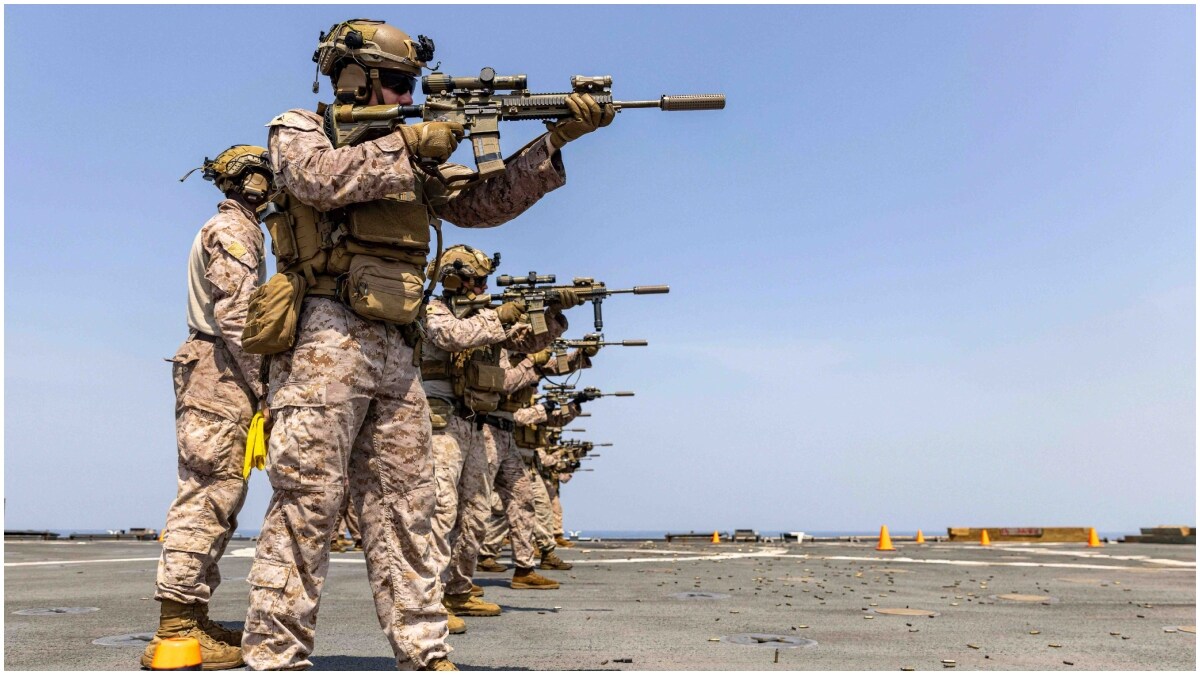
The ongoing convergence of a US force of approximately 8,000 ground forces, drawn from the 31st Marine Expeditionary Unit (MEU) based in Japan and the 11th MEU based in California, along with the 82nd Airborne Division in the Persian Gulf region, is expected to be complete by mid-April.
Such numbers militate against the idea of a conventional invasion as Iran is half the size of India with a population of 93 million. It would need much more bigger numbers than 8,000 to even launch a ground invasion into Iran leave alone to sustain it.
The troop trans-shipment and their composition is indicative of an American intent to: firstly, lead a surgical special forces ground assault into Iran; secondly, an operation with a limited aim—the most apparent one being to make a grab for the oil-hub of Kharg island that is located about 24 km off the Iranian coast and through which 90% of Iran’s oil trade took place; and thirdly, the US aim may be to secure the Hormuz strait from Iranian disruptions.
An interesting feature of the specialized forces deployment is that there are no heavy armoured or artillery units which may imply that the plan is to strike selectively and surgically and not look at a protracted conflict.
Yet, the troop movement may be a show of force too to gain more leverage during the negotiations.
But what has changed in the meantime is the entry of the Yemen-based Houthis who fired their first missiles and drones into Israel on March 28. In a single stroke, the Houthi entry has broadened the war into a much larger geography including the very important Bab el-Mandeb Strait.
A US seizure of Kharg island may be a cakewalk but maintaining and protecting it will be a near impossibility as the entire island will be well inside the range of Iranian missiles, coastal battery systems, drones and artillery fire not to speak of lurking fast attack crafts and midget submarines.
Iran on its part has been steadfast in its defiance with its Foreign Minister Abbas Araghchi challenging the impending US military deployment with a terse: “We are waiting for them.”
Having had years to prepare for what seemed like an imminent US attack, Iran may have prepared well enough—the reason why it continues to fire missiles and drones at US bases and infrastructure in nearby Gulf countries despite most of its missile and drone arsenal being depleted and its top leadership eliminated. Although much reduced in quantity, analysts say the Iranian attacks are much better targeted now.
Iran also has geography on its side as the Iranian coast has a sufficient number of islets, coves and natural harbours that are ideal for asymmetric naval warfare.
The only thing certain about the ongoing conflict now is that the summer of 2026 holds out supreme promises of being a torrid one.
