



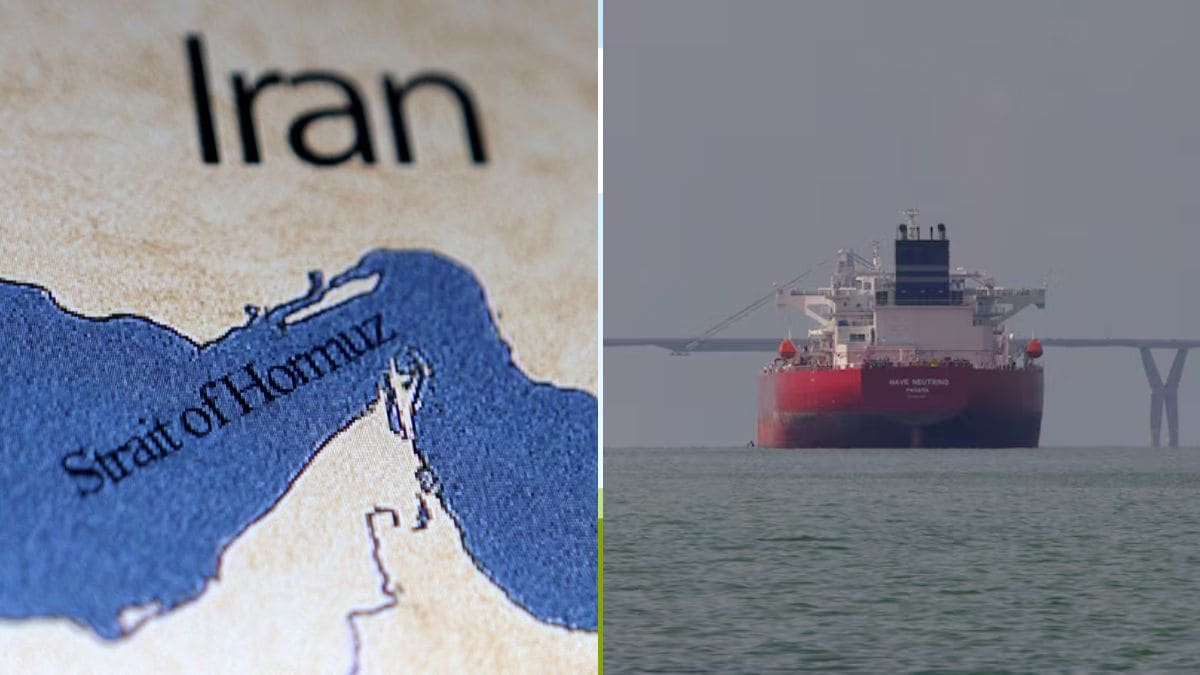
Two more LPG tankers headed for India were allowed on Saturday to cross the Hormuz Strait amid uncertainty over Iran's Islamic Revolutionary Guard Corps (IRGC) declaring the waterway "closed" a day earlier, which reportedly forced three Chinese vessels to abandon attempts to exit the strait.
The two Indian-flagged tankers—the BW Elm and the BW Tyr—had kept their AIS transponders switched on to indicate that they were of Indian origin, and did not face any harm while transiting through the embattled strait.
The two new tankers are part of a set of tankers that have been trickling into India over time as a result of diplomatic talks between New Delhi and Tehran, aiding the government's efforts to keep the LPG crisis at bay.
This includes the Shivalik and the Nanda Devi, two of the first vessels to exit the Hormuz Strait unharmed, leading up to the Jag Vasant and the Pine Gas, which docked in India earlier this week.
Uncertainty in the Hormuz Strait
The safe passage of the two Indian-flagged vessels comes after two Chinese-linked container ships on Friday were forced to turn back after trying to exit the Hormuz Strait on Friday.
Despite carrying Chinese flags, two COSCO-owned vessels—the CSCL Indian Ocean and the CSCL Arctic Ocean—were forced to turn back after attempting to pass through the strait as “safe passage could not be guaranteed”, a Kpler report said.
Notably, Friday also saw the IRGC declare the Hormuz Strait as "closed" to ships linked with the US and its allies, marking a major change in rhetoric from its earlier status of "special conditions" on the maritime chokepoint.
The uncertainty lies in the fact that Iran has already publicly allowed ships linked to five friendly nations—including India, China, and Pakistan—to cross the Hormuz Strait safely.
Yet, in the Friday announcement, the IRGC had also declared that it had "turned back" three container ships "of different nationalities".
As the identity of the third ship is unclear, it is speculated that the third that was "turned back" could also be the Pakistan-bound Selen carrying the flag of Saint Kitts and Nevis, which was intercepted and stopped from exiting the Hormuz Strait on Thursday.
