



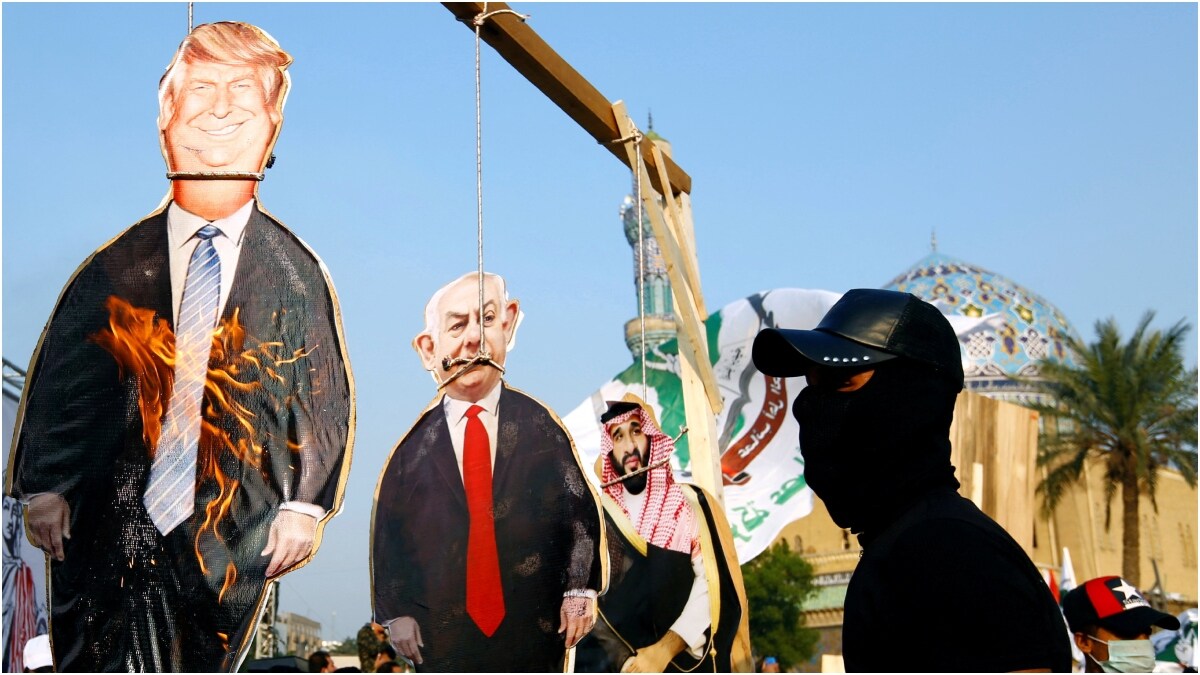
As the US-Israeli military campaign against Iran enters its second week, President Donald Trump has declared that he will accept nothing less than Iran’s “unconditional surrender”. He has gone further than outlining battlefield objectives, openly stating that he intends to be personally involved in the selection of Iran’s next supreme leader to ensure that the country does not pursue policies that could provoke another war.
In a lengthy post on his Truth Social platform, Trump sketched out his vision of a post-war Iran in which the United States and its allies would facilitate the emergence of “GREAT & ACCEPTABLE Leader(s)” and help rebuild the country’s economy. Borrowing from his signature political slogan, he coined a new phrase for the project: “MAKE IRAN GREAT AGAIN (MIGA!)”.
The president later clarified that his use of the term “unconditional surrender” should not necessarily be interpreted as a formal capitulation by Tehran. Rather, he suggested it could mean the complete destruction of Iran’s military capacity to fight, leaving the country unable to threaten the United States, Israel or their allies.
In discussing who these “acceptable” leaders might be, Trump has explicitly ruled out the possibility that Mojtaba Khamenei, the conservative son of the late supreme leader Ali Khamenei, could assume power. Mojtaba, who has close ties to the Islamic Revolutionary Guard Corps, was described by Trump as an “unacceptable” option.
At the same time, the president indicated that he would be willing to work with moderate Shia religious figures and even maintain Iran’s clerical system of governance, provided the leadership proved “fair” to the United States and Israel. In Trump’s formulation, the goal is not necessarily to dismantle the Islamic Republic’s political structure but to ensure that those running it align with American strategic interests.
Trump has repeatedly compared his approach in Iran with what he describes as his administration’s strategy in Venezuela, where he claims US forces removed former president Nicolás Maduro and allowed his deputy, Delcy Rodríguez, to govern as long as she complied with American demands regarding oil access. Despite the vast political, demographic and strategic differences between Venezuela and Iran, Trump has insisted that engineering leadership change in a country of more than 90 million people is “going to work very easily”.
Yet even as the president speaks openly about shaping Iran’s future leadership, the broader US military strategy articulated by his senior officials appears far more limited in scope. According to the White House, the military phase of the operation is expected to last roughly four to six weeks.
White House press secretary Karoline Leavitt has stated that the principal US objectives are the annihilation of Iran’s naval forces, the elimination of its ballistic missile threat, the permanent destruction of its nuclear weapons programme and the severe weakening of its regional proxy networks.
There is a noticeable disconnect between Trump’s rhetoric about selecting new leaders in Tehran and the messaging coming from key members of his cabinet. Both Secretary of State Marco Rubio and Defence Secretary Pete Hegseth have sought to distance the administration from the idea of regime change.
Their caution reflects a deep awareness of American public fatigue with large-scale military interventions after the long wars in Iraq and Afghanistan. Hegseth has explicitly dismissed the notion of embarking on another project of “nation-building”. Rubio has also told Arab foreign ministers that Washington’s official objective is not regime change, although the United States would prefer to see different figures ultimately running the country.
For now, Rubio emphasises, the military focus remains strictly on dismantling Iran’s missile infrastructure. That includes destroying launchers, stockpiles and production facilities. Any diplomatic engagement with the current leadership in Tehran, he argues, would risk undermining these ongoing military operations. The American gameplan appears to be using overwhelming military pressure to degrade Iran’s capabilities and ensure that it will not be able to pose a significant threat. Yet, Iran’s leadership is ready to fight on. For instance, parliament speaker Mohammad Bagher Ghalibaf has categorically rejected Trump’s surrender demands, insisting that the Iran’s future will not be dictated by Washington. Meanwhile President Masoud Pezeshkian has stated that Tehran remains committed to defending Iran’s sovereignty, even as international mediation efforts begin to emerge.
On the battlefield, the conflict has already inflicted heavy damage. Massive airstrikes on Tehran’s Mehrabad airport have reportedly destroyed air defence systems and helicopter manufacturing facilities. The war has also widened beyond Iran’s borders. Israeli attacks in Lebanon have killed more than 200 people and displaced lakhs of people.
The conflict has also drawn in external powers. Vladimir Putin has held discussions with Pezeshkian and offered condolences over the casualties, while urging a diplomatic resolution. US officials say Moscow has also provided Tehran with intelligence, including satellite imagery tracking American warships and military aircraft in the region.
Despite these developments, officials in Washington insist that the Iranian military is already suffering devastating losses. According to US assessments, roughly 60 per cent of Iran’s missile launchers and stockpiles have been destroyed. The impact has been immediate: Iranian missile attacks have reportedly fallen by about 90 per cent since the start of the campaign, underscoring the scale of the pressure now being exerted on Tehran.
