



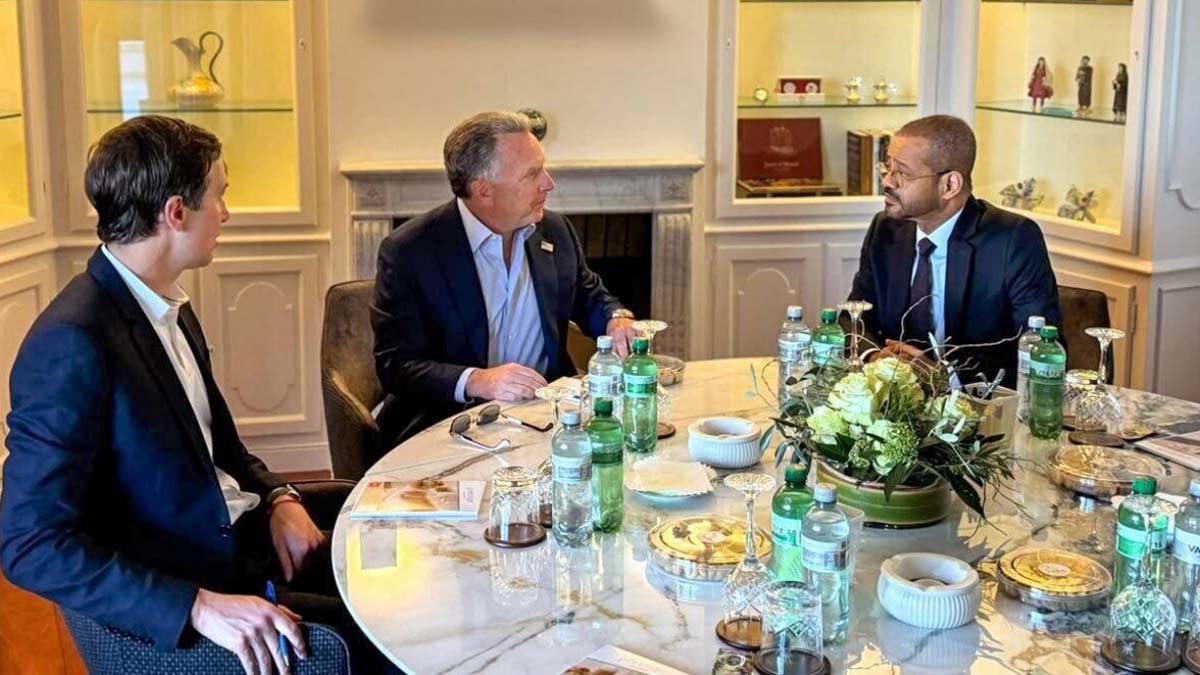
The United States and Iran expressed cautious optimism after high-stakes, indirect nuclear negotiations in Geneva on Thursday. The talks, aimed at preventing fresh American military strikes, were mediated by Omani Foreign Minister Badr Albusaidi and brought together senior representatives from both governments at a moment of extraordinary regional tension.
The Iranian delegation was led by Foreign Minister Abbas Araghchi. The US team was headed by President Donald Trump’s special Middle East envoy Steve Witkoff, joined by senior adviser Jared Kushner. Rafael Grossi, director general of the International Atomic Energy Agency, was also closely involved, pointing to the urgency of the discussions.
The meetings unfolded in two sessions: a three-hour round in the morning followed by a shorter evening exchange. At one point, Witkoff briefly stepped away to confer with Ukrainian negotiators, a reminder of the multiple geopolitical crises converging on Washington’s agenda. Araghchi later described the exchanges as among the most intense and candid the two countries had ever held. No breakthrough agreement was announced, but both sides committed to continuing technical-level talks in Vienna next week. Those meetings will bring together nuclear physicists, sanctions specialists and banking experts, signalling that negotiations are moving into a more detailed and consequential phase.
At the heart of the Geneva discussions lay the most contentious issue: uranium enrichment. The US delegation demanded that Iran permanently halt all enrichment activities, dismantle its nuclear facilities and transfer its roughly 400kg stockpile of highly enriched uranium out of the country. For Washington, anything short of “zero enrichment” leaves open the possibility of a rapid dash to a bomb.
Tehran flatly rejected that demand. Iranian officials insist that domestic enrichment is a sovereign right under the Nuclear Non-Proliferation Treaty. Before the talks, Iran had accumulated uranium enriched to 60 per cent purity, a short technical step from the 90 per cent threshold considered weapons-grade. While US intelligence assessments indicate Iran has not enriched further since June’s hostilities, the infrastructure and expertise remain intact.
This time around, Iran submitted written proposals as required by the US, offering a three-to-five-year suspension of major nuclear activities. It promised capping enrichment at 1.5 per cent during this period, limiting it to medical and research purposes. Iran also floated the idea of eventually joining a regional nuclear consortium, a framework designed to internationalise oversight and reduce proliferation risks.
On the sensitive question of its existing stockpile, Iran proposed a phased dilution of highly enriched uranium while keeping the material inside the country under stringent monitoring by UN inspectors. Grossi’s presence in Geneva was seen as critical to crafting verification mechanisms robust enough to reassure sceptics in Washington and European capitals.
Yet even as negotiators explored technical compromises, political fault lines remained stark. Senior US officials, including Secretary of State Marco Rubio, have insisted that any durable arrangement must eventually address Iran’s ballistic missile programme and its support for armed groups across the Middle East. Iran’s missile arsenal includes systems with a range of up to 2,000km, capable of striking Israel and US bases in the region.
Tehran has categorically refused to negotiate on what it calls non-nuclear issues. Iranian officials argue that their missile programme is purely defensive and not subject to nuclear talks. This sequencing dispute threatens to derail progress, as Washington views missiles and regional activities as inseparable from the broader security equation.
All of this diplomacy is unfolding under the shadow of possible war. Trump has ordered the largest American military build-up in the Middle East since the 2003 invasion of Iraq. Iran has warned that any attack would be met with a massive barrage of ballistic missiles against Israel and US installations across the Gulf. Defence analysts caution that such an exchange could quickly escalate into a protracted regional war.
The current crisis traces back to last June, when a surprise Israeli strike triggered a 12-day conflict. The confrontation culminated in US bunker-buster attacks on Iran’s key nuclear facilities at Fordow, Natanz and Isfahan. In the aftermath, Tehran restricted IAEA access to the damaged sites, leaving uncertainty about the full status of its programme.
Meanwhile, ordinary Iranians are bracing for the worst. Fear of renewed bombing has led to panic buying of bottled water, food supplies and short-wave radios. The economic backdrop is already dire. Years of sanctions have driven inflation above 60 per cent, with food prices reportedly soaring by more than 100 per cent.
The government also faces lingering domestic unrest following severe crackdowns on anti-government protests in which thousands were reportedly killed. As diplomats prepare for another round in Vienna, the stakes are existential. Failure would almost certainly lead the Middle East towards yet another war.
