



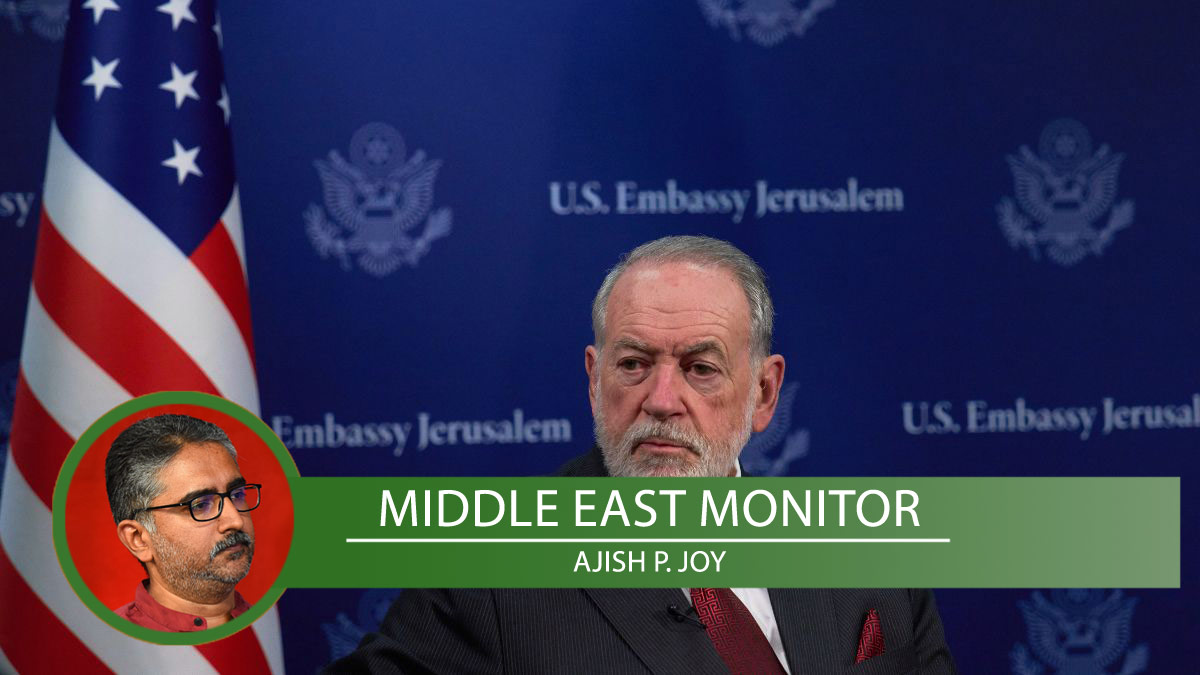
A wave of backlash erupted across the Arab and Muslim world on Saturday following remarks by US Ambassador to Israel Mike Huckabee, who suggested it “would be fine” if Israel seized a vast expanse of the Middle East. More than a dozen governments, along with powerful regional organisations, issued sweeping condemnations, describing the comments as dangerous, inflammatory and a direct threat to regional stability.
Leading the diplomatic outcry, Saudi Arabia condemned the “reckless” and “irresponsible” remarks in the strongest terms, describing them as “extremist rhetoric” that violates international law and diplomatic norms. The Kingdom warned that such statements endanger international peace by antagonising regional populations and demanded that the US State Department clarify its official stance. Similarly, Egypt expressed surprise and outrage, calling the comments a “flagrant violation” of the UN Charter and emphasising that Israel holds no sovereignty over occupied Palestinian or Arab territories. Cairo reiterated its categorical rejection of any attempt to annex the West Bank or separate it from Gaza.
Jordan dismissed the rhetoric as “absurd and provocative”, stating that it constituted a blatant infringement on the sovereignty of states across the region. Kuwait said the remarks legitimised Israel’s illegal territorial control, inflamed tensions and undermined the peace process. Oman and Iraq also expressed displeasure, warning that such rhetoric would unravel the already fragile Arab- Israeli relations.
International organisations also joined the protest. The Arab League, in which there are 22 member states, criticised what it called “attempts to justify territorial expansion using the Bible”. The Organisation of Islamic Cooperation branded the remarks an “unacceptable call” for Israeli expansion based on a rejected ideological narrative that could encourage further displacement and annexation.
The Palestinian Authority protested that the remarks directly contradicted US President Donald Trump’s publicly declared opposition to annexing the West Bank. A joint statement was issued by the United Arab Emirates, Egypt, Jordan, Indonesia, Turkey, Qatar and Syria, unequivocally denouncing the ambassador’s suggestions.
The uproar followed a combative interview recorded at Ben Gurion Airport between Huckabee and conservative commentator Tucker Carlson. During the exchange, Carlson pressed Huckabee on the biblical promise to Abraham’s descendants, said to encompass territory stretching from the Nile to the Euphrates, covering parts of modern Egypt, Syria, Lebanon, Jordan, Iraq and Saudi Arabia. When asked whether Israel had a right to that expanse, Huckabee replied, “It would be fine if they took it all.”
Although Huckabee later characterised the remark as “hyperbolic” and said Israel was not currently seeking to take over such territory, the clarification did little to quell the diplomatic storm. The interview laid bare a widening ideological divide within the American right. It underscored tensions between traditional Christian Zionists such as Huckabee, who frame support for Israel as a theological imperative, and the ascendant “America First” wing represented by Carlson.
An ordained Southern Baptist minister and evangelical figure, Huckabee has long endorsed hardline Israeli positions that diverge from traditional US diplomatic language. He has consistently rejected the two-state solution and declines to describe Israel’s presence in the West Bank as an occupation, instead using the biblical term “Judea and Samaria”. In 2008, he controversially stated that “there’s really no such thing as a Palestinian”, a view he has reiterated in recent years by objecting to the term “Palestinians” for Arab descendants of the British Mandate period.
Huckabee defended these theological and historical arguments. When Carlson questioned the indigenous claims of Israeli leaders by noting their Eastern European ancestry, Huckabee dismissed genetic or geographic criteria and instead cited archaeology and biblical tradition as evidence of an enduring Jewish connection to the land. He also defended US military aid to Israel as defensive in nature and argued that Iran’s sponsorship of militant groups makes it an inherent adversary of the United States.
His reliance on biblical covenants to frame modern geopolitics now sits at the heart of an unusually broad diplomatic confrontation between Washington and much of the Arab and Muslim world.
