



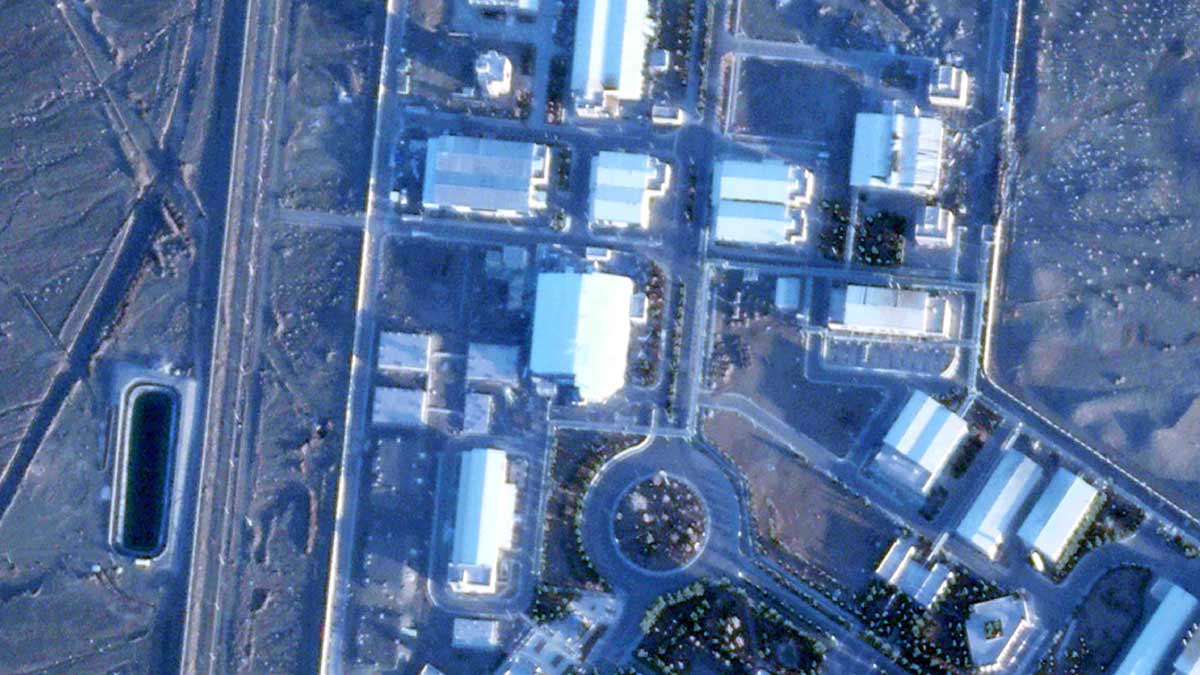
Recent high-resolution satellite imagery captured by Planet Labs PBC has revealed significant activity at Iran’s primary nuclear facilities at Natanz and Isfahan, both of which were targeted during the “12-day war” in June involving Israeli and American airstrikes. The images show that Iran has erected large roofs over damaged structures at both sites, a move widely interpreted by intelligence analysts as an effort to conceal the extent of destruction and ongoing recovery operations.
At the Natanz nuclear complex, satellite images indicate that a roof was constructed in December over the Pilot Fuel Enrichment Plant, a facility previously used to enrich uranium. A similar structure was completed in early January at the Isfahan Nuclear Technology Centre, covering a damaged building near the site’s northeast corner. Analysts assess that these roofs are not immediate steps towards restoring operational capability, but rather temporary measures designed to shield wreckage from foreign surveillance.
Analysts say the Iranian regime is likely attempting to assess and recover key assets, including stockpiles of highly enriched uranium, without American or Israeli satellites observing what survived the bombardment. Such concealment has taken on added significance because the International Atomic Energy Agency is currently barred from accessing the sites and must rely heavily on satellite imagery to monitor developments. By covering damaged structures, Iran effectively blinds international inspectors to the status of its nuclear remnants and any salvage efforts under way.
Beyond the visible surface repairs, satellite imagery also points to a deepening underground expansion of Iran’s nuclear infrastructure. Near the Natanz complex, at a site known as Pickaxe Mountain, or Kuh-e Kolang Gaz Lā, analysts have detected extensive excavation activity. Experts believe a new ultra-deep underground facility is being built, potentially buried more than 100 metres below ground to withstand bunker-buster munitions.
Tunnels leading into the mountainside at Isfahan are filled with dirt to protect them from missile strikes, and some are reinforced with new blast walls, reducing their vulnerability to air attacks.
Meanwhile, at the Parchin military complex located southeast of Tehran, a structure known as Taleghan 2, identified in documents seized from Iranian nuclear archives as a site used to test high explosives for nuclear weapon detonation, is being reconstructed quickly after it was destroyed by Israel in June. Analysts say this may signal an attempt to reconstitute research related to implosion-style nuclear weapons.
These developments come amid sharply rising tensions between Washington and Tehran. President Donald Trump has ordered the deployment of the Abraham Lincoln Carrier Strike Group to the Middle East, describing it as a “large armada” intended to pressure Iran. Trump has warned that “time is running out” for Tehran to agree to a new deal that would eliminate its nuclear programme and halt the killing of protesters. He has threatened military strikes larger than previous attacks if Iran refuses to negotiate, targeting what remains of its nuclear infrastructure.
While Trump has recently suggested that Iran “wants a deal” to avoid conflict, he has underscored that US forces are prepared to act with “speed and violence if necessary” should Iranian leaders fail to comply with American demands.
Iranian officials, however, have adopted a defiant posture. Foreign Minister Abbas Araghchi has ruled out direct negotiations while Iran remains under threat, insisting that any talks must be conducted on a “fair and equitable” basis. Tehran has explicitly excluded its ballistic missile programme from negotiations, viewing it as essential to national defence. Araghchi has warned that while Iran remains open to diplomacy, it is equally “ready for warfare”, and officials have stated that any aggression would be met with a limitless response targeting US interests.
Amid the brinkmanship, Turkey has emerged as a potential mediator. President Recep Tayyip Erdogan and Foreign Minister Hakan Fidan have been in contact with both Washington and Tehran in an effort to prevent escalation into a wider regional war.
The instability has already rippled through global markets. Crude oil prices jumped more than 3 per cent on fears that US military action could disrupt Middle Eastern supplies. US crude rose above $65 per barrel, while Brent crude settled above $70.
In Europe, British Prime Minister Keir Starmer has signalled support for Trump’s hardline stance. While stopping short of explicitly endorsing new military strikes, Starmer said preventing Iran from developing a nuclear weapon remains a “number one priority” and that Britain “supports the goal” of the US administration, a position widely seen as tacit backing for Washington’s pressure campaign.
