



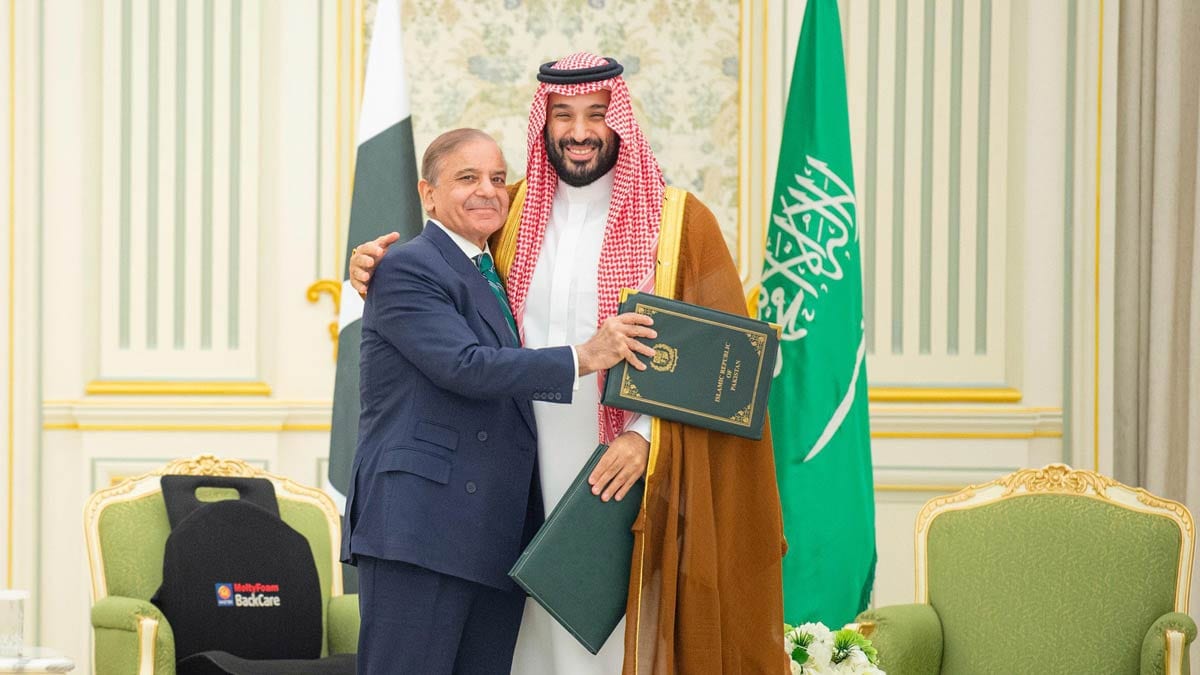
International relations pundits were quick in relegating the joint communiqué of the Emergency Arab-Islamic summit, convened on 15 September in response to the Israeli attack on Doha, as rhetorical and lacking substance. This was mainly because the declaration did not include real actions like diplomatic, economic, or financial steps to deter Israel from carrying out similar attacks on Arab and Islamic states in the future. However, the signing of the Strategic Mutual Defence Agreement between Saudi Arabia and Pakistan on 17 September, pledging that an attack on one will be treated as an attack on both, took many Middle East and South Asia watchers by surprise.
Though the timing is significant, it should not be conflated with either the Arab-Islamic Summit or the attack on the Qatari capital. More importantly, it is not the beginning of Islamic NATO. Saudi officials have clarified that the agreement had been in the works for over a year, a point implicitly corroborated by India's official statement on the pact.
Three key points make this agreement particularly important. This is the first formal agreement of its kind between the two Islamic states despite their decade-old cooperation. The agreement talks of “aggression against either country shall be considered an aggression against both”. This is the language of a mutual defence treaty, similar to Article 5 of the NATO Charter. Secondly, unlike earlier ad hoc or narrowly transactional cooperation, this agreement explicitly seeks to “develop aspects of defence cooperation between the two countries and strengthen joint deterrence against any aggression.” As such, it signals a more institutionalised and strategic framework for collaboration. Thirdly, it also allows both countries to present their cooperation as serving the broader Muslim community, not just their own bilateral needs, which strengthens its acceptance across the Islamic world. This is reflected in the way the statement of this pact invokes the “bonds of brotherhood and Islamic solidarity.”
The Palestine-Israel war, together with Washington’s unwavering support for Israel for its arbitrary actions in the region, likely deepened Riyadh’s security dilemma. These are likely the major immediate factors in pushing Mohammed bin Salman (MbS), de facto Saudi ruler and the heir apparent, to sign the pact with Pakistan. However, in retrospect, a broader strategic rationale makes Pakistan an obvious partner for such an agreement. The depth of cooperation between Riyadh and Islamabad across political, military, and economic fronts over the past eight decades is well known. This includes intermittent Saudi financial assistance to Pakistan during periods of economic crises, the training of Saudi military personnel in Pakistan, and even the deployment of Pakistani army officers within the Kingdom. In 1969, Pakistani Air Force pilots operated Royal Saudi Air Force Lightnings in response to a South Yemeni incursion along the southern Saudi border. During the 1970s and 1980s, an estimated 15,000 Pakistani troops were stationed in the Kingdom, including a brigade-level combat formation deployed near the Israeli-Jordanian-Saudi border.
For decades, Saudi Arabia has made substantial investments in Pakistan’s defence sector, reportedly viewing its nuclear capability as a critical asset. The Kingdom is also one of the major buyers of Pakistani arms, purchasing millions of dollars’ worth of small and medium conventional weapons. In 2015, Pakistan’s Army Chief, General Raheel Sharif, visited Riyadh to reaffirm Pakistan’s pledge to defend Saudi Arabia’s territorial integrity and its holy cities. That same year, during the intervention in Yemen, Pakistan promised to support the Kingdom if its borders were threatened. However, back then, Pakistan’s National Assembly voted down the proposal of direct military involvement against Yemen’s Houthis. In 2017, General Sharif was appointed commander of the Saudi-led Islamic Military Alliance to Fight Terrorism (called as Muslim NATO); a move that provoked criticism from Iran. Three years later, in 2018, a Pakistan Army contingent was sent to Saudi Arabia on a “training and advise mission”, presumably for deployment on borders and internal security purposes.
The current regional context further amplifies this logic: the uncertainty surrounding Iran’s nuclear programme following the US strike last June and Israel’s repeated and largely unaccountable military actions in the Gaza Strip, Syria, Lebanon, Iran, Yemen and, more recently, in Doha. Against this backdrop, a formal agreement with the nuclear-armed Pakistan provides Riyadh with a tangible means of exhibiting strategic deterrence toward both Israel and Iran.
Furthermore, President Donald Trump’s unconventional diplomatic approach on a number of issues, including his relentless support for Israel, could also be one of the imperatives for the Saudi move. Though at the face-value it may appear that Riyadh might upset Washington, it is unlikely that this pact was signed without Washington’s knowledge. Since Islamabad is hardly expected to risk upsetting President Trump, the possibility of a tacit US nod for the Saudi-Pakistan defence pact is most likely. Pakistan’s Army Chief, Asim Munir, made two back-to-back trips to Washington, one of which was at the invitation of President Trump, who also publicly lauded the former. Moreover, reports suggest that Prime Minister Shehbaz Sharif, together with Munir, is scheduled to meet President Trump on 25 September. MbS is also slated to meet President Trump later this year in November. These potentially point to Washington’s close awareness of these developments.
For some time, countries like Pakistan, Türkiye, Egypt, and Iran, all part of the Organisation of Islamic Countries (OIC), have been pushing for a so-called Arab/Islamic NATO. It is necessary to understand that this is highly unlikely in the near or immediate term. This is due to the intra-regional rivalries and divergent strategic priorities among the Arab/Islamic countries in the MENA region and beyond. For instance, Saudi Arabia and Iran have long been locked in a geopolitical contest for influence. Türkiye, for its part, pursues an independent regional agenda, at times clashing with Saudi and Emirati interests. Egypt, while formally aligned with Gulf monarchies, often prioritises regime stability at home. Hence, the strategic proximity between Riyadh and Islamabad ought to be treated separately.
While New Delhi is expected to navigate its foreign policy stance over the Saudi-Pak agreement deftly, what remains certain is close coordination among the six Gulf Cooperation Council (GCC) countries over defence matters, which was reflected in the GCC Joint Defence Council meeting held in Doha on 18 September. This is largely due to their shared values, economic interests, and similar political outlook. The provisions of the GCC Joint Defence Pact, which mirrors the NATO Charter’s Article 5, appear to have been invoked; the statement of the Extraordinary Session of the Joint Defence Council mentioned that “the attack on the State of Qatar is an attack on all GCC states”. GCC countries, in all likelihood, will work towards a more robust and integrated and coordinated defence posture, as evident in the joint statement.
Though it is unlikely to be a precursor to Arab/Islamic NATO, the Saudi-Pakistan defence pact is a clear warning that the confidence-building measures between the Arab states and Israel have effectively collapsed.
The author is a doctoral candidate at the Centre for West Asian Studies, Jawaharlal Nehru University, New Delhi.
