



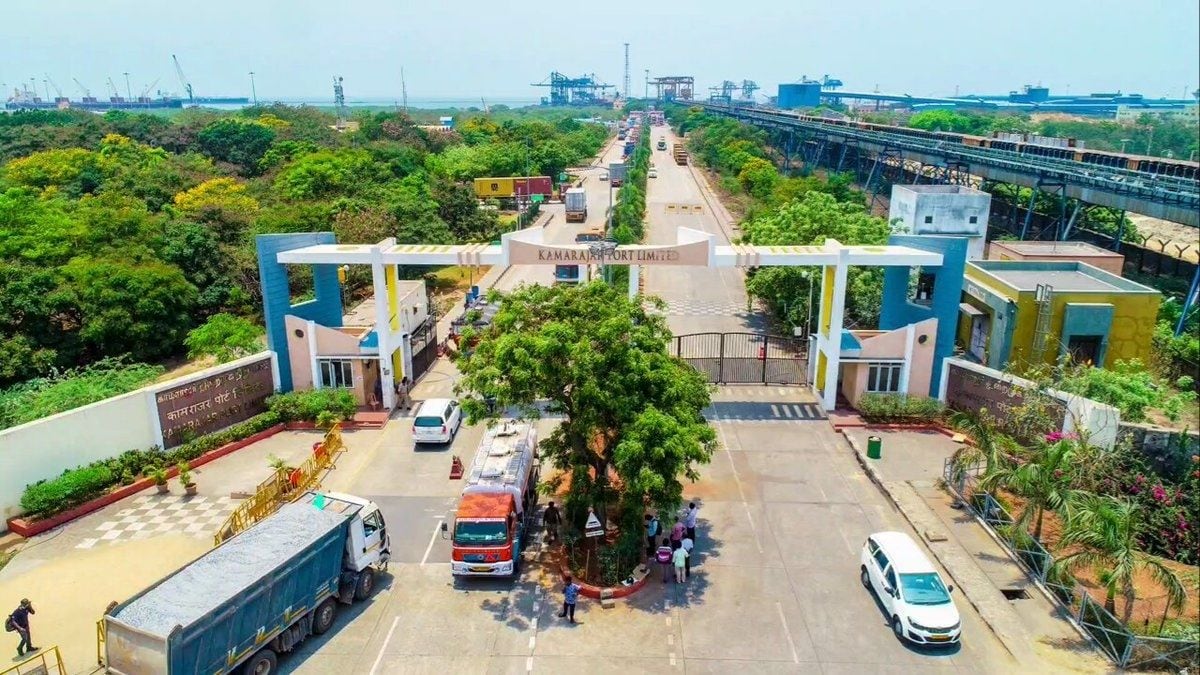
India has 14 notified major ports. While two are under development, among the 12 currently operational ports, only one is structured as a corporate body—the Chennai-based Kamarajar Port. And now, it is gearing up for an initial public offering (IPO) of around ₹1,200 crore.
Through an offer for sale, the Chennai Port Authority looks to dilute a portion of its wholly owned stake and raise capital.
This is also a historic milestone, as Kamarajar will, post IPO, become India's first state-backed port to list on the stock exchanges.
The other important thing is that it opens a rather rare window of opportunity for the average Indian retail investor to hold some stake in a highly profitable, government-backed infrastructure asset.
What sets the Kamarajar Port apart is also how it operates under the Companies Act rather than a traditional trust model, and therefore enjoys certain flexibility in its day-to-day operations and expansion strategies. It also sets a precedent for maritime privatisation efforts across the nation for the future.
As the port preps its IPO filing documentation with SEBI, let us take a look at its recently published earnings. For FY2026, i.e. the fiscal year that ended 31 March 2026, Kamarajar Port posted a net profit of ₹596.03 crore on an operating revenue of ₹1,239.14 crore.
In the first quarter of FY2027, Kamarajar Port reported an operating revenue of ₹316.10 crore, generating a net profit of ₹144.27 crore.
A quick look at the P&L also revealed that the first-quarter operating margin stood at 79.42 per cent. The balance sheet also stated that the total debt-to-asset ratio was a mere 0.09, and backed by a paid-up equity share capital of ₹300 crore.
It is with this strong book that this maritime giant will look to tap into the stock market. It will also look to meet its divestment target, and possibly even establish a clear valuation benchmark for other state-owned maritime assets across the subcontinent, adding more fillip to India’s Sagarmala push.
