



Leadership is no mere buzzword but a multi-dimensional concept spanning all industries. The shipping fraternity offers the best possible example of leadership in all its dimensions. Leadership is such an essential part of seafaring that the Audacious Leadership unit at Deakin University in Australia uses seafaring to teach business students leadership skills.
For a ship to function, we need all hands on deck and under deck to pull through. At sea, this potentially abstract concept of leadership can suddenly gain more traction, not only helping crew members succeed in ship operations but also ensuring safety for all. Everyone must pull their weight and take charge, or the ship won’t operate.
Offshore oil and gas, an industry of staggering proportions, supplies the energy needs for all nations, providing employment, wealth, and security for millions of families. Few really appreciate how dynamic and technologically driven it is and how it touches many parts of our lives. The offshore support vessels, being highly complex and specialised, form a part-and-parcel of this truly global business.
Intricate in design, offshore vessels are the workhorses of the oil and gas industry. Several advancements have led to newer ship designs and guidelines embracing safety, increased cargo movement, longer transit distance, increased reliability and redundancy and legislative demands.
The growth in the use of semi-submersible drilling rigs produced a demand for specialist anchor handling vessels. Development in drilling techniques produced a need to carry a variety of drilling fluids, while improvements in onshore logistics and pipe laying capabilities created a demand for larger platform supply vessels.
The increase in subsea construction and inspection, repair and maintenance operations drove the need for efficient vessels to support remotely operated vehicles and other specialist vessels.
Offshore vessels play multipurpose roles, from acting as a cargo ship, a tanker, a passenger vessel, a survey vessel, a tug, a crane vessel, a diving support vessel, an emergency response and rescue vessel, or an oil spill response vessel.
For example, under the same employment, an offshore vessel may be required to carry passengers, dry cargo on deck, fuel in its tanks and act as a tug, simultaneously. Another example could be a vessel being operated as a crane vessel while concurrently supporting diving operations.
The Indian offshore industry is controlled by the Oil and Natural Gas Corporation, which is the only major exploration and drilling company in India. This monopoly affects charter rates due to a lack of opportunities with other oil majors. The charter hire fluctuations due to oil prices and supply and demand issues are especially volatile on spot charters. Presently, most charters are for three years. To offset the volatility, it is preferable to have contracts of five years.
Ship owning is capital-intensive. With age limits of assets being constantly revised from 30 years to 25 to 21 to 19 and now to 15, the issue facing owners today is not the sheer number of vessels but the age and quality of available tonnage and whether owners can raise the capital to invest in newer, cleaner vessels for future offshore operations as exploration and production businesses continue to focus on age restrictions and lowering of overall emissions. For this, the government needs to promote the indigenous shipping industry by providing subsidies for shipbuilding in India.
The time spent in obtaining clearances makes it tedious for an Indian flagged vessel, with Indian crew holding Indian passports, to step into spot charters as it takes 50–60 days to clear all compliances.
Police verification is required for every seafarer, even though they have a valid passport. This verification can take anywhere between 15 and 30 days, following which a Non-Employee Duty (NED) pass is processed by ONGC, which takes about 7 days.
Vessels are required to have Ministry of Defence (MOD) clearance, which needs to be applied 30 days in advance of the charter, while Naval Security Clearance (NSC) is to be applied 7 days in advance of the charter; however, only after receiving MOD clearance.
E-applications and data analytics are required to reduce lead time for first-time vessels requiring naval clearance. Fast-track clearances should be available to Indian flagged vessels already working for a contract.
The shortage of trained personnel is another issue that needs to be investigated. Though most seafarers prefer the main fleet due to experience gained in cargo work and calculation of sea time for deck cadets in particular, many have moved to offshore during the boom in the industry. However, the current slump has seen many migrating to the main fleet.
Complex operations such as towing and anchor handling require skilled manpower, which is lacking. Though individuals are trained in DP operations, manual handling guarantees a fallback mechanism in case the DP system becomes non-operational. To ensure skilled manpower, economical simulation training is required to cater to the needs of diversified offshore operations.
The need for offshore vessels
Offshore vessels have complex and numerous pieces of machinery. Maintenance of this machinery involves obtaining spares from Japan, South Korea, China, Scandinavian countries, Europe, and the US. COVID-19 led to a disruption in the supply chain and long lead periods in importing spares, thereby escalating costs in repairs and maintenance. Most spares are not available off-the-shelf due to the scarcity of raw materials, impeding manufacturing. The regularisation will take time to reduce lead-time in procuring spares to pre-pandemic levels.
Another pain point is ship finance. Indian financial institutions have a negative outlook on funding asset purchases. Banks enforce stricter lending conditions with high interest rates. Further, the high cost of shipbuilding and long lead periods incur higher financing costs.
The term for an Indian rupee loan is 7 years, and for a foreign loan, it is 5 years. There is a need from the Government of India to recognise shipping as an infrastructure sector, thereby facilitating loans for a longer term, a minimum of 10 years, to withstand charter hire fluctuation. Further, banks do not consider the ship as full collateral and require other guarantees and collateral.
Additionally, they tend to lend only against a contract. Whereas an Indian flagged vessel is required to bid for a contract, a catch twenty-two situation which doesn’t augur well for an offshore ship owner.
Government support through a mechanism providing cheaper loans, longer repayment periods and an initial moratorium for one year on repayments, as tender finalisations take about six months, would be a welcome initiative.
Today, the offshore industry is not just about oil and gas. The current energy crisis has led to an acceleration in the clean energy sector. Investment into clean energy could be anywhere between $2 trillion and $4 trillion to honour the global commitment of bringing down the temperature to 1.5 degrees above the baseline temperature.
By 2030, fossil fuel consumption is expected to peak and reduce to 70 per cent of the total energy consumption. Offshore wind power offers a plausible alternative in such a scenario. Globally, offshore wind power is two decades old, with 2021 being the best year ever.
GWEC has raised its outlook for 2030 by 16.7 per cent, which equates to another 45GW of capacity. China made up 80 per cent of offshore wind capacity worldwide in 2021, bringing its cumulative offshore wind installations to 27.7GW.
By the end of 2022, Asia became the world’s largest offshore market. It could take until 2031 for Europe to regain the position. There is a bid globally to increase to 260GW by 2030.
India’s plan to call for 5,000 megawatts of offshore wind by 2022, and 30,000 megawatts by 2030, has seen little progress due to a lack of developed port infrastructure, higher costs of installing turbines and suspensions due to the pandemic. This is despite a 7,600km-long coastline and an offshore wind energy potential of 140GW by 2050. Of this, Gujarat and Tamil Nadu make up 71GW.
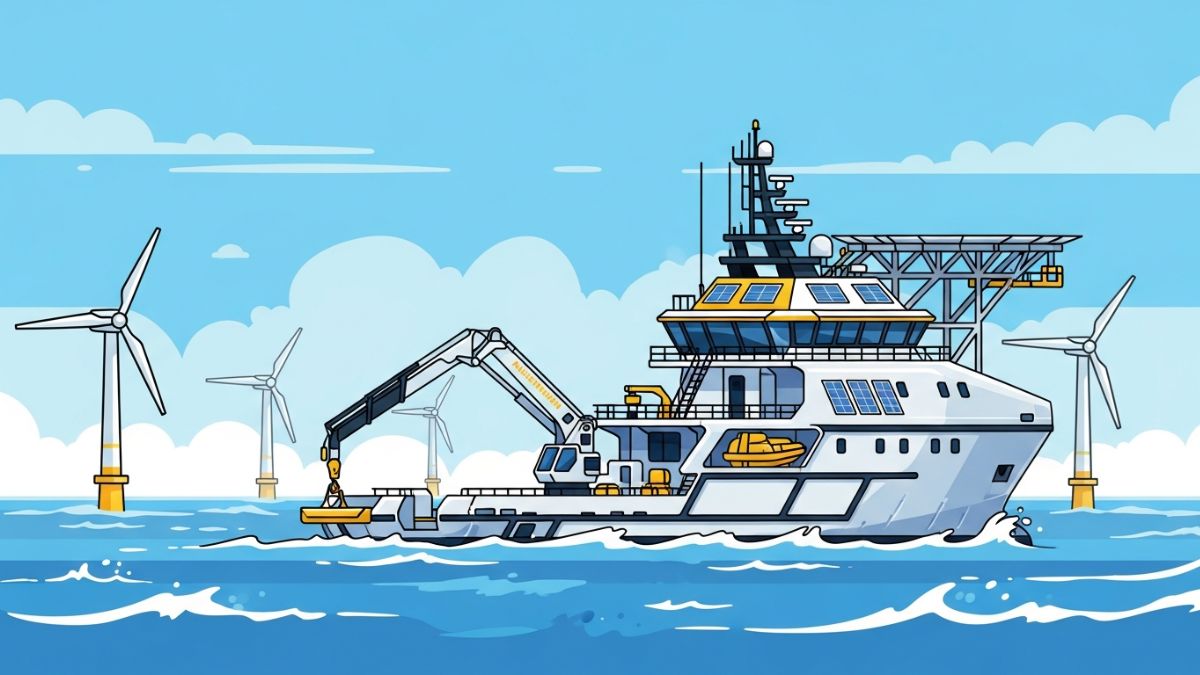
Service operation vessels cater to the offshore wind farms. These vessels offer solutions for the entire offshore renewables value chain, including offshore wind, tidal and wave power. Particularly, windfarm support vessels have a high focus on efficient logistics, crew and technician comfort, operability and gangway-connected uptime.
Features of a Service Operation Vessel include:
• Adjustable gangway
• Motion-compensated crane
• Premium cabin accommodation (40–100)
• Optimised hull and solar cells
• Emission-free propulsion
• Battery hybrid propulsion
Offshore support vessels have come a long way since the first vessel, ‘Ebb Tide’, built in 1956 to service the US Gulf Offshore. The global search for hydrocarbons and sub-sea minerals is moving into ever-increasingly deeper water and harsher environments, such as the Arctic.
To tackle these extreme weather conditions, the design and guidelines of offshore vessels continue to evolve. As we move into the future, the growing renewable energy market will see this industry thrive and expand long after the depletion of fossil fuels.
The author is director, Oceandeep Energies Pvt Ltd.
The opinions expressed in this article are those of the author and do not purport to reflect the opinions or views of THE WEEK.
