



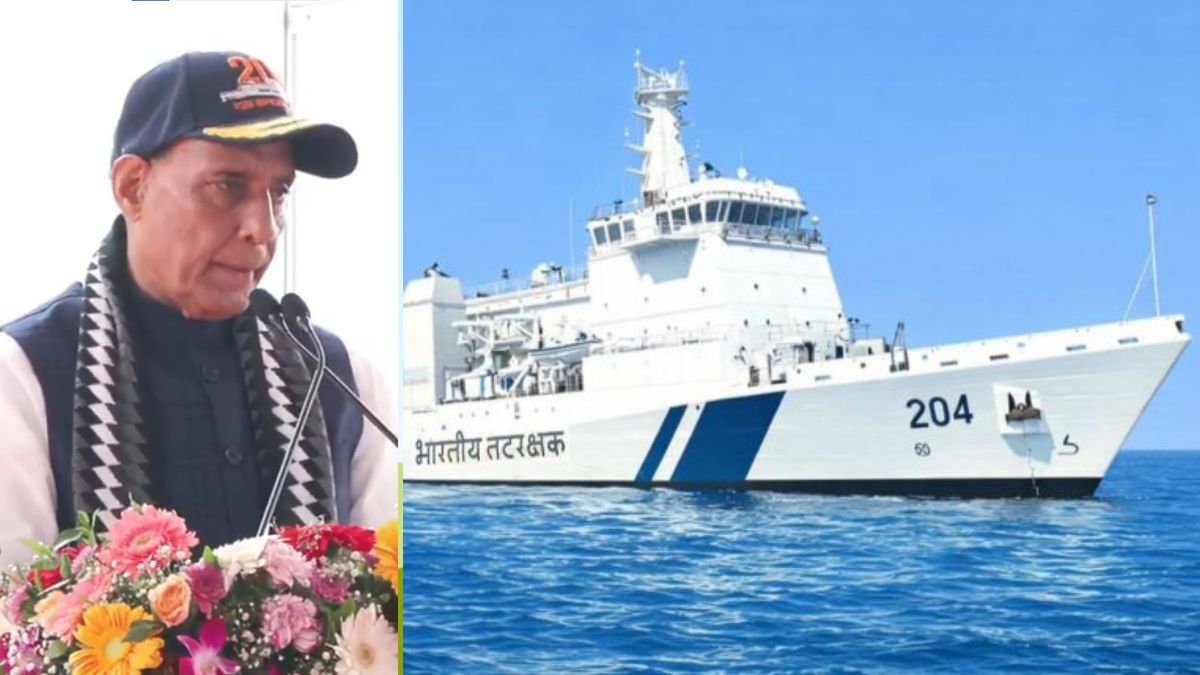
Defence Minister Rajnath Singh on Monday commissioned the Samudra Pratap for the Indian Coast Guard (ICG)—its first Pollution Control Vessel (PCV) that is 75 per cent indigenously designed.
Highlighting the capabilities of the Samudra Pratap, as well as the opportunities presented by PCVs, Singh declared that the new vessel would boost India's self-confidence.
"Our defence industrial ecosystem is maturing ... I hope that in the future, we must go from 60 per cent to 90 per cent indegenously designed vessels," he said at the ceremony in Goa's Vasco city.
The event saw the attendance of ministers and ICG officials, including Goa CM Pramod Sawant, Union Defence Secretary Rajesh Kumar Singh, and ICG Director General Paramesh Sivamani.
Delivered by Goa Shipyard Limited (GSL) to the ICG in December 2025, the Samudra Pratap is the first in a series of two PCVs (02 PCV Project) designed to help the ICG combat oil spills at sea.
Measuring 114.5m in length and 16.5 m in breadth, with a displacement of 4,170 tonnes, this is the largest vessel in the ICG's fleet, the defence ministry said on Wednesday.
"The true meaning of 'Make in India' is visible in projects like this," Singh noted, lauding India's growth over the years into a "responsible maritime power".
This comes after two high-profile naval pollution accidents in Indian waters earlier in 2025, that had caused major ecological problems—the fire aboard the MV Wan Hai (IMO: 9294862) in June and the listing (tilting to one side due to the entry of water inside the vessel) of the MSC Elsa 3 (IMO: 9123221) in May.
In that regard, Singh pointed out that marine pollution was on the rise in recent years, which was a cause for concern.
"It is obvious that as marine pollution increases, it will affect the livelihood of fishermen, the future of coastal communities, and the safety of our coming generations," he said.
