



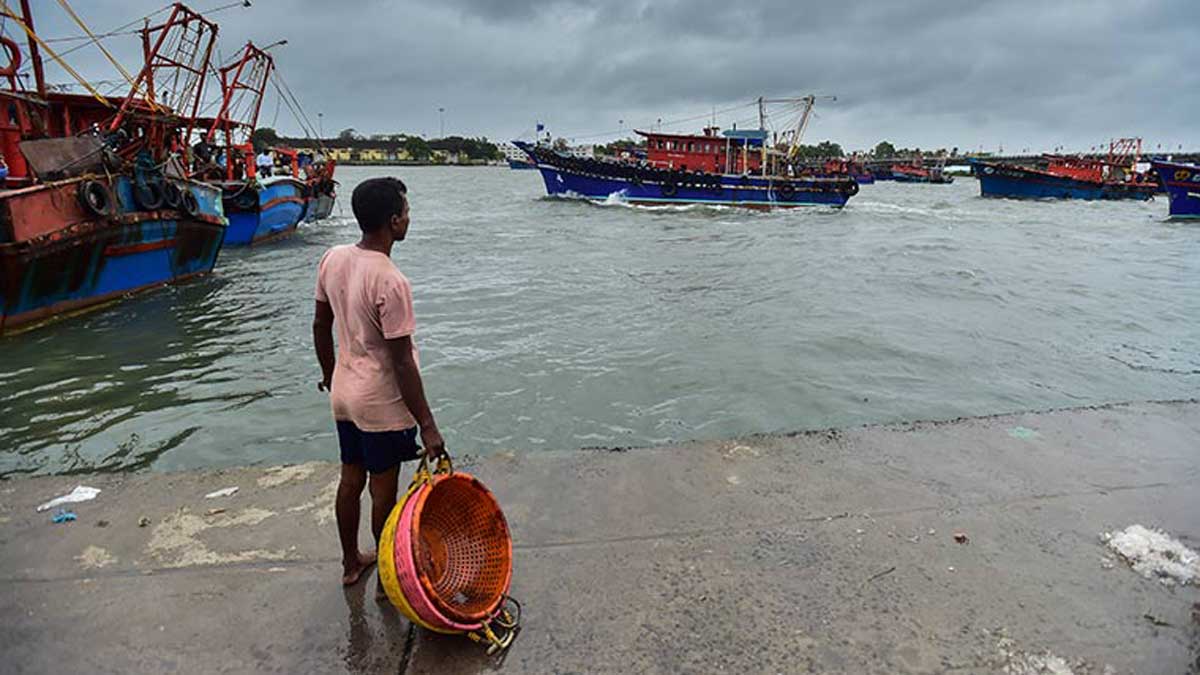
The Kerala government expressed concerns over the Union government’s move to allow industrial-scale fishing in the deep sea as part of its Blue Economy policy. It also noted that it has already conveyed its objections regarding the Draft Rules for Sustainable Harnessing of Fisheries in the Exclusive Economic Zone of India, 2005. The rules will apply to all fishing and fishing-related activities carried out by Indian fishing vessels in India’s Exclusive Economic Zone.
The demand for regulation of marine fishing in India’s Exclusive Economic Zone (which stretches from 12 nautical miles, approximately 22km, to 200 nautical miles, approximately 370 km) was first raised by small-scale fishers more than 20 years ago. Their primary concern was to protect their legitimate share of fish resources from the mechanised fishing sector, which was depleting stocks under the prevailing open-access regime.
In 2009, facing growing demands and agitations from small-scale fishers along the country’s coastline, the government proposed the Marine Fisheries (Regulation and Management) Bill, 2009 to regulate fishing in maritime zones beyond territorial waters. However, widespread opposition from fishing communities and other stakeholders meant that the bill was never finalised or enacted.
In 2021, the Union government introduced another draft Indian Marine Fisheries Bill. States such as Kerala and Tamil Nadu were at the forefront of opposition, and the bill was never tabled in Parliament for consideration.
The current Draft Rules for Fishing in the EEZrepresent the third attempt by the government to create a statutory framework regulating fishing in India’s EEZ.
Kerala’s primary concern is with the legal form of the draft rules. The state noted that fisheries in territorial waters fall under the constitutional responsibility of states, which already have their own Marine Fishing Regulation Acts. The new framework, however, reduces state fisheries departments to limited roles of verification and adjudication.
Kerala also argues that the Union government’s proposals would create a convoluted structure that adds layers of bureaucracy without clear rationale, leaving fishers trapped in overlapping jurisdictions. For instance, under the draft rules, a small-scale fisher aggrieved by a decision of the adjudicating officer (a state officer) would be compelled to appeal before the Joint Secretary of the Government of India in Delhi.
The state further observed that the draft rules place overwhelming emphasis on the issuance, renewal, and cancellation of access passes—reducing fisheries governance to little more than a licensing regime. Kerala also warned that the proposed framework appears to favour export-oriented, industrial-scale fishing interests, including multinational companies. It argued that the draft legislation effectively places corporate entities on the same footing as individual fishers, thereby normalising the entry and dominance of big players in a sector historically sustained by small and traditional communities.
Large mechanised operators also stand to gain from provisions such as mid-sea transshipment, Kerala noted, which would further widen inequities within the sector. It warned that permitting mid-sea transshipment raises serious security and sovereignty concerns, as it could provide cover for foreign mother vessels to intrude into the EEZ under the guise of receiving transshipments, increasing the risks of illegal, unreported, and unregulated fishing.
The state also criticised the proposed penalty framework, arguing that it disproportionately favours large mechanised vessels. Kerala government noted that fines of Rs 30,000 to Rs 1.5 lakh for such vessels are far too low compared to the commercial value of high-value catches such as tuna or sharks, while small-scale fishers may face suspension or cancellation of their access passes for relatively minor infractions.
Kerala further noted that the draft rules fail to integrate considerations of climate change, ocean warming, and shifting migratory patterns, which are increasingly significant for tuna and squid fisheries in the EEZ. It also objected to the provision that all revenues collected under the rules—including licence fees, penalties, and other charges—would flow exclusively to the Union government. The southern state argues that this centralised appropriation of resources creates an imbalance: the Centre takes the revenue, but states bear the burden of implementation.. Unless there is a clear mechanism for revenue-sharing or earmarking funds for fisher welfare, safety, and coastal development, the state warned, the proposed rules risk alienating states and deepening distrust among fishing communities.
