


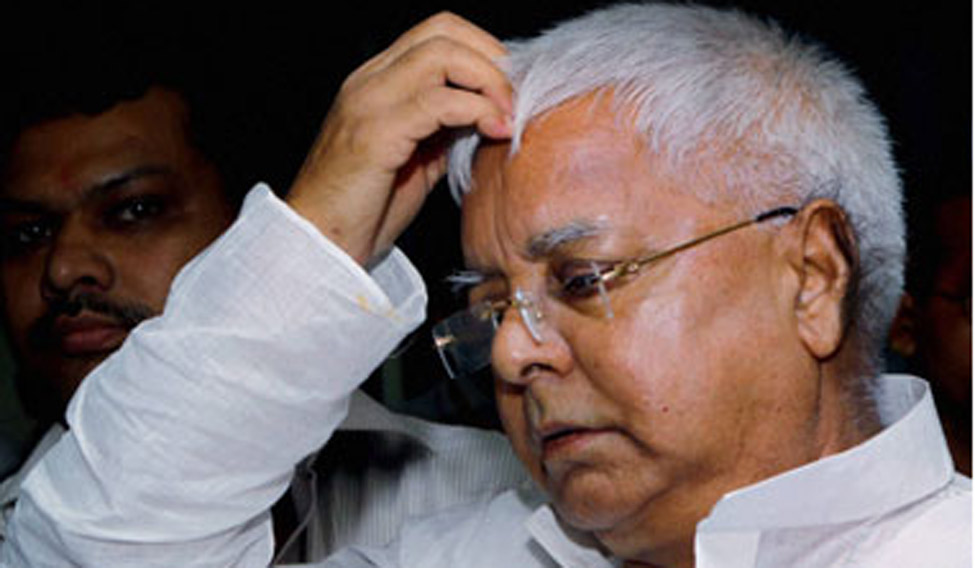
Lalu Yadav’s prison term has made breaking headlines but the case of fictitious livestock would not have reached its logical conclusion if a frail bureaucrat had not withstood the marauding powers of the former Bihar chief minister way back in 1991.
That was 26 years ago, almost three decades, Yadav was on a roller coaster ride in his impoverished state. Extremely powerful and lethal, he and his men could do anything and everything in the state. Like Phantom tales, there were rumours how he got trains shifted to the platform of his choice, kidnap people at random, his associates were notorious gunslingers.
Yadav was equally powerful at the Centre, an important ally in the shaky, 14-party coalition government headed by the soft-spoken, genial Inder Kumar Gujral. Yadav, who presented himself as a champion of low-caste groups, had even twice put his name forward for prime minister, losing each time but playing a key role in selecting the new leader.
Yadav was very, very powerful.
But none of it could browbeat Murari Nand Tiwary, the chief income tax commissioner of Bihar in the early 1990s who probed the $285 million scandal first, and kept the files opened for further investigations.
It was a bold decision.
Days before his death in Delhi on December 28, 2017, Tiwary, 83, had expressed his happiness as the Rashtriya Janata Dal head was finally convicted and sentenced. That, he told his family, is the power of an honest bureaucrat. It was almost like a chapter from Antony Chekov’s God Sees The Truth But Waits.
Weakened due to illness and old-age, Tiwary remembered how he and his men in 1992, led one of the first raids on those connected with the fodder scam across Bihar. “It was a daylight robbery, everything was fudged to steal cash, fake vouchers were issued to fill the books, scooters were shown as trucks ferrying the fodder,” he said, when recalling how powerful politicians like Lalu went on a rampage blinded with power as if there was no law of the land. As if the law will never catch up with him. .” Will truth in all its manifestations ever see the light of the day? How frightening it will be and what toll it will take, only future will tell.” He wrote in 2004 in his book,
The cash, reported to have been stolen over nearly 20 years, came from agricultural support programmes aimed mainly at helping the 350 million Indians who live in extreme poverty.
Tiwary investigated meticulously how politicians and senior officials in Bihar invented phantom livestock herds, then made fraudulent payments for fodder and medicine for the animals, as well as for artificial insemination equipment
In the latest judgement, Special CBI court judge S.S. Prasad convicted Yadav for fraudulent withdrawal of Rs 33.67 crore from Chaibasa treasury in 1992-1993. Former Bihar CM Jagannath Mishra was also found guilty and awarded a five year jail term for embezzling funds from the Chaibasa treasury. Both Lalu and Mishra were also fined Rs 5 lakh each by the Ranchi court.
The allegation is that fake allotment letters were used to withdraw Rs 33.67 crore instead of the state sanctioned amount of Rs 7.10 lakh. Yadav was first convicted in a fodder scam case in 2013 and was awarded five years' imprisonment. He faces another two scam cases for illegal withdrawal of Rs 3.97 crore from the Dumka Treasury and Rs 184 crore from the Doranda Treasury.
Tiwary’s own book, Travails of a Civil Servant, detailed the pressures he endured during his stay in Bihar, the tome even went for a first print run of 200 copies. But it was eventually pulled back from the printers by his family members for fear of reprisal from Yadav, considered among India’s ruthless politicians.
In the book, Tiwary documented the interactions he had with Yadav, and his powerful cabinet ministers. A few years after the scandal shook India, Tiwary retired from service and joined as a member of the Settlement Commission in Kolkata. But he told his successor not to bow down to the political powers and fight till last.
He had to live through troubled times, there were cops visiting his house saying they have orders from the CM to take the Income Tax Chief Commissioner to CM’s residence. .
Often, powerful-looking, armed men in open jeeps would keep a watch on the house. They were posted to instill fear in the minds of Tiwary and his family members.
Unfortunately nothing worked in favour of Yadav. Tiwary not only probed the fodder scam, even conducted several raids on hawala operators who ferried cash from one destination to other.
Yadav, so arrogant, did not even understood the importance of the case. Once he called Tiwary to his office and told him to arrest Pappu Yadav, another gangster turned politician. Tiwary asked for a written order, Yadav was shocked.
No one in Bihar defied Yadav, Tiwary did.
“Every effort is made to subjugate any officer known for his firmness and sully the reputation of those who are honest” Tiwary wrote in his book when reminiscing about his days as Chief Commissioner posted in Patna. “In fact so systematic and powerful and unsparing is the sweep of Mafia that it is a miracle that we still have some honest and tough officers in the country”
Tiwary was a man of words, a man of honour. Born in 1934 in the village of Daranagar in Bihar, he did his masters in English from Patna University. After teaching for a couple of years in the Ara Jain College, Tiwary joined the Indian Revenue Service in 1959 and had an exemplary career for 36 long years. His book Essential Hinduism received a commendation letter from then prime minister Atal Bihari Vajpayee.
Tiwary was weary of political corruption and scandal investigations that rarely result in convictions. An upright bureaucrat, Tiwary believed firmly that as far as it lays within his jurisdiction” no honest man will suffer and no dishonest man will prosper”. He wrote a strongly-worded letter to then President Shankar Dayal Sharma and resigned from the Settlement Commission in protest against the government’s reported move to curb the powers of then Chief Election Commissioner T.N. Seshan who was bringing about wide ranging electoral reforms. The President signed an ordinance equating the CEC with the ECs in violation of the constitutional provisions of Article 324(3) which makes the CEC Chairman of the multi-member Election Commission.
When an infuriated Sharma wrote back why Tiwary’s pension should not be stopped, the affable bureaucrat - now retired - wrote on May 2, 1996: “I am a very proud civil servant (even though retired). I will rather forgo my entire pension and live in abject penury than compromise on the right of the citizens to freedom of speech and expression earned for us by the martyrs and enshrined in Article 19 of the Constitution. But before you impose the penalty upon me Mr President please let it be known to all serving and retired civil servants that even their pension will depend upon singing praises of the Govt in power”
Tiwary was a man who believed that he must oppose that which is wrong, whether it is sought to be committed by a colleague, a subordinate or a superior.
His pension was restored, Tiwary lived and died in the glory of an honest bureaucrat.