


 Add as a preferred source on Google
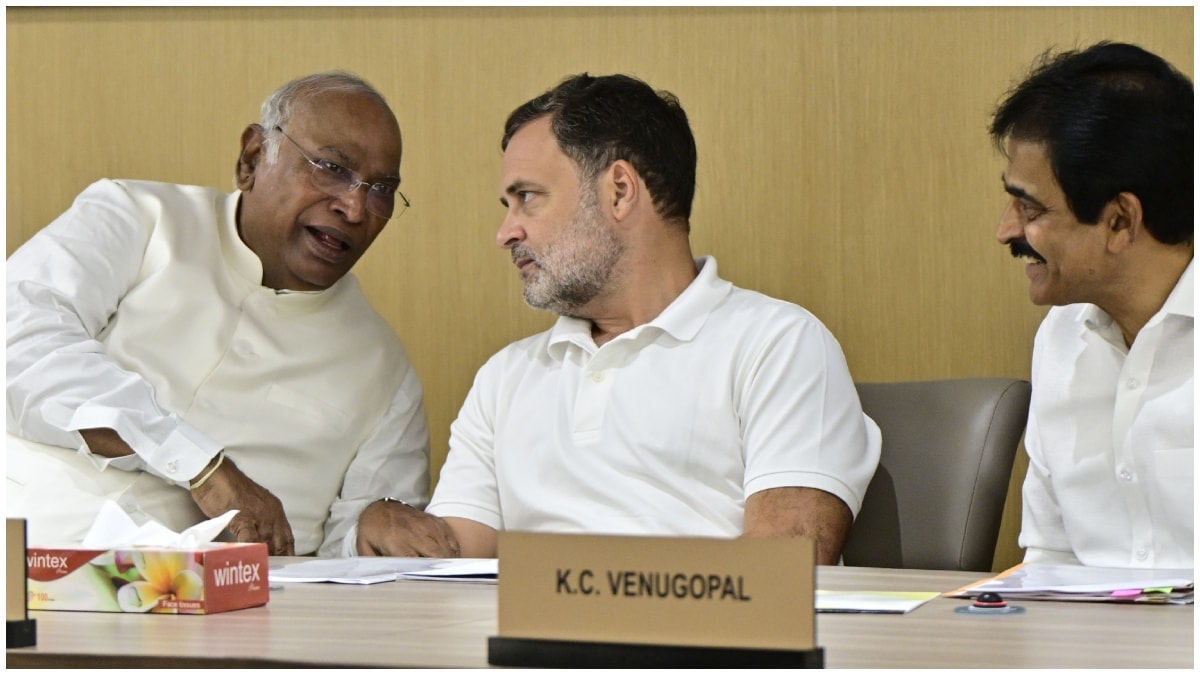
Floor leaders of INDIA bloc parties met at the residence of Congress president Mallikarjun Kharge in Delhi on Saturday to discuss a joint strategy in Parliament ahead of the special session beginning Monday.
Congress leader Rahul Gandhi, Trinamool Congress's Abhishek Banerjee, Independent Rajya Sabha MP Kapil Sibal, RJD leaders Abhay Kumar Singh and Manoj Jha, CPI's P. Sandosh Kumar, IUML's E.T. Mohammed Basheer and RSP's N.K. Premachandran were among those who attended the meeting.
Congress general secretaries Jairam Ramesh, Priyanka Gandhi Vadra and K.C. Venugopal were also present.
The meeting assumes significance amid indications that the government is preparing to introduce a fresh constitutional amendment Bill in Parliament to facilitate delimitation and the implementation of women's reservation.
Some non-INDIA bloc parties, including the DMK, AAP and BJD, chose to stay away despite being invited.
NCP(SP) working president Supriya Sule had said on Friday that she would skip the meeting owing to the illness of her father and party patriarch Sharad Pawar. However, her party's position on the proposed legislation has fuelled speculation about its possible support for the Bill in Parliament.
Meanwhile, the DMK on Saturday announced its support for the proposed legislation through a resolution. Senior party leader and MP A. Raja said the decision was taken following deliberations at a meeting of the party's parliamentarians chaired by DMK president M.K. Stalin in Chennai.
The proposed legislation seeks to increase the strength of the Lok Sabha and state Legislative Assemblies by 50 per cent to facilitate the immediate implementation of the women's reservation law. The strength of the Lok Sabha is proposed to rise from 550 to 850, while the maximum strength of state Legislative Assemblies would increase to 650.
Raising questions about the proposed expansion of the Lok Sabha, Kapil Sibal questioned whether a House with 850 members would be able to function effectively.
"Look, we need to examine this from the perspective of what is going to happen at the national level and what lies ahead. At the national level, if this Bill is passed, the number of Lok Sabha seats could increase to around 850. The first question is whether a House of 850 members can function properly," Sibal told reporters.
He also questioned the government's intent behind linking women's reservation with delimitation, arguing that the quota could be implemented immediately within the existing strength of the Lok Sabha.
"Their objective is not merely women's reservation. We are ready for women's reservation. They can implement it immediately within the existing 543 seats. So that is not their real objective. Their real objective is to remain in power for the next 30-40 years. And for that, what matters most to them is the Delimitation Bill," he said.
The Centre is set to introduce a fresh constitutional amendment Bill in the Lok Sabha on Monday to facilitate one-third reservation for women. The proposed framework envisages a 50 per cent increase in each state's and Union Territory's allocation of Lok Sabha seats, along with a corresponding increase in the strength of their Legislative Assemblies.
The revised seat allocations and constituency boundaries are also proposed to be frozen until 2051.
Specials
×
Search results for
What will be Opposition's strategy in Parliament? INDIA bloc leaders meet at Kharge's residence
The delimitation bill seeks to increase the strength of the Lok Sabha and state Legislative Assemblies by 50 per cent

Disclaimer: Comments posted here are the sole responsibility of the user and do not reflect the views of THE WEEK. Obscene or offensive remarks against any person, religion, community or nation are punishable under IT rules and may invite legal action.
