



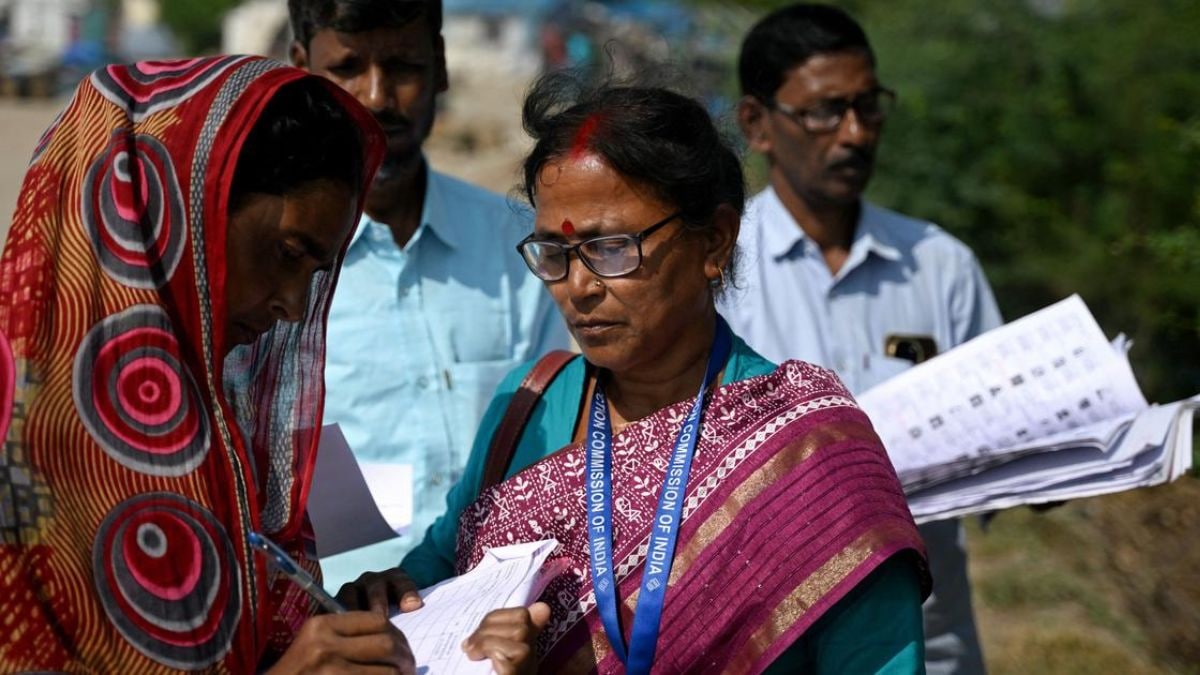
For an election authority that has traditionally relied on voters to establish their eligibility and complete enrolment formalities, the latest intervention marks an important administrative rethink. The Election Commission of India (ECI) is now asking its own field machinery to trace voters missing from draft electoral rolls, regenerate their enumeration forms, and facilitate their return.
The question, however, is whether this will translate into greater accountability for officials when procedural lapses result in the exclusion of eligible voters.
In a supplementary affidavit filed before the Supreme Court on November 14, the Commission has outlined additional mechanisms for electors left out of the draft rolls during the ongoing Special Intensive Revision (SIR). The measures go beyond providing another opportunity to apply. They seek to make electoral officials active participants in identifying and reaching out to voters who may have been excluded because of missed forms, incorrect classification, or communication gaps.
The move comes amid concerns over voters categorised as Absent, Shifted, Dead, or Duplicate (ASDD), and those who could not submit enumeration forms within the prescribed period. While the stated objective of the SIR is to improve the accuracy of electoral rolls by removing ineligible and duplicate entries, the exercise has raised a parallel concern: how can the Commission ensure that genuine voters are not lost in the process?
The Supreme Court's intervention brought this issue into sharper focus. During proceedings on October 28, the court asked the Commission to explore ways of reaching out to people whose names were missing from the draft rolls. The ECI subsequently issued instructions on November 6 to Chief Electoral Officers in seven states and Union Territories where the exercise is underway.
The latest affidavit provides a framework for implementing these corrective measures.
Under the new arrangement, voters who have not shifted residence but failed to submit their enumeration forms can submit a fresh, signed form along with Annexure B, explaining why they could not submit it earlier. They can approach the Electoral Registration Officer (ERO), Assistant Electoral Registration Officer (AERO), or Booth Level Officer (BLO), either personally or through a family member. An online submission facility, including electronic signatures through the ECINET platform, is also available.
For those who have shifted within the same state, the Commission has provided a separate route. They can submit an enumeration form with Annexure C, specifying their new address and Assembly constituency, along with address proof. They need not follow the usual Form 8 procedure for shifting their registration.
But the more significant change is the responsibility being placed on the electoral machinery itself. Partially filled enumeration forms are to be regenerated on the ECINET dashboard. BLOs have been asked to contact affected electors and deliver forms through physical visits, WhatsApp, email, and SMS wherever contact details are available.
They must also undertake house-to-house enquiries and make efforts to trace voters through neighbours, family members, resident welfare associations, and Booth Level Agents of political parties.
The booth-wise lists of voters classified as ASDD are also to be displayed at polling stations and local administrative offices, and uploaded on the websites of Chief Electoral Officers. This is intended to make exclusions more transparent and allow affected citizens to understand why their names have not appeared in the draft rolls.
The distinction is important. In an exercise where the immediate responsibility for responding to an omission often rests with the elector, the ECI is now asking officials to identify omissions and facilitate corrections. This does not mean that the legal requirement to establish eligibility has shifted entirely from voters to officials. Applicants must still submit prescribed forms and satisfy the relevant legal requirements. What has changed is the emphasis on administrative outreach.
The Form 6 controversy highlights another difficulty. Form 6 is ordinarily used by first-time applicants seeking inclusion in electoral rolls. Its declaration created apprehension among previously registered voters whose names disappeared during the SIR. They feared that submitting the form again could expose them to prosecution under Section 31 of the Representation of the People Act, 1950, for making a false declaration.
The ECI has now clarified that no prosecution will be initiated merely because an applicant had figured in an earlier electoral roll and subsequently submitted Form 6 to seek inclusion during or after the SIR. Those who have already submitted Form 6 need not file a fresh enumeration form. The clarification removes an important source of anxiety for voters seeking re-entry.
The Commission has also provided that once an excluded elector's application is accepted, the original Electors Photo Identity Card (EPIC) number will be reassigned. This ensures continuity in electoral identification rather than treating such voters as entirely new entrants.
The Supreme Court's continuing scrutiny could also become important in assessing whether the safeguards are translating into actual inclusion. The Commission may need to demonstrate not just that additional facilities have been created, but that eligible voters are benefiting from them.
