



In diplomacy, what matters is rarely what meets the eye.
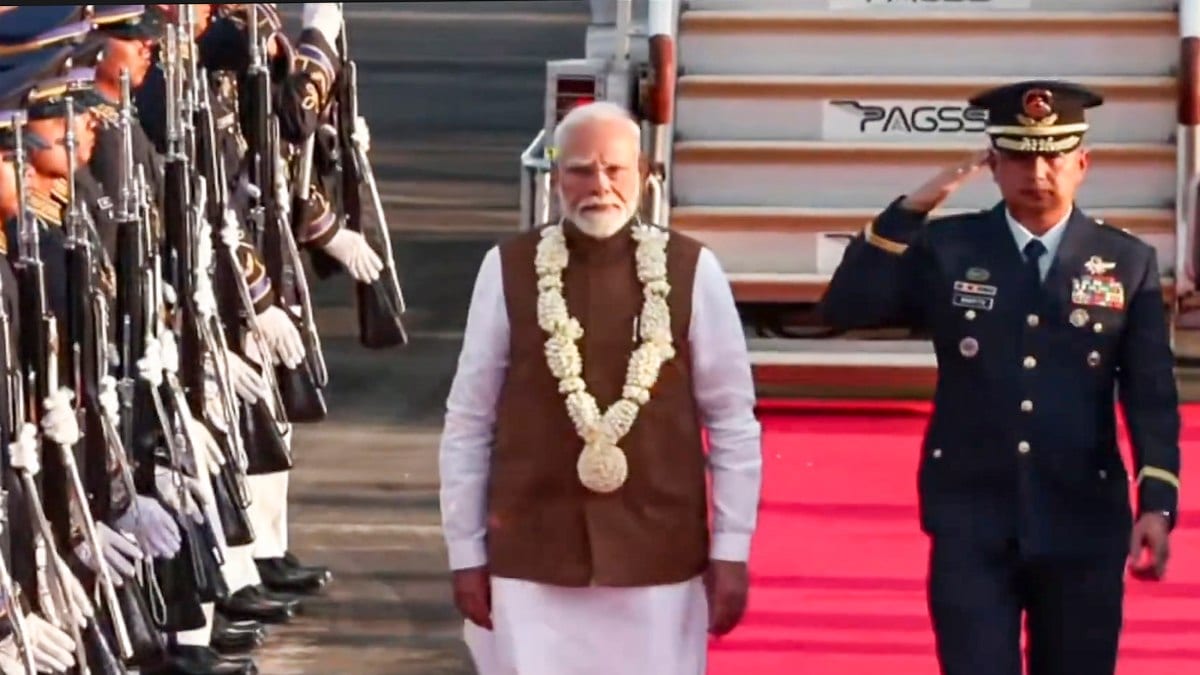
Prime Minister Narendra Modi’s visit to Manila is officially about ASEAN. From New Delhi's point of view, the real action will be on the sidelines.
On Tuesday evening, Modi will join US President Donald Trump, Japanese Prime Minister Sanae Takaichi and Australian Prime Minister Anthony Albanese for the first Quad leaders’ meeting in more than two years.
It will also be the first Quad summit held in a non-Quad country — a telling detail. India, as chair, was supposed to host it. It could not, largely because Trump would not travel to New Delhi.
The meeting comes amid deep uncertainty about the Quad’s future under Trump 2.0.
A recent report that described the grouping as being on “life support” drew a swift rebuttal from Dylan Johnson, the US Assistant Secretary of State, who called it “fake news” and listed the ministerial and working-level meetings held in the last two years. Work is now on to formalise the Manila meet, he said.
A second, more persistent charge is that the Quad has become a vehicle for preserving American primacy, at the expense of the other three members.
Those apprehensions are inevitable as long as the Quad is understood — however much its members deny it — as an anti-China platform.
That is why what happens after Manila matters as much as Manila itself. On Thursday, Trump is scheduled to meet Chinese President Xi Jinping and Russian President Vladimir Putin in Shenzhen, on the sidelines of the APEC summit, for the first-ever G-3 meeting.
On paper, Manila will cover the usual Quad menu: maritime security, critical and emerging technologies, climate, health, economic security, infrastructure and connectivity.
What is not on paper will tell India whether it is a priority for Washington, or merely a partner.
First, the India-US reset. New Delhi will be watching whether Manila offers a chance to reset ties with the US that have been clouded by months of discord — prolonged trade and tariff negotiations, visa curbs, deportations, and growing American proximity to Pakistan’s military establishment.
A warm sideline conversation, a joint statement that acknowledges India’s concerns, or even a commitment to a future bilateral visit would signal that the US still sees India as central. A perfunctory handshake before Trump flies to Shenzhen would signal the opposite.
Second, the geography. Will the language of the Quad Foreign Ministers’ meeting in Atlanta on October 31 survive? That meeting, for the first time, singled out the Strait of Hormuz, the Red Sea and Bab el-Mandeb, and called for protecting navigation and crew safety.
These are the geographies that matter most to India. This is the primary route for India’s energy security. It is here — in Hormuz, in the Sea of Oman, in the Black Sea — that Indian seafarers have been killed in attacks linked to the wars in Iran and Ukraine.
Traditionally, the Quad has looked east, to the South China Sea and the Western Pacific. Atlanta suggested it was finally looking west, to where India’s oil, trade and lives are at stake.
If Manila reaffirms that westward shift, India gains. If it reverts to a Pacific-only agenda, Delhi will have to secure the western Indian Ocean alone.
Third, the state-controlled Chinese media have already urged India to exercise its strategic autonomy and not derail the slow improvement in India-China ties. For India, which has always insisted the Quad is not China-centric, the balancing act gets harder with every Quad statement.
New Delhi will want language on principles — UNCLOS, freedom of navigation, rule of law — not language that names China. Canberra and Tokyo will want something sharper. The wording of the joint statement will be parsed in Beijing, line by line.
Fourth, prestige. Despite being chair since 2023, India has not managed to host a Quad leaders’ summit. A successful Manila summit would allow New Delhi to claim it revived the grouping as chair, despite the odds.
A failed one would reinforce a harsher narrative: that India could not host, could not deliver, and that the Quad only works when it piggybacks on ASEAN.
Manila, in short, is not about ASEAN. It is about whether, two days before Trump sits down with Xi and Putin, India can lock in a Quad that works for India — on trade, on maritime security in the West, and on critical minerals — and prove that it is still a priority, not just a partner.
