



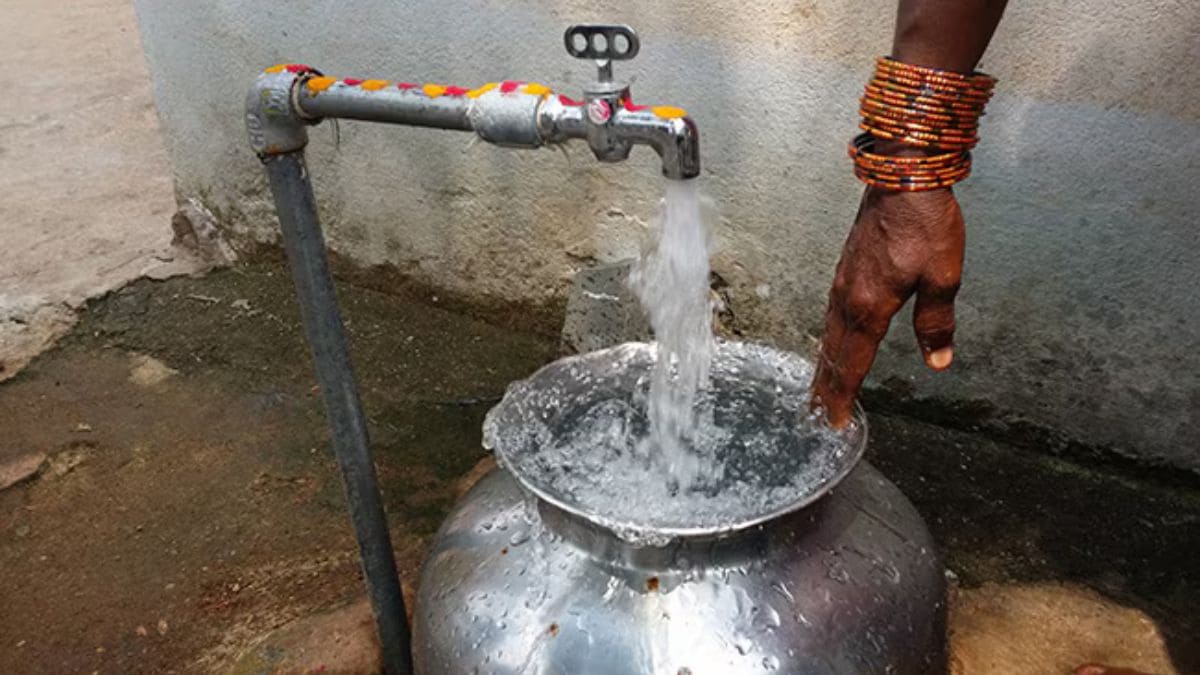
In 1776, Adam Smith observed that nothing is more useful than water, and yet it "will purchase scarce anything" (and diamond, while completely useless, is worth a fortune). Goa has spent the past few decades proving him right with admirable consistency.
The monsoon gives the state roughly 11,000 million cubic metres of rain a year; we deliver about 230 million of them to our taps. Supply of about 630 MLD falls short of demand by 50 to 65 MLD—a gap that has launched a thousand press releases.
The Drinking Water Minister, to his credit, has said publicly that about 40 per cent of the water we treat is never billed. On 630 MLD, that is roughly 250 MLD, or four times the shortfall. Goa is not short of water. It is short of a container without holes.
None of what follows is rocket science. Most of it would be familiar to any student of water management, and to many engineers who have served Goa well. That is rather the point.
Begin with the pipes. Much of what lies under our roads was laid decades ago, for a smaller and more patient Goa, and has been patched, rather than renewed, ever since. Old pipes leak, and they burst more readily when water arrives for a few hours and then stops, as it does across much of the state.
The CAG put unaccounted water at about 35 per cent in 2012–13; it is higher now. A smart-metering pilot in Panaji cut losses from 38 to 15 per cent and then, in the finest Goan tradition, remained a pilot.
Nor do we really have a network—whatever the maps call it. A network has loops, so that water can reach a town by more than one route when a main fails. Ours is closer to a set of long, lonely lines running out from a handful of treatment plants. When one main needed repair this summer, much of South Goa went dry for two days. That is not resilience; it is a single point of failure with a press office.
What once cushioned such failures has quietly disappeared. Service reservoirs are too small for the towns that have grown around them, and the wells and village tanks that once kept water close at hand have been filled, polluted or forgotten. So a burst main is no longer an inconvenience but an emergency, and the emergency is met by a tanker.
That brings us to price. Piped water costs ₹40-60 a kilolitre to produce; the first domestic slab, as last reported, is a few rupees.
A 2025 Boston Consulting Group study, What Is Water Really Worth?, finds that tariffs typically recover only about a fifth of water's full cost, so Goa is hardly alone, merely enthusiastic: for a while we made the first 16,000 litres a month free, then quietly un-made it.
Meanwhile villages buy tanker water at ₹120-250 a kilolitre. Goans already pay handsomely for water; they simply pay the tanker rather than the pipe. And because every litre is sold below cost, the villa with a pool, using some 3,500 litres a day against 700 in a traditional home, collects the largest subsidy. We have, in effect, built a welfare scheme for swimming pools.
If all this is so familiar, why does so little change? Partly because water is run by a department rather than a utility: revenue flows to the treasury, not the pipes, and nobody is rewarded for losing less.
Partly because the price is politics, and governments of every colour find it easier to promise free water than reliable water. Partly because responsibility is scattered across offices, and the tanker trade fills the gaps between them, profitably. And partly because concrete is more photogenic than maintenance: a new plant gets a ribbon; a replaced pipe does not.
Hence the enthusiasm for big new sources. Some of it is deserved. The 150 million cubic metres sitting in old mining pits are a genuine strategic reserve, and the mining companies that dug them are well-placed—with the right public framework—to help turn a liability into an asset. But a reserve is for dry years, not for leaky pipes. The cheapest new litre is still the one we stop losing; it has already been treated and pumped.
The remedies are as unglamorous as the problem. Make the Department of Drinking Water a ring-fenced utility with a professional head and published targets, reporting losses, hours of supply and water quality, ward by ward, every month.
Tie every new treatment plant to a verified cut in losses. Develop the mining pits as a drought reserve in partnership with their owners, once surveys of quality and stability are done. Replace the oldest pipes first. Link the separate systems into loops, rebuild local storage so every town holds a day or two of supply, and meter the network zone-by-zone so leaks are found in days rather than seasons.
Protect a lifeline for households and charge the full cost above it. Make treated sewage the default for gardens and construction, and register borewells and tankers, so the aquifer stops being free to whoever pumps it.
Nor is this mere theory. Portugal faced a version of our problem in 1993. It did not privatise; it corporatised, creating the state-owned Águas de Portugal and an independent regulator that publishes every operator's results.
Wastewater services, which then reached fewer than three in ten citizens, now reach about nine in ten. Portugal still loses a quarter of its water, mostly in the municipal pipes it never reformed. The lesson: what you professionalise gets fixed, and what you leave to politics keeps leaking.
Our forefathers ran the khazans for centuries through village associations that tended the sluice gates and shared the costs. Goa practised accountable water management long before the consultants arrived. We need only remember it. The monsoon keeps its promise to Goa every year. It is time we kept ours.
The author is the former Managing Director and Senior Partner of the Boston Consulting Group.
The opinions expressed in this article are those of the author and do not purport to reflect the opinions or views of THE WEEK.
