



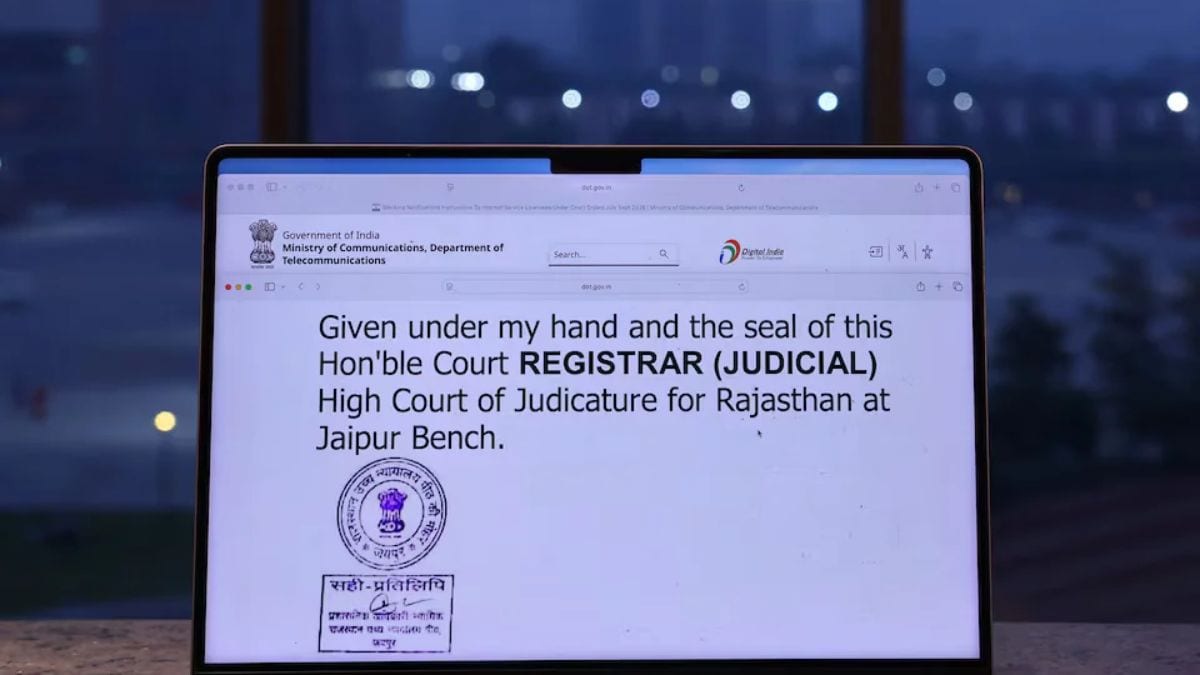
Prime Minister Narendra Modi's office on Saturday summoned Telecom Secretary Amit Agrawal after more than 100 websites were taken down based on fake court orders.
Agrawal will now have to cut short his trip to another state to explain how allegedly AI-generated court orders led to the takedown of as many as 129 illegal betting websites, a Reuters report said, citing two government officials.
However, the report did not offer finer details on how exactly the court orders were fabricated, and how much (if any) AI was used in the process.
Notably, the concern here isn't the crackdown on the online betting websites—as they are already illegal in India—but rather the lack of safeguards in the country's content-takedown system that could lead to fake court documents being used to bring down legitimate websites.

The shocking case of website takedowns, which comes after the agency earlier flagged two court orders dated July 21 and September 2, have now opened a criminal probe into potential forgery and cheating.
The fake orders—from the Allahabad High Court and the Rajasthan High Court—bore blue court seals and a fake QR code, and were also published on the court websites, making them seem genuine.
Both courts have also called the orders "fake" and "fraudulent", though no arrests have been made in the false-order cases till now. Both orders had also been available on the telecom department's website for months, after which as of Saturday, only one had been taken down.
This comes just months after the Supreme Court in July flagged two insolvency tribunals—the National Company Law Tribunal (NCLT) and the National Company Law Appellate Tribunal (NCLAT)—for citing judgments that simply did not exist.
Thought to be the result of AI hallucinations, the non-existent precedents had then raised fresh questions about the growing use of generative AI in legal practice, especially to summarise lengthy judgments, draft pleadings, and to speed up legal research.
ALSO READ | Can AI be trusted in court? Supreme Court's warning opens debate on regulating legal AI
It also raised questions of who should be held accountable for such errors: the lawyer who used the tool, the judge who relied on the research, the tribunal that reproduced it, or the technology company that built the AI model?
Lexlegis AI founder Saakar Yadav had told THE WEEK at the time that the answer lay in recognising the limits of general-purpose AI systems, and that human involvement was still a necessity.
“Every court, law firm, and regulator regardless of jurisdiction, is vulnerable when legal research is entrusted to systems that optimise for plausibility rather than truth. The future of legal AI will not be defined by larger models alone, but by verified legal corpora that keep reasoning grounded in authentic sources of law. In legal practice, there is no room for educated guesses,” Yadav had said.
The key takeaway from the gray questions that the July cases posed, is the absence of a formal framework governing AI use in Indian courts, in line with countries like the US, Canada, Australia, and the UK.
