



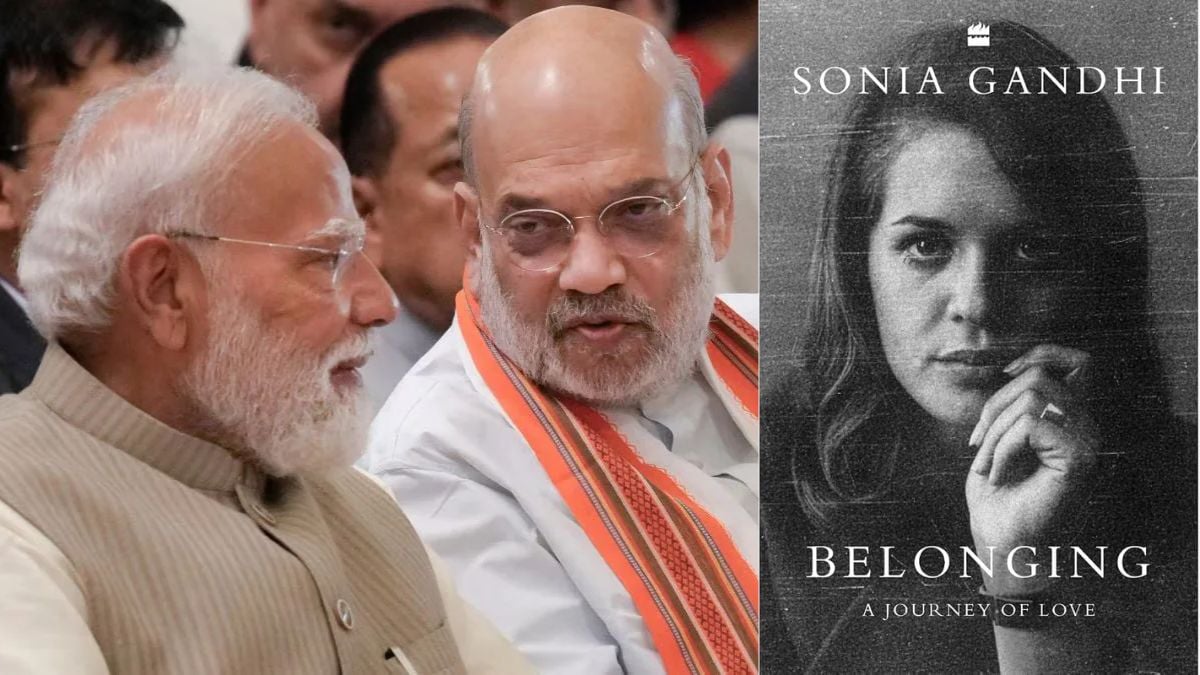
In her memoir, Belonging, Sonia Gandhi mounts a strong attack on the BJP and RSS, accusing them of putting India's democracy at risk. Yet she remains confident that the country will resist their attempts to change its character.
In the 12 years since Prime Minister Narendra Modi came to power, Sonia says she has had very limited and formal interactions with him. Their differences, she writes, are ideological and not personal.
Her concerns, she says, began well before Modi came to power. She entered politics because she feared that the BJP, driven by the RSS and its network of organisations, would create divisions between communities and weaken the Constitution. The same concerns influenced her decision in 2004 to decline the post of prime minister. She writes that the BJP would have turned her foreign origin into a political issue, which could have created instability.
Her memoir, released on November 10, has generated curiosity as it covers some of the most turbulent periods in India's political history, which she witnessed and in which she played a key role. A reluctant politician who turned down the post of prime minister and has remained reticent in her public statements, Sonia has also written about her personal life. She writes warmly about those who supported her. Her account begins with her meeting Rajiv Gandhi in Cambridge when she was 19 and he was 21, bringing to light some little-known details of her younger years. Later pages and chapters are filled with detailed accounts of last decades since her arrival in India. Her version of events and conversations are likely to spark further debate, and also serve as valuable document on country's political history.
In fact, the two photographs used on the cover and back cover sum up the six-decade journey captured in the book's more than 500 pages: a black-and-white photograph of Sonia in her teens and a recent photograph on the back cover.
It is her views on the BJP and Modi that are expected to generate political heat in the coming days.
Her account of her personal journey is rich in detail. She describes scenes and even recalls thoughts in her mind, including the one she had on the night before announcing her decision to decline the post of prime minister.
Her views on the BJP are more direct and political. She attributes the Congress defeat in 2014 to public fatigue and an unfavourable political climate. The UPA government, she writes, had become tired and failed to communicate its achievements. Businesses were unhappy with what they described as "policy paralysis", while much of the media also favoured the opposition.
She maintains that several corruption allegations against the UPA were later found to be baseless. Some officials who prepared exaggerated reports, she adds, were subsequently rewarded by the BJP.
She also recalls the Anna Hazare movement of 2012. According to her, some of its prominent figures have since acknowledged that the movement received quiet support from the BJP and RSS. She notes that after the UPA government lost power, the campaign lost momentum. The Lokpal law passed by her government, she argues, has also lost its importance under the BJP.
On Modi's rise, Gandhi describes how the RSS prepared the ground for his political success. She recalls large hoardings, hologram campaigns and teams of young people managing social media. The source of the money spent on the campaign, she says, remained unclear. With the support of influential media owners and his ability as a public speaker, Modi persuaded many voters that he could deliver the change they wanted.
Interactions with Modi
Her description of her relationship with Modi is equally revealing. More than 12 years into his rule, she says, they have had almost no meaningful interaction. They occasionally meet at formal gatherings, including meetings in the Speaker's chamber at the end of Parliament sessions. Their exchanges are limited to a formal namaste. She says this is different from the political culture of earlier years, when leaders across party lines maintained cordial relations. Modi, she writes, often avoids eye contact.
Their conversations, when they happen, are brief and polite. After her hospital stays, Modi has occasionally asked about her health. She has thanked him and said she is recovering. Apart from such exchanges and formal birthday and New Year greetings, they have rarely spoken.
Gandhi says their differences are not personal but ideological. Her understanding of India, shaped by her family, is based on liberty and equal respect for all religions and cultures. Modi's worldview, she argues, has been shaped by RSS thinkers and places greater emphasis on religion, cultural identity, hierarchy and control.
Her strongest criticism concerns the way Modi governs. She cites the 2016 demonetisation exercise as an example of his centralised and authoritarian approach. She argues that it failed to achieve its stated objectives, disrupted businesses and caused hardship to millions. The introduction of GST, she says, added to the economic difficulties. She also points to the growing gap between the rich and poor.
In her assessment, the forces supporting Modi are weakening the institutions and principles that have held India together for nearly eight decades. She describes them as "an authoritarian force bent upon changing the very nature of our country."
Rahul and Priyanka's political fight
The Congress's political battle, she writes, has also become personal for her family. Her son Rahul and daughter Priyanka are now at the centre of what she sees as a struggle over the future of Indian democracy. Rahul has taken over her former constituency of Rae Bareli. She recalls being worried about his entry into politics, particularly during his long padayatras across the country. She now has similar concerns about Priyanka.
Having lost her mother-in-law, Indira Gandhi, and her husband, Rajiv Gandhi, she says she understands the risks involved in political life. She describes her opponents as ruthless and unprincipled, accusing them of using religion to advance a right-wing agenda. As their ideology has gained influence, she writes, their politics has become more aggressive.
Yet the book does not end on a pessimistic note. Gandhi argues official claims are increasingly losing credibility. People facing rising prices, unemployment and corruption are becoming more willing to question the government. In her view, the misuse of power eventually leads to its own decline.
