



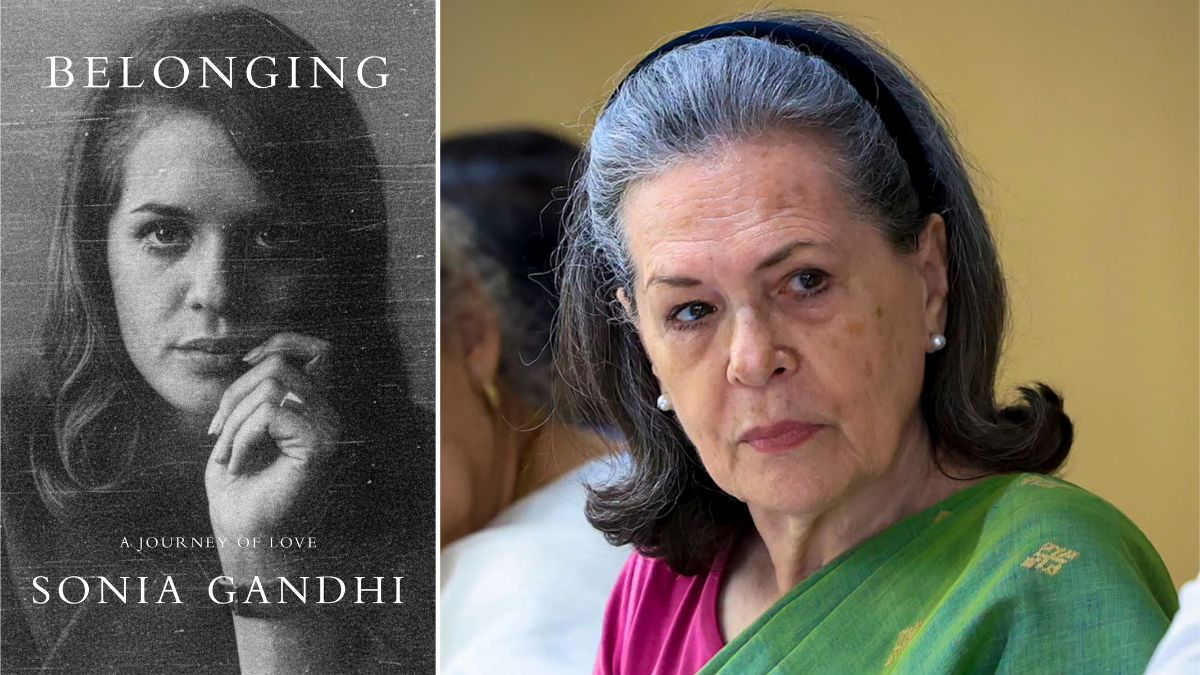
Congress Parliamentary Party chairperson Sonia Gandhi revealed in her memoir that the Prime Minister's post was never her personal ambition or goal. She chose Manmohan Singh to lead the country in 2004, believing he had "unquestionable" integrity and a deep understanding of governance.
Gandhi gives an insight into the PM post-decision during the UPA era in her newly released memoir, 'Belonging: A Journey of Love'. She also recalls the time when Congress leader Pranab Mukherjee hinted at his "long-held desire" to become the PM.
In her memoir, Sonia Gandhi framed her political rivalry with PM Modi not as a personal feud, but as a clash between two fundamentally different worldviews. She also says that he had not given her eye-contact unlike the past leaders.
"He fought for his vision of India, I fought for mine... We come from different ideological worlds; his idea of this country is vastly different from mine. All I learnt about India was assimilated from the members of my family, their lives of service, and their faith in a nation that encompassed a host of races and cultures, languages and faiths... [His idea of India] was constructed by the ideologues of the RSS and the experience of his own growing up," she says.
"To this day, I've had practically no real contact with him. We meet at semi-official gatherings... When he comes face-to-face with me, we greet each other with a formal namaste. This is different from the past, when leaders across party divides would treat one another with cordiality. He tends to look away, avoiding eye contact," she says about PM Modi's demeanour and personal interactions.
5 top quotes from the memoir:
1. "There were several senior colleagues, seasoned and qualified for the post, who would have been more than willing to accept it but amongst all of them was one who had long been in my sight as a person above reproach, and possessed a deep and consummate understanding of governance. That was Dr Manmohan Singh, a member of the Congress Working Committee," Gandhi says in the book.
"He was not allied to any camp in the party. Over a period of time, the Congress had been painted as being left of centre, and our government would now be supported by the Communist parties as well. I thought Dr Manmohan Singh would assuage the doubts of many about our ability to manage and continue the policies that had been begun years ago," she says, elaborating the reason why she chose Dr Singh.
2. "What I found most alarming was my mother-in-law's occasional explosions of temper. They could freeze the staff into numbness. On one occasion, a member of the staff who had forgotten to remind her of an important appointment, and not for the first time, was made to stand in a corner of the room while others hurriedly passed by, all feeling rather embarrassed," she says about Indira Gandhi's temper.
3. While pointing out the separation of powers between the party and government, Gandhi also narrates an anecdote of how Pranab Mukherjee once hinted at his desire to be PM.
"A core group met weekly with the prime minister to ensure coordination between the two. Its other members were Pranab Mukherjee, who had been a minister in Indira Gandhi's cabinet in the 70s; the politically insightful Arjun Singh, a former chief minister of Madhya Pradesh; A. K. Anthony, a former chief minister of Kerala; and Ahmed Patel.
4. "Though I had been the subject of worse accusations over the years, the fabrication that distressed me most was that I was looking into official files for something improper for anyone outside the government. I had always been particular about adhering to rules, all the more so during this period," she says.
5. "Under the leadership of former PM Manmohan Singh, the economy flourished... And today, the Modi government is weakening these policies. People have begun to realise that the promises made by the BJP in 2014 were hollow," she says on PM Modi's economic policies.
The 544-page book, published by HarperCollins India, covers the arc of Gandhi's remarkable life -- her childhood in post-war Italy, her marriage into the Nehru-Gandhi family, the assassination of her husband Rajiv Gandhi and her entry into politics.
