



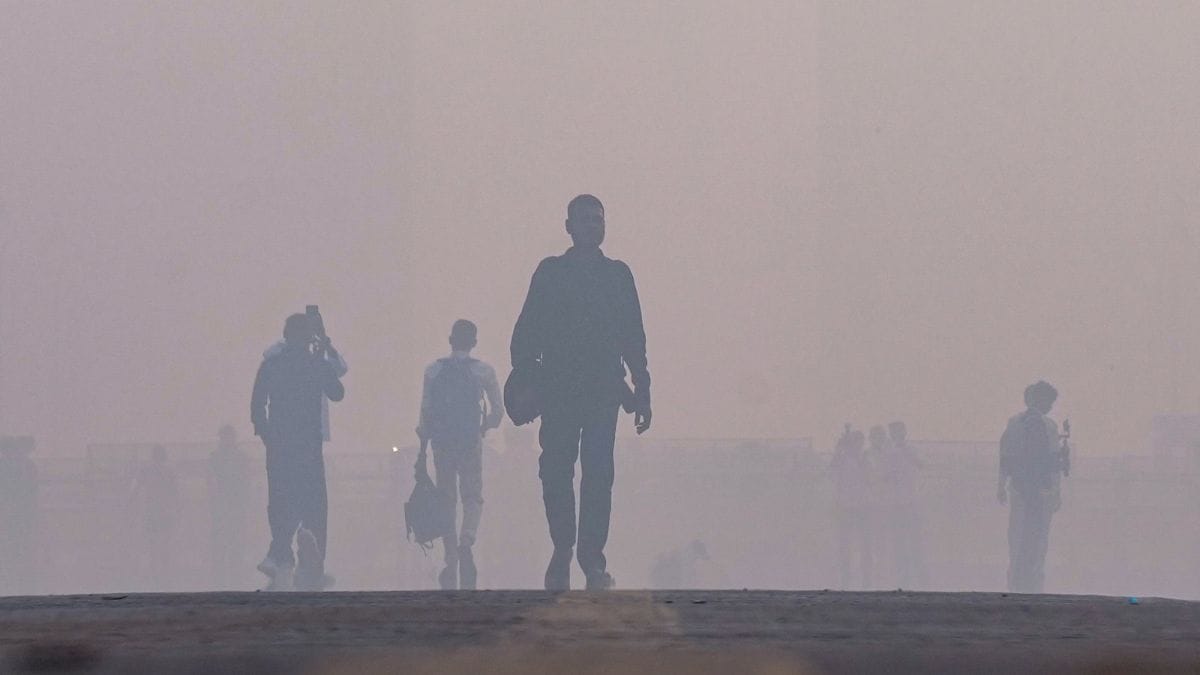
Nearly a day after Air Quality Index (AQI) levels went missing in many areas on Diwali night (Sunday), the Delhi Pollution Control Committee (DPCC) released the data on Monday.
This comes after 36 of the total 59 air quality stations in the national capital, as per Central Pollution Control Board (CPCB) records, went dark overnight into Monday, which led to the Aam Aadmi Party (AAP) claiming that the ruling BJP government had engaged in "AQI data fraud".
“There were some technical glitches (in the air quality monitors), but all our 43 stations are giving data," a Hindustan Times report said, citing a government official.
The shocking new data now shows that PM2.5—the fine particles that come from vehicle emissions, firecracker smoke, and stubble burning—levels had spiked up to 3,744 micrograms per cubic metre (µg/m³), which is more than 60 times the national standard of 60 every 24 hours, the report added.
Mundka saw the highest reading of 3,744 µg/m³ at 2 AM, JNU saw 3,023µg/m³ just two hours later, while NSUT’s West Campus reached 3,008µg/m³ an hour after that.
Mandir Marg, Nehru Nagar, and Wazirpur were among 11 other DPCC stations where AQI levels spiked dangerously past 2,000. In fact, not a single station's PM2.5 level for those missing hours dropped below 1,000, reflecting the severity of the crisis.
How do PM2.5 levels factor into an overall AQI reading for an area? This pollutant's sub-index (a type of numerical score relative to its air quality standard) is compared with many others, after which the worst sub-index figure becomes the AQI for that particular region.
Since India's AQI scale will only show a maximum of 500 even if pollution levels cross about 420µg/m³, this puts the CPCB's official Diwali-night AQI reading of 370—which anyway risks crossing over the 'severe' level—into question.
AQI levels also reached new heights when the case of the missing AQI data turned political, with AAP president Saurabh Bharadwaj claiming that it had crossed 3,000.
"The government's data is based on fraud. We showed how monitoring stations were shut down, and how 20 new AQI stations were installed in remote, lush green areas of Delhi. Water is being sprinkled directly over the monitoring stations in polluted spots to manipulate the readings," he told ANI, urging people not to trust the official data.
The BJP, however, responded with claims that the AQI crisis was due to a “well-thought-out conspiracy” to spike up pollution levels in Delhi during Diwali by encouraging stubble burning in Punjab, where the party is in power.
BJP MP Praveen Khandelwal alleged that the AAP had orchestrated a “well-thought-out conspiracy” to keep pollution levels in the national capital high during Diwali by encouraging stubble burning in Punjab, where the party is in power.
"Punjab decided to burn stubble vigorously so that Delhi remains polluted on Diwali and they can blame us for it,” he told ANI.
Delhi minister Kapil Mishra had also raised similar allegations, pointing out that Punjab had reported 1,200 stubble-burning incidents on Sunday. His comments also came after other reports showed more than 3,000 such cases reported in Punjab between September 15 and November 6.
