



Placards, speeches, and conversations formed the backdrop to the ‘Jantar Mantar @ Kochi’, where participants gathered over concerns surrounding the Special Intensive Revision (SIR) of electoral rolls and the demand for the resignation of incumbent CEC Gyanesh Kumar. Beyond the central demand of the campaign, the gathering reflected the different reasons people had for taking part.
Throughout the event, one allegorical display continued to move through the audience. An actor portraying Chief Election Commissioner Gyanesh Kumar behaved like a dog leashed to a demonic-faced figure, a representative of the "fascism" that has supposedly taken over the nation.
The event convenor, N.S. Madhavan, stressed the need for an anti-BJP movement. Other speakers highlighted targeted voter deletions and human rights violations. AISF President Viraaj Devang’s line, “Hum pagal nahi, hum maha pagal hain”, resonated with the masses. He claimed that the Indian government is sending batches of IPS personnel to Israel for training so that they can return and treat protesting Indian citizens the way Palestinians are handled by Tel Aviv.
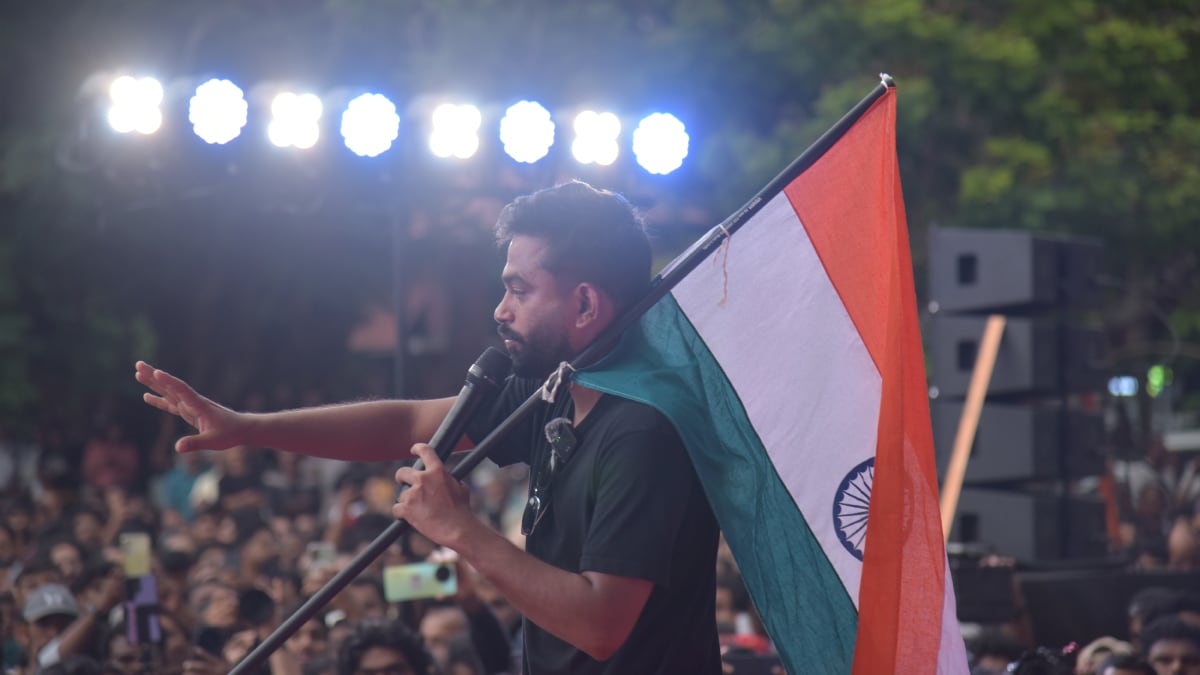
CJP founder Abhijeet Dipke chose to start his speech by raising the tricolour, calling it a unifying force that was now being used as a weapon of division by the ruling party at the Centre. Dipke further stated that Gandhi, Nehru, and Ambedkar are the soul, mind, and backbone of India respectively.
With so many issues at the forefront, it was obvious that for participants, this protest meant different problems being addressed and different outcomes expected. For Shalini, the protest was more than about the SIR of voter rolls; it was a question of democracy and whether the political system would endure over time, stating that youth involvement was imperative to ensure that democracy sustains itself.
Ziya, a first-year law student, claims that the SIR is just one among a host of problems the country faces. She says the SIR and the role of the CEC were the breaking point for Gen Z’s frustration stemming from other issues such as unemployment, and, more importantly, that citizens’ constitutional rights are being violated.
The audience was not a mere collection of Gen Z protestors, but comprised people of all ages and from all walks of life.
A 73-year-old native of Kadakkal (Kollam, Kerala), Shashikumar, says the nation is facing unfavourable circumstances and that he had always wished for change in recent years. He finds refuge in the youth’s ability to assimilate and comprehend information, and relief in the way they swiftly act upon that very information.
And then, there were the affected parties, looking for a way to reclaim their constitutional right to vote.
Salma, a Muslim protestor, claims that she was surprised to find herself on the protest grounds here at Rajendra Maidan, but her family’s plight—wherein four of six members were deleted from the voter rolls—forced her to come. She says it is a proud moment to identify as an Indian, but when some in power look down upon and discriminate against them, it increases the uncertainty of being recognised as an equal citizen. For Salma, the protest is not only about the SIR, but also about how her religion is determining her status and voting rights as an Indian citizen.
Migrant workers, native to states such as Gujarat, West Bengal, and Bihar, also made sure to mark their attendance at the event.
Speaking to Rashid, a daily-wage worker from Gujarat, he says that Prime Minister Modi has caused significant damage to the harmony and democratic fabric of the nation ever since the 2002 riots. As a daily-wage worker in this economy, he states that he does not have the time or money to keep visiting offices and producing documents if his name is removed from the voter list. When asked why he showed up to the protest, he says: "We already struggle to make ends meet; now we are worried about whether we will even have the right to participate in a democracy. That is why I have come here today."
For someone who is probably the youngest active protester on site, young Ayaan from the fourth grade brings a lighter perspective. The young lad managed to run past the tightly packed stands to scream at the top of his voice and get Dipke’s attention—in which he actually succeeded! When asked where he places himself in the protest, he claims: "We are the future of India, of course I should be here!"
While some joined in to get a better understanding and general awareness of the problem at hand, others joined in to express solidarity, embracing a Gandhian–Gen Z fusion approach—without anger and violence, and with humour and wit.
Why was Keralam chosen for the protest this time? As Dipke and many other speakers addressed, choosing Kochi or Keralam is not just about extending the reach of the movement, but about appreciating the state’s literacy, civic sense, and mutual respect for all parties. Starting in God’s Own Country, the CJP founder aims to create many more Jantar Mantars across India, stating that it is impossible to denotify all of them.
However, one fear looms over everyone: what safeguards are there for protestors, especially with allegations of facial recognition scans, invasion of privacy, unreasonable use of force, and unjust jail time by the three pillars of democracy?
The gathering at Rajendra Maidan may last only a few hours, but the questions surrounding electoral participation, voter inclusion, and institutional accountability are unlikely to end with it. Whether Kochi becomes another stop in a continuing movement or remains a one-day mobilisation is something only the days ahead will reveal.
