



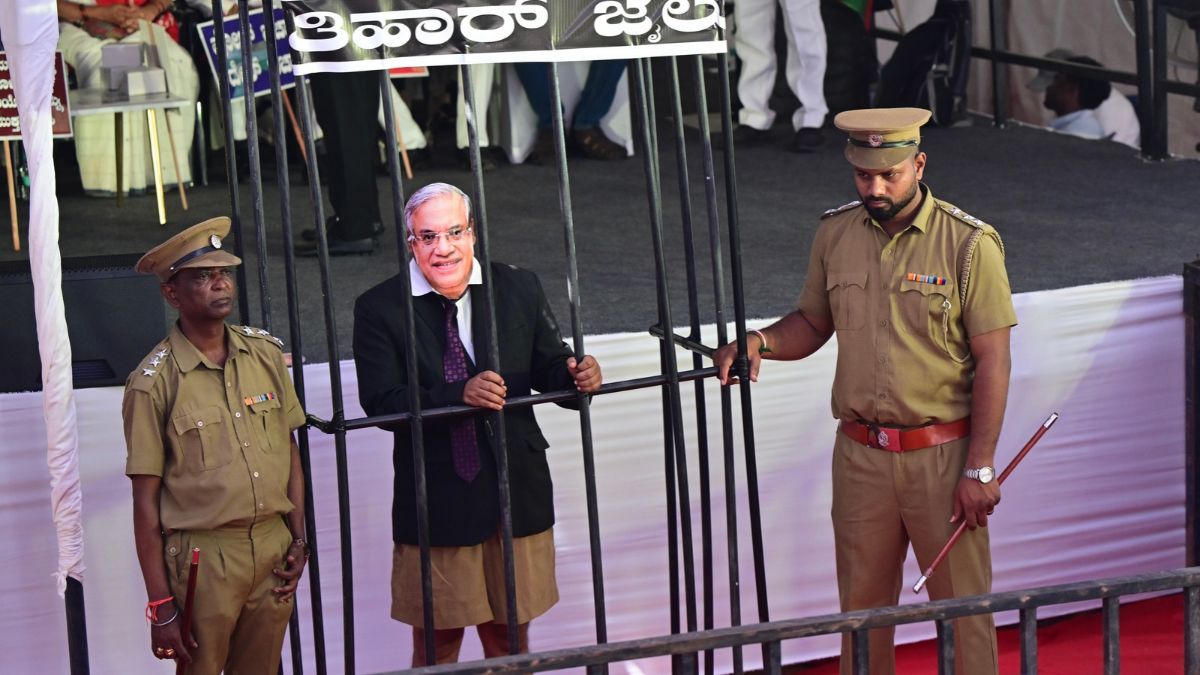
A week after Karnataka published its final electoral rolls following the 129-day Special Intensive Revision (SIR) exercise, the INDIA bloc returned to the streets in Bengaluru.
On Thursday, the INDIA bloc, led by the Congress, brought together Opposition parties and civil society organisations at Freedom Park for a public protest titled ‘Save Vote, Save Country’. The gathering demanded the resignation of Chief Election Commissioner (CEC) Gyanesh Kumar, alleging that the SIR had undermined citizens’ democratic right to vote.
But sustaining public support appears to be its next challenge.
Thursday’s demonstration was also a continuation of the INDIA bloc’s November 1 mobilisation at Ramlila Maidan in New Delhi. Most prominent Karnataka Congress leaders, however, were absent from the Delhi gathering as the state was celebrating Karnataka Rajyotsava.
At Freedom Park, KPCC president B.K. Hariprasad reiterated that the agitation would continue until Gyanesh Kumar resigned. The alliance announced plans to take the campaign to district headquarters, taluks and blocks. Chief Minister D.K. Shivakumar, former CM Siddaramaiah and leaders of several INDIA bloc constituents participated. Actor and activist Prakash Raj, who has been actively opposing the SIR exercise, was also present.
Prakash Raj argued that the movement should not end with the resignation of the CEC.
“Gyanesh Kumar will anyhow go, but this protest should continue until the SIR is scrapped and the BJP is thrown out,” he said.
CM Shivakumar recalled his intervention during the SIR process, claiming that it had helped prevent deletions through Form 7 applications. The CM’s sit-in outside the office of the Chief Electoral Officer drew criticism from the opposition BJP and JD(S), which accused him of obstructing the Election Commission’s work.
Siddaramaiah, in his address, described the SIR as a grave violation of the Constitution. He accused the CEC of acting at the behest of PM Narendra Modi and said people across the country were demanding his resignation.
Yet, beyond the speeches and accusations, the movement faces a larger question: why has the anti-SIR campaign not generated the same sustained public response as the protests against alleged irregularities in the NEET examination? Despite a large number of voters losing their voting rights, the movement, as of today, is sustained largely by the support of political parties opposing the SIR. Sustained participation by ordinary voters, however, remains a challenge.
The publication of the final rolls has also changed the nature of the campaign in Karnataka. Many have argued that the process is now over and questioned the need to continue the protests.
Despite the absence of a clear roadmap for the agitation ahead, the public protest meeting adopted five resolutions, demanding the withdrawal of the SIR, the resignation of Gyanesh Kumar, the repeal of the law governing the appointment of the CEC and the restoration of independence in the appointment process in accordance with Supreme Court directions.
It also urged the Karnataka government to reject the final SIR electoral rolls and use the 2025 electoral rolls as the basis for the forthcoming taluk and zilla panchayat elections.
The INDIA bloc has announced that its campaign will travel beyond Bengaluru to various cities across the country. But whether the protests will be able to force Gyanesh Kumar out—as former Union Education Minister Dharmendra Pradhan was pressured to resign following massive protests by students led by CJP—remains a question.
In Karnataka, the final electoral rolls recorded 4,55,00,011 voters—a reduction of 99,32,303 from the 5,54,32,314 electors registered before the revision.
Although the Election Commission maintained that the exercise followed prescribed procedures, the Congress and other Opposition parties continued to question the scale of deletions and the possibility of eligible voters being left out.
In Delhi, protest sites have shifted, while the detention of CJP leaders appears to have dampened the mood. The movement now rests largely in the hands of Opposition parties and how they take it forward—both on the streets and in Parliament.
