



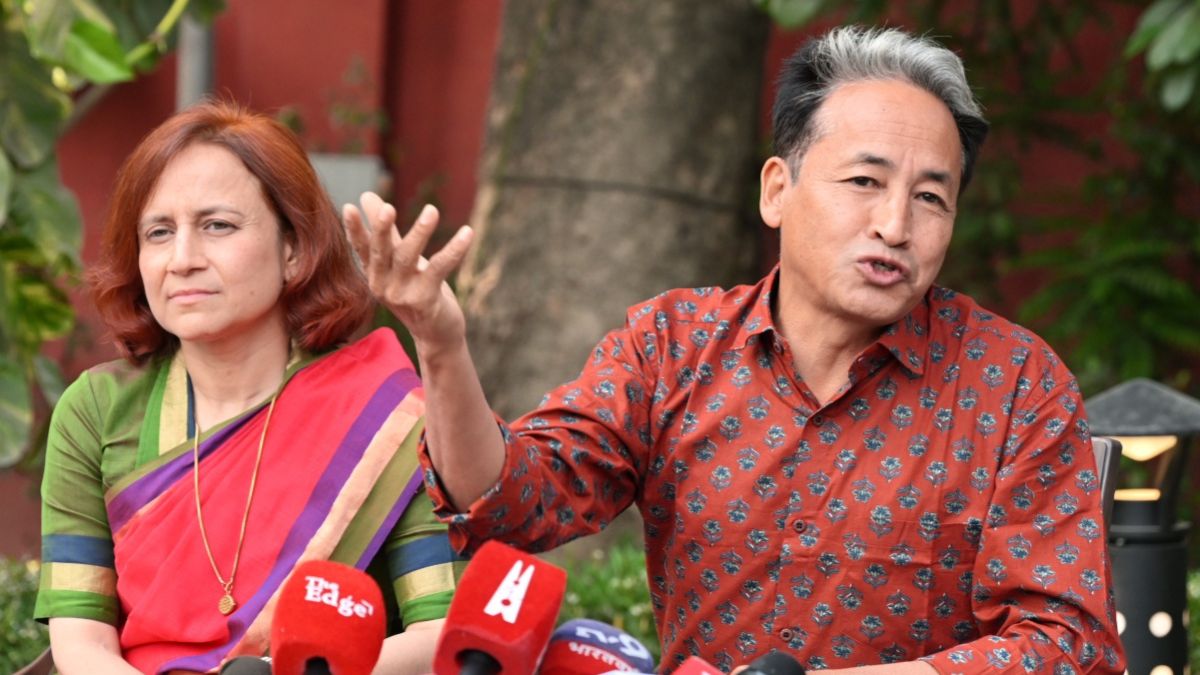
Amid a fresh standoff with the Ladakh administration over the functioning of the Desert Flower School in Phyang, climate activist Sonam Wangchuk and his wife, Gitanjali Angmo, clarified on Wednesday that their priority was to ensure the best possible education for the children in the region
At a press conference, the two said their initiative was driven by the interests of young children and the need to provide them with quality education, and not by any confrontation with the administration.
Their clarification comes after the Ladakh administration directed the Himalayan Institute of Alternative Learning (HIAL), led by Wangchuk and Angmo, to halt activities at its Phyang-based school until the Jammu and Kashmir and Ladakh High Court issues further directions.
The administration, through a notice issued by the Leh Tehsildar on November 1, alleged that the school had commenced classes and other activities without obtaining the necessary permissions, clearances and approvals from the authorities concerned. It also advised Angmo against taking further steps towards the school's functioning while the land allotment dispute remains pending before the High Court.
However, HIAL has disputed the administration's position, maintaining that the school is part of its ongoing educational activities and that the interests of the children should not suffer because of the dispute.
In its reply to the Tehsildar, the institute said that 50 children between the ages of three and five had already been enrolled in kindergarten. It argued that stopping the school's activities would adversely affect the interests and rights of these young students.
The school, named Desert Flower, is envisioned as part of HIAL's broader educational initiative, which focuses on alternative learning, sustainability and education rooted in the Himalayan environment.
Angmo has maintained that the institute has responded to the administration's notice and is willing to comply with lawful directions. She has also argued that the delay in obtaining the required no-objection certificate cannot be attributed to the institute, claiming that the administration itself has not processed the necessary clearances.
The latest notice is linked to the larger dispute over the land allotted to HIAL in 2018 for establishing an educational institution dedicated to sustainable mountain development. In August 2025, the Union Territory administration cancelled the allotment, citing unpaid dues, the absence of an executed lease deed and what it described as a prolonged failure to comply with the terms of allotment.
The decision was challenged before the High Court, where the matter remains pending.
HIAL, meanwhile, has maintained that the land was allotted for a public-interest educational initiative and that it has undertaken academic programmes, community training, climate-adaptive construction and other activities with the participation and approval of government authorities.
Angmo has also pointed out that the institute has obtained a status quo order from the High Court, directing the UT administration to maintain the existing position concerning the land and not create third-party rights.
In its response to the November 1 notice, HIAL requested the authorities to withdraw the communication so that the functioning of Desert Flower School would not be affected. It reiterated its commitment to complying with directions issued by the court.
The dispute has put the spotlight on the future of HIAL, an institute that has also undertaken work in sustainable construction and developed shelters for the Indian Army to withstand extreme Himalayan conditions.
For Wangchuk and Angmo, however, the immediate concern is the education of the children enrolled at the school. Their position, as articulated at the press conference, is that the ongoing administrative and legal dispute should not come in the way of providing young children in Ladakh access to quality education.
