



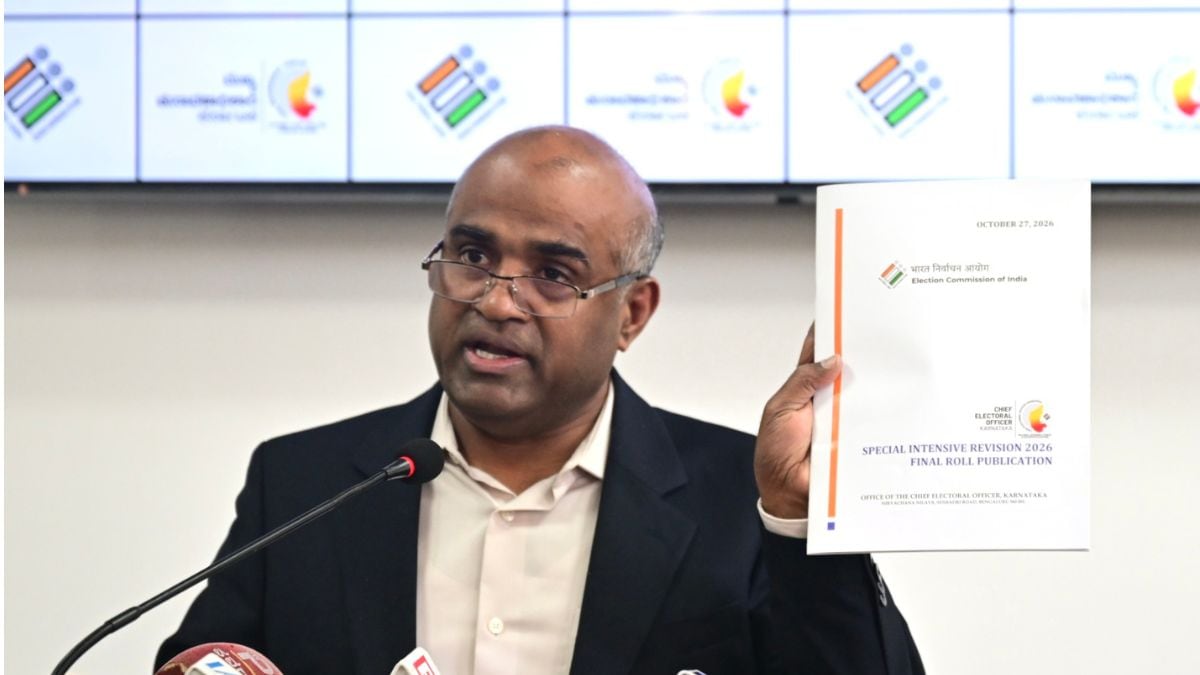
Karnataka’s final electoral roll, published on October 27 after the Special Intensive Revision (SIR), contains 4,55,00,011 voters. This is an increase of 8,64,036 voters, or 8.64 lakh, from the draft roll published on August 24. However, the final electorate is still 99,32,303 voters, or 99.32 lakh, lower than the 5,54,32,314 voters recorded on June 16.
The three figures show how the electorate changed at each stage of the revision.
As of June 16, 2026, Karnataka had 5,54,32,314 registered voters. When the draft electoral roll was published on August 24, the number had decreased to 4,46,35,975. This was a reduction of 1,07,96,339 voters, or around 1.08 crore, from the June count.
The 1,07,96,339 voters excluded from the draft roll were categorised under ASDDO, covering electors marked as absent, shifted, dead, duplicated or falling under other categories.
By October 27, the final electoral roll contained 4,55,00,011 voters. This represented an increase of 8,64,036 voters, or 8.64 lakh, from the draft roll.
Even after this increase, the final electorate remained 99,32,303 voters, or 99.32 lakh, below the June 16 count.
During the exercise, 43,82,824 notices were issued to voters whose entries fell under the no-mapping and logical discrepancies categories. According to the Chief Electoral Officer’s office, hearings on all these notices have been completed across the state.
The notice process became one of the major points of contention during the revision, with concerns raised over the exclusion of eligible voters and the difficulties some faced in establishing their eligibility within the stipulated period.
The 129-day process involved house-to-house visits by Booth-Level Officers (BLOs), rearrangement of polling stations, publication of the draft roll, and a subsequent period for claims and objections.
The ASDDO categorisation and the notice process drew criticism from civil society groups and opposition leaders. Allegations included voters being wrongly marked as dead, discrepancies in names and other details, and attempts to delete names through Form 7 objections.
The Karnataka SIR happened at a time controversy around the exercise resulted in protests by political parties and civil society groups including Cockroach Janata Party (CJP) and the Anti-SIR Alliance. Deputy Chief Minister D.K. Shivakumar also protested at the Election Commission’s office, while opposition leaders raised concerns over the handling of the revision accusing the mass deletion by filings bulk Form 7 applications.
Between June 16 and October 22, the Election Commission received 25,87,461 applications under Forms 6, 6A, 7 and 8.
According to the figures released by the Chief Electoral Officer’s office, these included 10,42,863 applications under Form 6 for inclusion of new voters, 4,840 applications under Form 6A from overseas Indian electors, 2,28,917 applications under Form 7 concerning objections to entries or requests for deletion, and 13,10,841 applications under Form 8 for shifting or correction of electoral details.
The additions to the final electoral roll included 8,77,000 voters through Form 6, another 2,313 through Form 6A and 1,28,622 through Form 8, taking the total additions to 10,08,038.
Meanwhile, 1,88,324 voters were deleted from the electoral roll. The figures include deletions due to death, absence, duplication and objections filed through Form 7.
With the publication of the final electoral roll, the Election Commission has maintained that enrolment and correction of electoral details are continuous processes.
Karnataka Chief Electoral Officer V. Anbukkumar said “eligible voters who believe they have been left out can apply for inclusion by submitting Form 6 along with the prescribed documents”
The publication of the final roll marks the completion of the SIR exercise, but the difference between the pre-SIR and final electorate remains significant.
The June-to-draft comparison shows a reduction of 1,07,96,339 voters, from 5,54,32,314 to 4,46,35,975 while the draft-to-final comparison sees an increase of 8,64,036 voters, from 4,46,35,975 to 4,55,00,011. The June-to-final comparison shows that the final electorate remains lower by 99,32,303 voters.
