



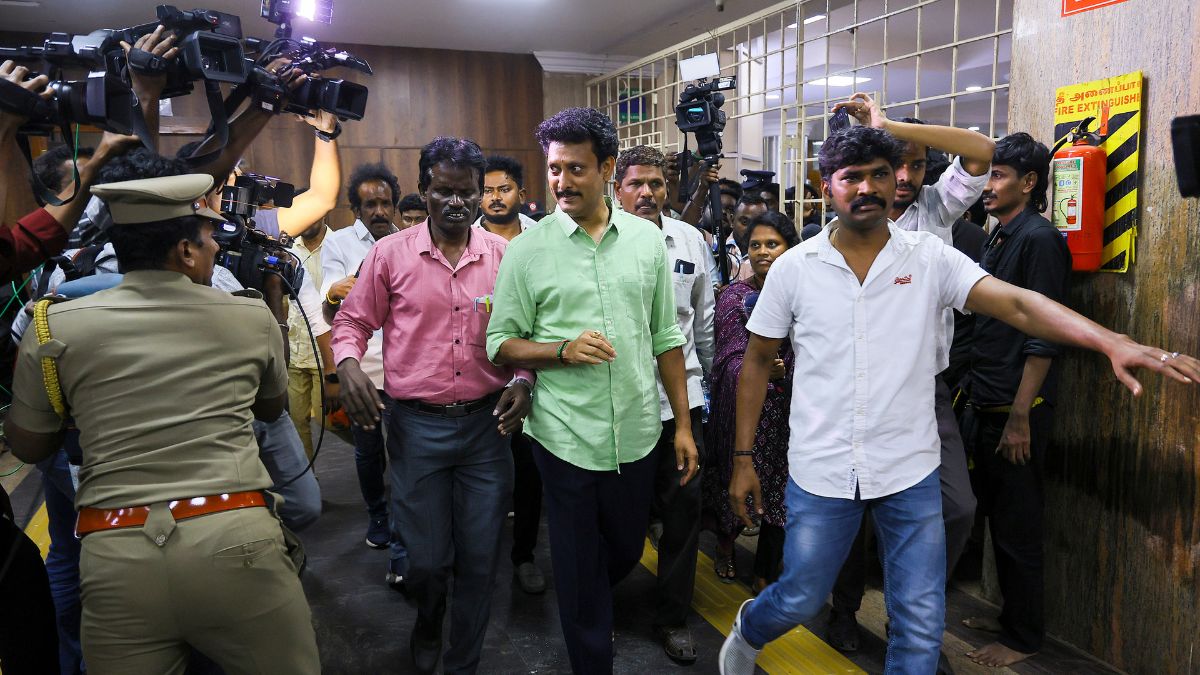
The drama surrounding former minister Anbil Mahesh Poyyamozhi’s arrest reached a climax late Monday night, October 26, as defence counsel and prosecution lawyers sparred over the legality of his arrest, the necessity for custodial interrogation, and the alleged ₹100 crore private school approvals scam.
Mahesh was produced before the Special Court for Prevention of Corruption Act cases in Chennai at around 10:10 p.m., following questioning by the Central Crime Branch and a medical examination at a government hospital. The remand proceedings stretched for nearly three hours, ending with Special Court Judge L.S. Sathiyamurthy remanding him in judicial custody until November 6.
The courtroom battle followed a day of swift developments. The Madras High Court had dismissed Mahesh’s anticipatory bail petition earlier in the morning, leading to his arrest by police later that evening for questioning. In court, proceedings went beyond whether the former minister should be remanded, becoming a direct challenge to the circumstances and legality of his arrest.
Senior advocates P. Wilson and Saravanan, appearing for Mahesh, questioned the police action. Saravanan objected to the arrest being made at the office of senior advocate Wilson, describing the episode as unprecedented. Wilson argued that Mahesh had been discussing his legal options with counsel after the rejection of his anticipatory bail plea when the police moved in.
The defence also challenged the procedure followed in the case, contending that the necessary sanction from the competent authority, the Governor, had not been obtained for proceedings under the Prevention of Corruption Act.
The lawyers opposed remand, arguing that the case was largely documentary and that custodial interrogation was unnecessary.
Public Prosecutor John Sathyan countered that the police had waited for about an hour outside Wilson’s office before arresting Mahesh. He relied on the High Court’s order rejecting anticipatory bail and argued that the investigation needed to establish the money trail and identify the ultimate beneficiaries.
The prosecution informed the court that complaints pointed to illegal collections running into hundreds of crores of rupees, claiming the scope of the scam had expanded from ₹100 crore to ₹400 crore. Prosecutors also warned that the accused could influence witnesses or tamper with evidence if the probe was hindered. The alleged involvement of Mahesh’s close aide Muthukumar, who remains absconding, added urgency to the police’s request for further investigation.
After hearing both sides, the judge ordered judicial remand until November 6. Mahesh was subsequently escorted to Puzhal Central Prison under tight security.
The remand hearing thus became the flashpoint in a politically charged case. For the defence, the core arguments focused on due process and the legality of the arrest, whereas the prosecution prioritised tracing the alleged illicit funds and uncovering the broader syndicate behind the school approval racket. Politically, the TVK celebrated Mahesh’s arrest, claiming more corruption would soon be unearthed. Conversely, the DMK called the move a 'political vendetta,' arguing that mandatory legal procedures—including obtaining prior sanction from the Governor—were bypassed.
Politically, the arrest has cast a sharp spotlight on Chief Minister Joseph Vijay’s anti-corruption crusade while exposing deep discomfort within the DMK ranks. Though the court’s remand order does not establish Mahesh’s guilt, the late-night proceedings guarantee that the battle will be waged on two distinct fronts: inside the courtroom, where evidence must withstand strict legal scrutiny, and in the political arena, where accusations of corruption and vendetta are already flying.
