



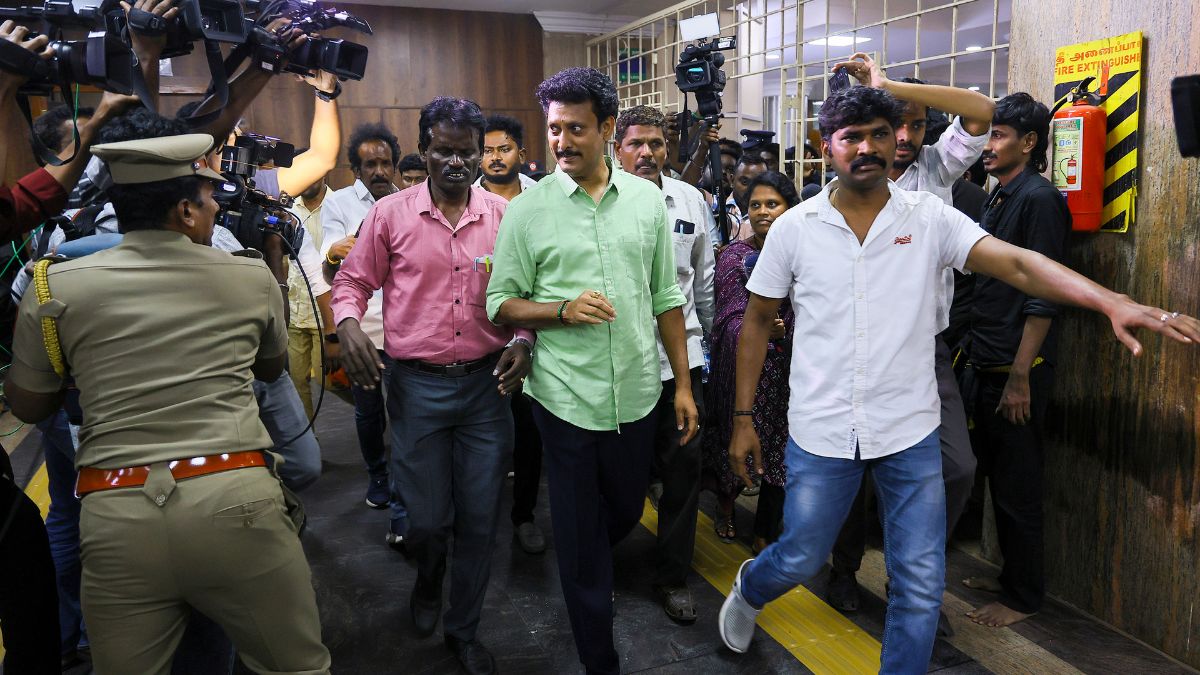
Hours after the Madras High Court on Monday rejected the anticipatory bail plea filed by former school education minister Anbil Mahesh Poyyamozhi the Central Crime Branch (CCB) of the Greater Chennai Police arrested Mahesh. The case concerns an alleged ₹100-crore collection from private schools in exchange for recognition, licences and other statutory clearances. Mahesh has denied wrongdoing and is contesting the case.
Justice V. Lakshminarayanan dismissed the anticipatory bail petition filed by Mahesh after the CCB argued that officers investigating the case have gathered sufficient evidence in the case which suggests the alleged involvement of the former minister and demanded custodial interrogation. The former school education minister who lost from his home turf Thiruverumbur in the assembly general elections is considered to be a close associate of DMK’s youth wing secretary and the Leader of Opposition Udhayanidhi Stalin. Mahesh is also looked at as one of the prominent next generation faces of the DMK, who was vociferous against the ruling BJP and the RSS, particularly in implementing the New Education Policy, 2020.
How did the case begin?
The investigation began with a complaint by D.C. Ilangovan, secretary of the federation of association of private schools, Tamil Nadu. The complaint alleged that B.T. Arasakumar, who headed an unregistered organisation called the Tamil Nadu private schools association, collected money from school managements by promising to facilitate official approvals.
These included permanent recognition, permission to upgrade schools, building plan clearances and other statutory permissions, which are considered to be essential for private institutions seeking to operate legally, expand their facilities or regularise their status.
According to investigators, school managements were allegedly led to believe that the association had the political and bureaucratic connections necessary to get their applications cleared. The money was reportedly collected under the guise of membership subscriptions or a “party fund.” The alleged fraud came to light after school representatives complained that promised approvals had not materialised and the money had not been returned. Police subsequently arrested Arasakumar on June 27, 2026, and widened the investigation as more complaints emerged. By September, investigators said 177 schools were linked to the case.
Why has Anbil Mahesh been implicated?
The case took a significant turn when investigators searched premises linked to Mahesh in Chennai and Tiruchirappalli in September. The CCB subsequently named him as an accused and invoked provisions of the Prevention of Corruption Act. Investigators alleged that he had a role in collecting money from school managements in the name of a party fund. Witness statements reportedly referred to meetings with the former minister and assurances concerning government orders.
Mahesh challenged the allegations, arguing that there was no evidence to establish that he received illegal gratification or personally committed an offence. He has also approached the court seeking to quash the first information report (FIR). However, the precise extent of his alleged involvement remains to be established through the investigation and judicial proceedings.
Why did the High Court reject Mahesh’s anticipatory bail plea?
On October 26, the Madras High Court dismissed Mahesh's anticipatory bail application. The prosecution argued that further investigation was necessary, including examining the alleged financial transactions and the roles of the accused. The court's decision removed the immediate legal protection he had sought against arrest.
The CCB arrested him later during the day. Meanwhile, the Enforcement Directorate has registered a separate case under the Prevention of Money Laundering Act to investigate the suspected financial trail.
The investigation, however, has its own complications. Arasakumar, the original accused, had earlier been arrested and detained under the Goondas Act. He subsequently obtained bail after the police failed to file the chargesheet within the prescribed 90-day period. The proceedings involving Mahesh are separate legal developments within the wider investigation
What does the case mean for the DMK?
The political implications might turn into a larger disappointment for the DMK leadership. Mahesh is not just a former minister but a prominent face of the DMK considered close to Udhayanidhi Stalin and also to the DMK first family.
DMK president M.K. Stalin has condemned the arrest, alleging political vendetta by the ruling TVK government. The party maintains that the arrest is an attempt to divert public attention from the government's own problems. But the larger issue goes beyond the confrontation between the DMK and the TVK. If the allegations are substantiated, the case could expose how access to government approvals was allegedly monetised, leaving educational institutions vulnerable to intermediaries claiming political influence.
For now, the ₹100 crore figure represents the alleged scale of the scam, not a judicially established loss or a finding of guilt against Mahesh. The central questions as to who collected the money, where did it go, and what role, if any, did public officials play still remain unanswered. The answers to these central questions will only determine whether this becomes a case of alleged private school fraud that escalated into a political scandal or evidence of a wider corruption network.
