



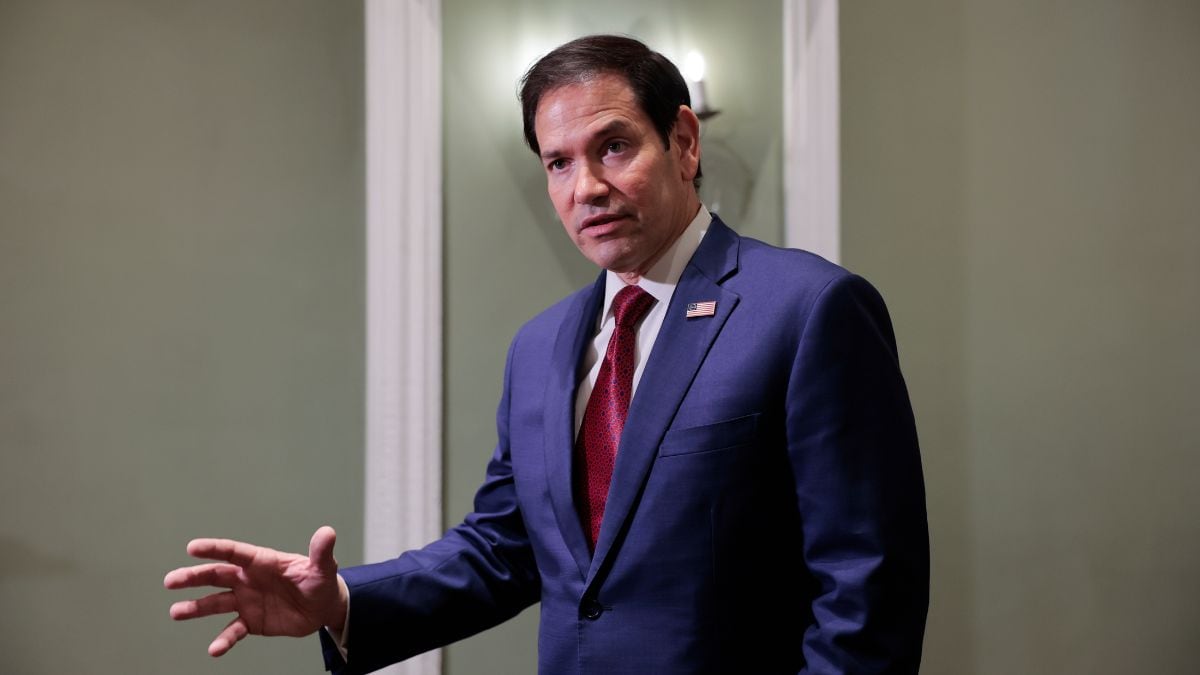
External Affairs Minister S Jaishankar hosted US Secretary of State Marco Rubio in Mumbai for his second visit to India in under five months, amid the countries' strained bilateral ties over Washington's unpredictable trade policies and tightening immigration rules.
Rubio said on Tuesday that he anticipated a trade deal between the United States and India could be reached within a matter of weeks, not months. He said that about 99 per cent of the work is complete.
“We’re very, very close. I would say we’re about as close as you can be without (inaudible) agreement. I think there’s a small number of items to wrap up, so I think that will happen shortly – we’re hoping; it should. And hopefully I’ve got some good news to announce fairly soon, and perhaps (inaudible) can sign it thereafter,” He said.
Rubio then described India as a crude oil refining "superpower" and advocated for processing more Venezuelan crude in India. The Secretary of State is scheduled to visit Reliance Industries Ltd-owned Jamnagar Refinery on Wednesday.
In a brief media interaction, Rubio responded to a question on whether the US administration was upset with New Delhi over the amount of Russian oil it procured last year and its efforts to reduce the volume.
"I think what India has expressed repeatedly is its desire to diversify its energy portfolio, which is a smart thing to do. Obviously, it's not easy to do that from one day to the next day," he said.
"I think they've made substantial progress in that regard, and we're happy to see that. But in the end, it's not just about Russian oil; it's about their desire to diversify, and obviously we think we can be a source of some of their energy inputs," he said.
"Obviously, we've discussed Venezuela and other countries, and I think it's in our interest to have a strong ally with a diverse energy portfolio," he added.
The US Secretary of State also hailed India's oil refining capabilities.
"India is a refining superpower. They have the ability to do that, and they have companies that know how to do that," Rubio said, pointing out that certain Indian companies have "pre-existing oil concessions in Venezuela".
"I'm not claiming to you that Venezuela alone can fill the hole that could be caused by some of the things that are happening around the world, but I think over time, it most certainly can, and in the short term, it can certainly provide the means," he said.
"So, that's one of the things we'll talk about. With India, we've talked about it in the past, and they sound ready. They're ready to do it, they're willing to do it," he noted.
The top diplomat also answered a question on his trip to Reliance Industries Ltd's refinery in Jamnagar on Wednesday.
"Energy is related to national security. Countries fight wars over energy; economies collapse over lack of energy. We're going to go see a company that has a tremendous amount of refining capability. It makes all the sense in the world to talk to them about it," he said.
During the media interaction, Rubio said several geopolitical developments; including the situation in the Strait of Hormuz and Houthi attacks on energy pipelines in Saudi Arabia, impacted energy supplies, causing several countries to grapple with a diesel shortage.
Last week, US President Donald Trump suspended certain sanctions against Russia and five of the biggest buyers of Russian oil, including India. He also announced a deal with Russian President Vladimir Putin to release hundreds of thousands of tonnes of Russian diesel onto the world market.
After the meeting, Jaishankar took to social media to say that he and Rubio "shared views on further advancement of our ties, focusing on trade, energy, technology, defence and people-to-people ties."
The US State Department said the secretary and the external affairs minister discussed regional and global issues, including developments in West Asia.
"The secretary reiterated that increased energy trade with the United States can play a transformative role in diversifying India's supply chains while meeting its sizable consumer demand," it said.
"He also commended recent progress in bilateral defence and civil nuclear cooperation, and advocated for the increased purchase of US technologies and systems, which can enhance the security and prosperity of both our countries," the State Department added.
The MEA also said that the two sides reviewed the entire gamut of India-US relations and discussed ways to further strengthen the Comprehensive Global Strategic Partnership.
"Both sides had a detailed exchange of views on a wide range of areas, including trade, defence, technology and energy security. They also exchanged views on regional and global developments," it said.
India-US relations became tense after Washington imposed punitive tariffs on India last year and President Trump made assertions regarding his role in de-escalating the India-Pakistan military clashes of May 2025 that drew sharp reaction from Indian officials.
Washington's new immigration policy and its decision to increase H1B visa fees also contributed to the slide in India-US ties.
The ties came under fresh strain after the US decided to restrict a key green-card processing programme for major global and Indian IT firms, including Tata Consultancy Services and Wipro.
