



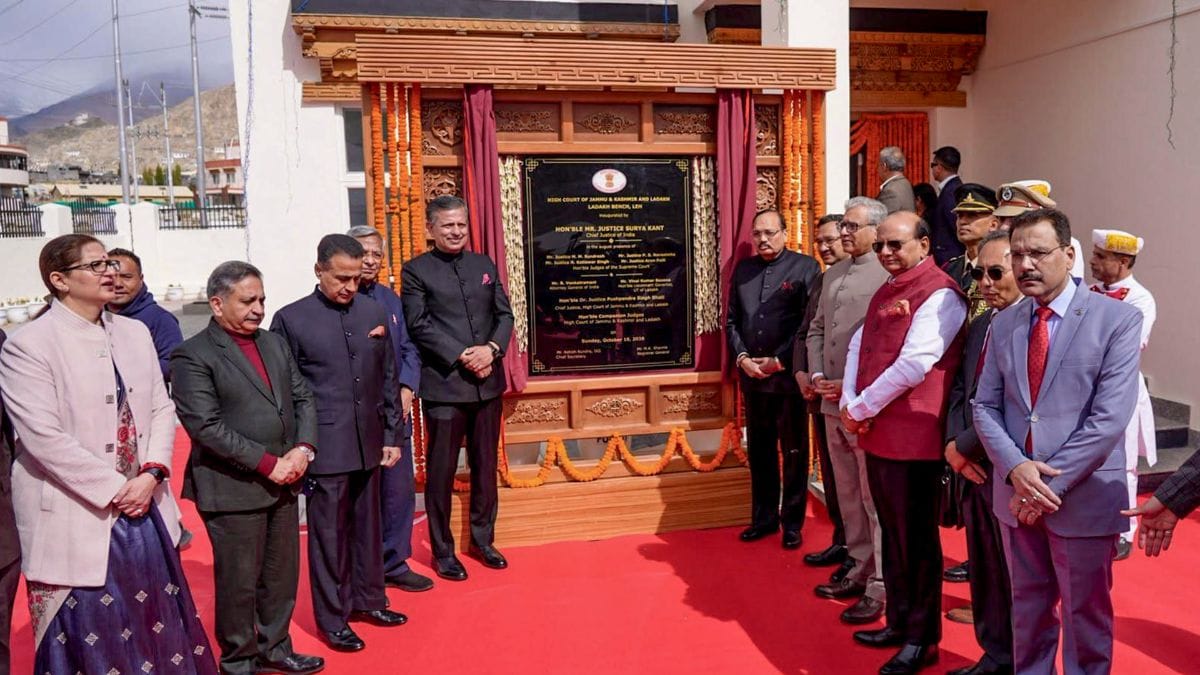
Situated 3500km above sea level in Leh, Ladakh finally gets its own High Court bench, almost a century after the establishment of the J&K High Court.
The Court was inaugurated by the Chief Justice of India Surya Kant, in the presence of Supreme Court Justices M.M. Sundresh, P.S. Narasimha and Arun Palli, along with the Jammu & Kashmir and Ladakh High Court Chief Justice Pushpendra Singh Bhati, Attorney General for India, R. Venkataramani and Ladakh Lieutenant Governor Vinay Kumar Saxena.
The move comes after almost a century-long struggle faced by the residents of Leh and Kargil, subject to long-distance travel through challenging mountain terrains to reach the main High Court benches in Srinagar or Jammu.
The new local bench relieves citizens of the travel duration and financial burden, which often cost more than the lawyer's fee.
In his address, the CJI stated that the Supreme Court would list all matters originating from Ladakh on a single day once adequate video conferencing facilities are available to lawyers practising before the new bench, so that litigants need not travel all the way to Delhi.
75 pending cases originating from the Ladakh region have already been identified, transferred and listed before the new bench with initial cases on opening days set to be heard by the Division Bench comprising HC Chief Justice Pushpendra Singh Bhati and Justice Sanjay Parihar.
The Leh facility is eco-friendly, and will work as a fully IT-enabled paperless court with dedicated e-filing portals, document management systems, solar-powered units, and a green wall initiative as well.
The CJI further noted that access to justice should be measured by affordability and outcomes—not merely physical proximity—and emphasised that justice begins not in the Court's compound, but at the litigant's door.
He also stated that being the highest HC bench in India (altitude-wise), it was imperative to understand that what matters today is not how high this Court sits, but how close it now stands to the people it serves, with a call to strengthen legal aid through awareness camps in villages, paralegal volunteers, better access to lawyers, Lok Adalats, and prompt compensation for survivors of crime.
The bench also seeks to create opportunities for advocates, court staff, translators and other legal professionals.
Ladakh became a separate Union Territory following the Jammu and Kashmir Reorganisation Act, 2019, with longstanding demands for constitutional safeguards, including Sixth Schedule status. Ladakh is not politically or culturally uniform, with Leh and Kargil having contrasting concerns. The bench is located in Leh, but its legitimacy remains to be tested, on the grounds of whether the residents of Kargil can access it equally.
The problem of unequal access to justice is not unique to Kargil, but is central to the nation.
The national average prison occupancy is 131 per cent, with some prisons operating at 200 per cent capacity or more. Out of this, 76 per cent of all prisoners are undertrials (awaiting trial rather than convicted).
This sheds light on the mammoth backlog of cases the Indian judiciary faces: as of December 31, 2025, there were 92,118 pending cases in the Supreme Court of India. This, along with severe shortages of judges, magistrates and operational staff in subordinate and high courts strain the capacity of the justice system, thereby hindering access to justice.
Today, for every 710 citizens, there is only one lawyer, and only five public legal aid panel lawyers per 1,00,000 people.
Sheela Barse v. Union of India (1986) is a landmark Supreme Court judgment that established the right to a speedy trial as a fundamental right under Article 21 of the Constitution. Yet, in reality, justice is often slow, expensive and intimidating, with legal systems resembling an exclusive membership rather than a fundamental right.
The Bar Council of India estimated that roughly 35-40 per cent of practicing advocates in India may hold fake, forged or unverified law degrees, further eroding trust in the system.
Despite 80 per cent of India's population being legally eligible for free legal aid, it is accessed by a very small fraction. This spotlights the gaps in implementation and outreach. Uncertainty on how to act, limited confidence in the justice system, illiteracy, legal fees, lack of awareness on available provisions, misinformation, and case backlogs add on to the problem and risks transforming a universal right into a luxury good that is democratically promised but economically rationed.
In the case of Ajay Kumar Pandey v. State of Jammu and Kashmir (2012), the Supreme Court explicitly held that ‘access to justice’ is an inalienable fundamental right guaranteed under Articles 14 and 21 of the Indian Constitution.
The Government has responded to the problem of unequal access to justice with schemes, awareness campaigns, technological advancements, legal clinics and legal aid programmes such as the establishment of NALSA, Nyaya Bandhu, video conferencing, e-filing, tele law, legal literacy and awareness and Sewa Kendras.
Yet, lapses in its implementation remain such that the courthouse doors remain open to everyone, though the cost of walking through them suggests otherwise.
