



On Monday, Congress leader Rahul Gandhi walked the wide stage at 24, Akbar Road with a swagger Delhi had not seen from him in months. Aggressive, but controlled. Confident, as if he knew the government was befuddled.
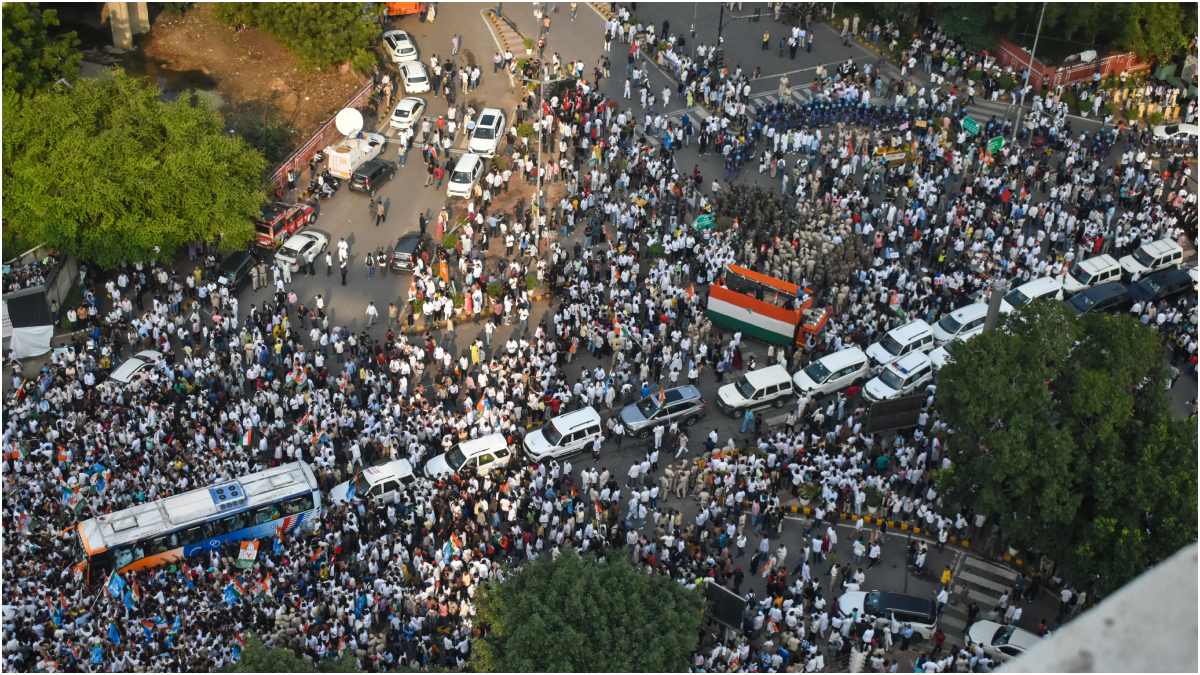
A few kilometres away, that befuddlement was concrete. Literally. Barricades, Vajra vehicles, riot gear, and young men and women facing them off at Raisina Road, Patel Chowk, Connaught Place — anywhere but Jantar Mantar, which had been sealed off.
From Saturday, Delhi has looked like a war zone without a war. No curfew has been declared, but for a four-kilometre radius around the seat of power, it feels like one. There is no sign of the protest ebbing yet, although by their nature, mass movements have a short shelf-life. This one may be different.
Because what is unfolding in Delhi is not a conventional protest. Its strength does not lie on the street. The street is just the tip. The mobilisation is virtual; the physical crowd is a fraction. Social media is the magnifier — omnipresent, omnipotent and slippery.
That is why the state is struggling. A prolonged internet curb will only push the movement underground, from where it will emerge more angry, more vicious. One can seal Jantar Mantar. One cannot seal Telegram.
India is only the latest country to be hit by what political sociologists now call “composite movements” — a strange new species of dissent that has erupted from Santiago to Kathmandu in the last decade. They have three defining traits: one, joint mobilisation of forces from Left to Right who otherwise share nothing; two, a deep, uneasy distrust among the allies themselves; and three, a penchant for conspiracy narratives.
All three are present in abundance in Delhi.
The Cockroach Janta Party — CJP — is the spearhead. But it is not alone. Around it are Left student groups, Congress workers, INDIA bloc constituents, apolitical Gen Z first-timers who came via a Dhruv Rathee video or an Instagram reel. Their unity is not organisational. It is emotional.
What binds them is a social base the state has long ignored: the educated, unemployed youth. Young Indians who did everything they were told — degrees, coaching, exams — and found that nothing guarantees a future. That frustration, building over a decade, is the fuel.
Their demands sound similar, but are not the same.
CJP is maximalist and populist: Resignation of Chief Election Commissioner Gyanesh Kumar, criminal proceedings against him, rollback of the Special Intensive Revision of electoral rolls that deleted 130 million names, and a new ECI framework with civil society in it.
The Left wants a systemic transformation of the election architecture itself.
The Congress and INDIA bloc want a more immediate fix: restore the deleted names, put SIR on hold.
Related demands. Not identical demands. That difference matters.
And that is the core strength — and danger — of a composite movement. It is inclusive, so the adversary — the state — never knows who to talk to. There is no one leader.
No one controls the narrative either. If one constituent cuts a deal with the government or is bought off, it is organically rooted out. Its space is instantly taken by someone more radical. The movement does not collapse; it mutates.
That is why Delhi sits on a razor’s edge today.
The way out is not more barricades, more Section 163 orders, or more detention centres — 15 already, with over 3,000 detained since October 10.
The way out is to see the core. The educated, unemployed youth are not demanding just a voter list correction. They are demanding a safety valve for their own future — a sense that the system is not rigged, that an exam is not leaked, that a vote is not deleted, that hope is not a luxury.
Address that anxiety, and the street may quieten. Miss it, and October will not be a moment in a month. It will be a season.
