



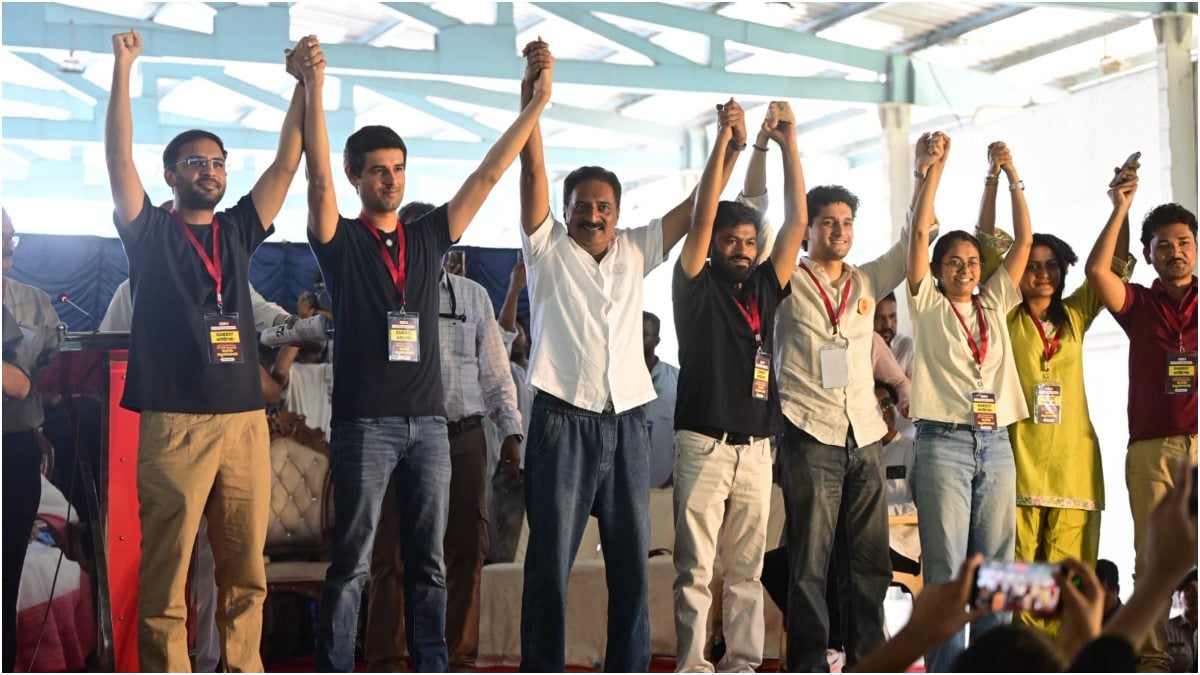
Bengaluru’s Freedom Park, on Thursday, witnessed the beginning of a nationwide protest against Chief Election Commissioner Gyanesh Kumar, as a large gathering of young protesters joined a People’s Tribunal and rally against the Special Intensive Revision (SIR) of electoral rolls.
The protest, organised by the anti-SIR alliance along with the Cockroach Janta Party (CJP) and supported by civil society and youth organisations, brought together people from different parts of Karnataka who claimed to have been affected by the SIR process. Actor and activist Prakash Raj, CJP founder Abhijeet Dipke and YouTuber Dhruv Rathee were among the main speakers.
The protesters arrived carrying the national flag, placards and masks associated with Gen Z protest culture. Slogans including “Vote Chor, Gaddi Chor”, “Gyanesh Kumar, Gaddi Chhodo” and “Gyanesh, it’s done bro” rent the air at Freedom Park.
The People’s Tribunal featured testimonies from people who said they had been affected by the electoral-roll revision. Former judge Gopal Gowda, senior journalist Vijayamma and retired bureaucrat Ibrahim were among those who heard the testimonies.
People from Vijayapura, Bhalki, Babaleshwar, Kodagu, Chitradurga and other parts of Karnataka were brought to the tribunal. Organisers said people from 73 booths, particularly from marginalised sections, had been brought to Bengaluru.
Among those who spoke were people from Vijayapura, where around 200 families were said to be living without proper documentation for their houses. The issue, speakers said, illustrated the difficulties faced by people who do not possess formal documents during the SIR exercise.
Prakash Raj addressed the gathering in Kannada and said Dipke, Rathee and other speakers would address the audience in Hindi. “This is just the beginning,” Raj said, describing the gathering as the beginning of a larger movement against SIR.
CJP founder Abhijeet Dipke began his address by saying, “Namaskara Bengaluru, hegiddira?” Thanking Prakash Raj for helping organise the gathering, Dipke said he would speak in Hindi because he wanted Prime Minister Narendra Modi and those he called “vote chors” to hear the protesters.
“The death was of democracy,” Dipke said, alleging that voters who were alive had been deleted from electoral rolls.
He alleged that the Election Commission had deleted voters at the direction of the BJP-led government and questioned why such deletions were taking place.
“They need ownership over you,” he said.
Dipke also invoked M.K. Gandhi, B.R. Ambedkar and Jawaharlal Nehru, describing Gandhi as the “soul” of India, Ambedkar as its “backbone” and Nehru as its “mind”.
He said the foundations of the country had been laid by these leaders and accused the RSS and BJP of attempting to replace the values of the Constitution with their own ideology.
Dipke also attacked the idea of “one nation, one election”, alleging that the slogan was part of an attempt to create “one nation, one party”.
He then turned to the 2024 Lok Sabha election, referring to the BJP’s “400 paar” campaign and its eventual tally of 240 seats. He alleged that the party had subsequently begun looking at ways to remove voters who did not support it.
Dipke claimed that 13 crore voters had been deleted across India, including around one crore in Karnataka. He presented the figures as evidence of what he described as a wider pattern of “vote chori”.
He cited alleged voter deletions in several states and named political leaders including Mamata Banerjee, Arvind Kejriwal, M.K. Stalin and Pinarayi Vijayan while arguing that regional political forces were being weakened. “The pattern is to destroy regional forces and leaders so that the RSS can impose its ideology on us,” Dipke said.
He then asked the crowd: “Are you ready to hit the streets?”
The crowd responded with slogans of “Vote Chor, Gaddi Chor”.
Dipke said the protesters had been called “cockroaches” and that the movement had adopted the term as a symbol of resilience.
“He might have power, but the streets belong to us,” he said, calling for the protesters to reclaim what he described as India’s democracy.
Dipke also warned Gyanesh Kumar that the protest movement would continue.
“Gyanu, it’s done bro,” he said.
He announced that a larger protest would be held in Delhi on October 10.
Aishe Ghosh, who also addressed the gathering, said the movement was not about one political party but about protecting democratic institutions.
“Gyanesh, it’s done bro. We are coming for you,” she said.
Ghosh said the BJP and RSS were attempting to undermine the values of the Constitution and that the younger generation would not tolerate it.
She announced that student organisations including SFI and DYFI would collectively lead the campaign to protect democratic institutions.
“October 10, Chalo Delhi,” she said, calling on people to join the Delhi protest.
Veeraraj Devang, another speaker, referred to an earlier protest in Delhi that he said had continued for 35 days. He said the protesters would continue the fight for voting rights.
CJP national secretary Afreena Nawaz also addressed the gathering.
Retired judge Gopal Gowda, who heard testimonies at the People’s Tribunal, launched a detailed attack on the Election Commission’s handling of electoral-roll revisions.
Gowda referred to the Supreme Court’s May 27, 2026 judgment concerning Form 6 and electoral-roll revision and questioned aspects of the court’s interpretation of the Election Commission’s powers.
He argued that changes to the electoral-roll rules could not be made without proper legal authority and parliamentary approval.
Gowda also criticised what he described as the Election Commission’s handling of the SIR process and said the issue required greater public scrutiny.
Speaking as a former judge of the Supreme Court, Gowda said democratic institutions had come under severe pressure and that ordinary citizens, farmers and unemployed youth were suffering. “Students are the mainstream of this struggle,” he said, urging young people to take up leadership roles as politicians, lawyers and public representatives.
He also appealed to the Union and state governments to address unemployment among young people.
“Are we not ashamed?” he asked.
Gowda said intellectuals, students and young people had extended support to the movement and described those participating in the protest as the “heroes of the country today”.
He also questioned the Election Commission over allegations of irregularities and demanded greater accountability from the institution.
The biggest crowd-puller at the event was YouTuber Rathee, who was attending a public protest in Bengaluru for the first time. His participation had been announced by Prakash Raj a day earlier.
Rathee began his address by referring to claims that he had come to India for “regime change” and rejected suggestions that he was funded by Elon Musk or George Soros “This is my first protest. I don’t want regime change, and I am not funded by Musk or Soros. I came with my own money,” he said.
Rathee said he wanted to specifically address BJP voters. “I would specifically tell BJP voters who you support: this issue pertains to everyone,” he said.
He argued that the right to vote should not depend on political affiliation and said voters should examine the allegations surrounding SIR irrespective of which party they support.
Rathee cited what he described as three pieces of evidence concerning electoral-roll revisions.
Referring to West Bengal, he alleged that around 70,000 voters had been removed before the election and later restored after the results. He questioned why genuine voters were not present on the rolls when the election took place.
He also referred to Bihar, alleging that large numbers of voters had been removed and questioning why their names and addresses had not initially been made public.
Rathee alleged that the Election Commission had shown “zero transparency and accountability” in the process.
He also referred to reports about electoral rolls in Uttar Pradesh and Goa and questioned the procedures followed for adding and deleting names.
“You are adding and deleting names of your own accord,” he alleged.
Rathee said civil society groups had travelled from district to district in Karnataka and found people who had allegedly been marked as dead despite being alive.
“Prakash Raj called me here,” he said, thanking civil society groups for documenting such cases.
“Gyanesh has to resign,” Rathee said.
He stressed that the protest was not about one political party.
“This is not from a party. I am telling you as a voter. This pertains to all, even BJP voters,” he said. “You have to support us if you think every citizen should be allowed to vote.”
The protest repeatedly returned to the cases of people who claimed to have been wrongly marked for deletion.
The organisers said the testimonies represented a wider problem involving voters from different parts of Karnataka. Noor Sridhar, another speaker, said the Karnataka government should not accept the SIR process.
The gathering ended with slogans against the Election Commission and Gyanesh Kumar, followed by “Vande Mataram” and “Bharat Mata Ki Jai”.
Prakash Raj said the gathering was only the beginning.
“This is just the beginning. We will fight to save democracy, the Constitution and freedom and restore the dignity of every citizen,” he said.
The organisers announced a women’s protest march later in the afternoon and a larger demonstration at Delhi’s Jantar Mantar on October 10.
