



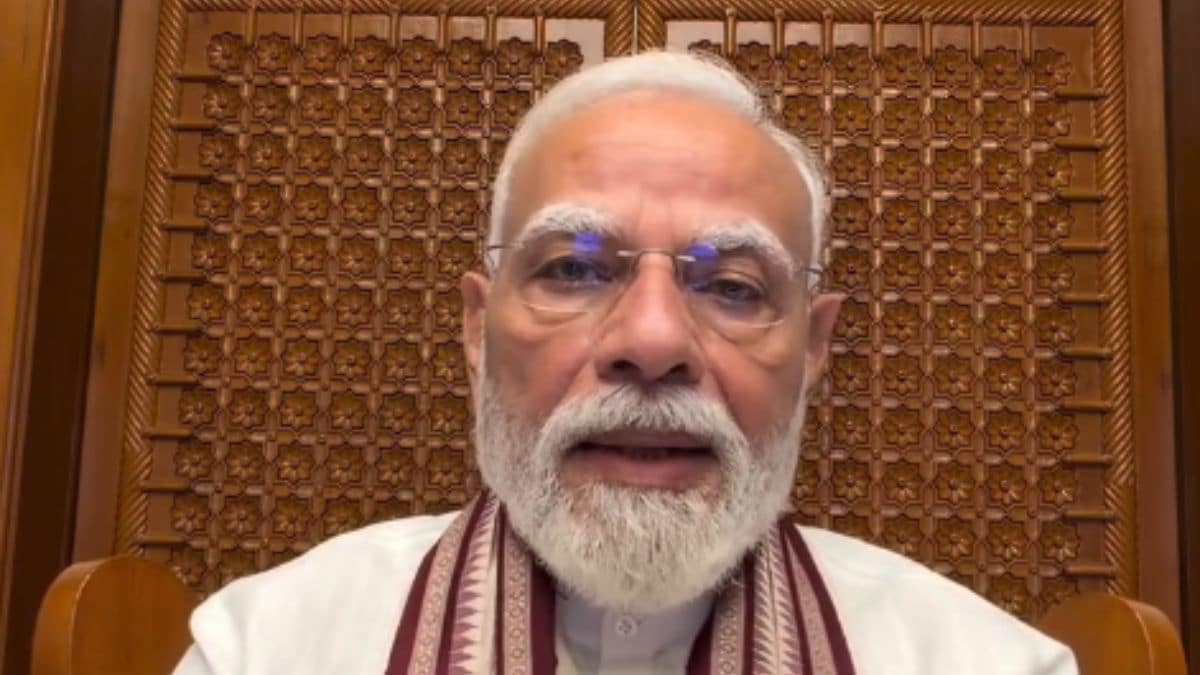
For more than a decade, Prime Minister Narendra Modi and the Bharatiya Janata Party have enjoyed an extraordinary advantage in India’s political communication ecosystem. The BJP understood social media earlier than most of its opponents and built a formidable digital machinery around Modi, party messaging, supporters, influencers and an extensive network across WhatsApp, Facebook, X, YouTube and Instagram.
For years, the political conversation often appeared to move in one direction: the BJP created the narrative, its ecosystem amplified it, and mainstream media followed. But that environment appears to be changing. The BJP has certainly not lost its digital presence, and Modi remains one of India’s most powerful political brands. Yet recent numbers suggest that its once near-uncontested dominance over political attention is becoming more competitive.
The latest weekly YouTube data from DataBeings provides one of the clearest indications of this shift. For videos uploaded between August 29 and September 4, the top ten political YouTube channels collectively generated 94.9 million views. The Indian National Congress accounted for 51.3 million views, or 54 per cent of the total. Modi’s channel recorded 13.1 million views, while the Indian Youth Congress generated 8.6 million and Uttar Pradesh Congress 5.7 million. The BJP recorded 4.5 million views.
The striking figure is the gap between Congress and Modi. During this particular week, the Congress channel alone generated almost four times the views recorded by the prime minister’s channel.
These figures do not mean that Congress has overtaken BJP in subscribers, lifetime reach or overall digital influence. Modi’s digital footprint remains considerably larger. The significance of the numbers lies elsewhere: they indicate that, during this period, Congress was able to generate substantially more current attention around the content it was publishing.
That distinction matters because digital politics is increasingly less about who accumulated the largest audience over a decade and more about who can make people stop scrolling today.
The broader ecosystem makes the numbers even more interesting. Congress, Indian Youth Congress, Uttar Pradesh Congress and Rahul Gandhi together generated approximately 69 million views in the DataBeings sample. Modi, BJP and Yogi Adityanath together generated around 19.2 million. That is roughly a 3.6 times difference within this dataset.
It would be irresponsible to translate this directly into electoral support. YouTube views are not votes, and channels differ in size, output and content strategy. But it would be equally unwise to dismiss the difference. A political party that consistently captures attention online is creating an opportunity to influence the political conversation.
The second set of DataBeings numbers, covering political spokespersons and news-media panellists on X during August 2026, points in a similar direction. Congress’s Supriya Shrinate recorded 2.4 million engagements, followed by Pawan Khera with 1.2 million. AAP’s Sanjay Singh recorded 9,34,525, while BJP’s Sambit Patra recorded 5,85,949. Congress figures occupied several of the higher positions in the rankings.
Instagram adds another dimension. Average engagement on Congress’s party account reportedly rose from around 50,000 to 72,000, while BJP’s increased from approximately 25,000 to 34,000. At the individual level, however, Modi remains significantly larger. His average Instagram engagement reportedly surged from approximately 1.19 million to 4.63 million per post following the July 20 protests. Rahul Gandhi’s average engagement also increased from approximately 1,52,000 to 4,26,000.
This suggests that the political battle on Instagram is evolving at two levels. Modi retains enormous individual reach and can generate extraordinary engagement when an issue becomes politically charged. At the same time, the Congress appears to be building stronger engagement at the party-account level and across a wider ecosystem of leaders and youth-oriented accounts.
This is where the idea of “Modi fatigue” becomes worth examining, although it remains a hypothesis rather than an established fact. A politician can remain popular while becoming less novel. After more than a decade at the centre of Indian politics, Modi’s speeches, rallies and political messaging are no longer new to audiences. Another speech or government achievement video may not generate the same curiosity it once did.
The shift is particularly important among younger audiences. Politics is increasingly consumed through Instagram Reels, YouTube Shorts, podcasts, long-form interviews, memes, creators and WhatsApp rather than only television debates and newspapers. This creates an opportunity for Rahul Gandhi and Congress, whose individual numbers may still be smaller than Modi’s but whose wider ecosystem is becoming more capable of generating sustained digital attention.
The BJP pioneered much of this model. Its strength came from taking a central message and distributing it through thousands of accounts. But the digital tools that once belonged disproportionately to the BJP are now available to everyone. Opposition parties, independent journalists, political creators and ordinary users can take an issue, reinterpret it and potentially reach millions without traditional media organisations.
The gatekeepers are disappearing.
Earlier, political communication generally moved from politician to television channel to debate to public. Today, the direction can be reversed. An ordinary citizen can record something, a creator can post it, the clip can become viral, political accounts can react, mainstream television can pick it up, and political leaders can be forced to respond.
That represents a major structural change.
However, there is an important warning against reading too much into any single set of numbers.
Views are not votes. Engagement is not persuasion. Followers are not supporters. A viral video does not automatically translate into a vote.
The DataBeings figures should therefore be understood primarily as indicators of attention and engagement, not electoral support. But attention still matters. Before a political message can persuade someone, that person has to notice it. Before an issue becomes a movement, people have to talk about it. In that sense, digital attention is increasingly becoming political capital.
The most significant development is therefore not that Congress has suddenly become bigger than BJP. It has not. Nor is it that Rahul Gandhi has overtaken Modi digitally. He has not. Modi remains far larger in overall personal digital reach, and BJP continues to possess an enormous organisational infrastructure.
The important development is that the opposition is increasingly capable of competing for attention.
The BJP’s challenge may therefore not be an immediate collapse in popularity. It may be that its digital monopoly is slowly becoming a competitive market. The opposition is increasingly capable of creating narratives rather than simply reacting to them, while younger audiences are increasingly willing to seek political information outside traditional media.
It would be premature to declare that Modi has “lost his charm.” The available evidence does not establish that. But it is equally difficult to argue that nothing has changed.
India’s political internet is becoming more fragmented, more personality-driven and more decentralised. Modi has not disappeared from the digital conversation. But the assumption that the digital conversation will automatically belong to Modi and the BJP may finally be disappearing.
Because in the new political economy of the internet, followers are important, but attention is everything.
(The author is a political analyst. The opinions expressed in this article are those of the author and do not purport to reflect the opinions or views of THE WEEK.)
