



For Tamilaga Vettri Kazhagam (TVK) chief and Tamil Nadu Chief Minister C. Joseph Vijay, the byelections in Madurantakam and Dharapuram are not just about filling two Assembly vacancies and adding numbers to the treasury benches to reach the magic number. The bypolls have turned out to be an early test for the fledgling government to understand whether the political momentum that carried the actor-turned-politician to power in April has survived the TVK’s transition from campaign to government.
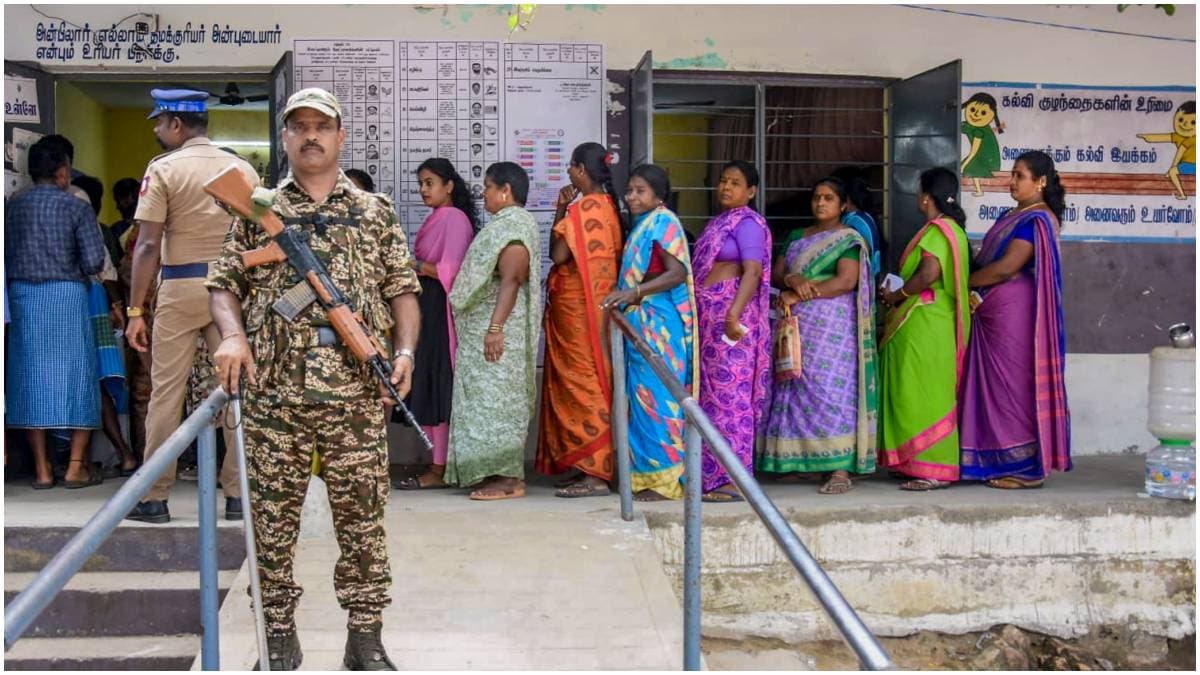
The final polling percentages on Tuesday have added another layer to that test. Madurantakam recorded 83.86 per cent turnout, while Dharapuram registered 78.53 per cent, according to the Election Commission’s polling figures. Earlier in the day, as voting began, the turnout was brisk — by 11 am, Madurantakam had recorded 35.55 per cent and Dharapuram 37.28 per cent.
The numbers are significant because both constituencies were won in the April Assembly elections by AIADMK candidates who subsequently resigned, only to join Vijay's TVK and be renominated. K. Maragatham Kumaravel is contesting again in Madurantakam, while P. Sathyabama is the TVK candidate in Dharapuram.
In April, Maragatham Kumaravel won Madurantakam on the AIADMK ticket with 69,284 votes (34.95 per cent). TVK's candidate then polled 62,090 votes (31.32 per cent), while the DMK secured 30.18 per cent. Dharapuram saw a larger gap. Sathyabama won for AIADMK with 81,100 votes, or 40.56 per cent. The DMK candidate secured 32.20 per cent and TVK's candidate 23.23 per cent.
Five months later, voters have been asked to make essentially the same political choice again, but under a different party symbol. The decision of Kumaravel and Sathyabama to contest from Madurantakam and Dharapuram, respectively, has raised another question: whether voters have accepted their switch from the AIADMK to the TVK.
But this time around, the turnout is high, prompting all three major players — the TVK, DMK and AIADMK — to study the numbers closely. However, the turnout percentage alone does not indicate which party will ultimately benefit. Of course, the high turnout indicates that voters were sufficiently mobilised to participate.
For Vijay, however, the political stakes are clear. The bypolls are the first electoral contest since his government took office and the first opportunity to measure the TVK's organisational strength outside the larger statewide election. Vijay himself made an unusually intensive intervention, campaigning for four days in the two constituencies through public meetings and roadshows. The choice of candidates also makes the exercise more than a routine bypoll.
For the DMK, on the other hand, the bypolls offered a separate opportunity, as it fought without the broad alliance configuration that accompanied the April Assembly election. The AIADMK, meanwhile, was attempting to reclaim seats whose representatives crossed over to the ruling party.
Apart from these political equations, the bypolls also sent another message: they generated substantial local political interest. However, what this means electorally will become clear only when the votes are counted.
The results on October 9 will therefore provide Vijay with something that the April election could not — an early, constituency-level reading of how voters view his party after its transition from opposition politics to government. For the DMK, the results will indicate what it means to contest without its allies, while for the AIADMK, they will show whether voters still value the party founded by MGR and helmed by Jayalalithaa.
