



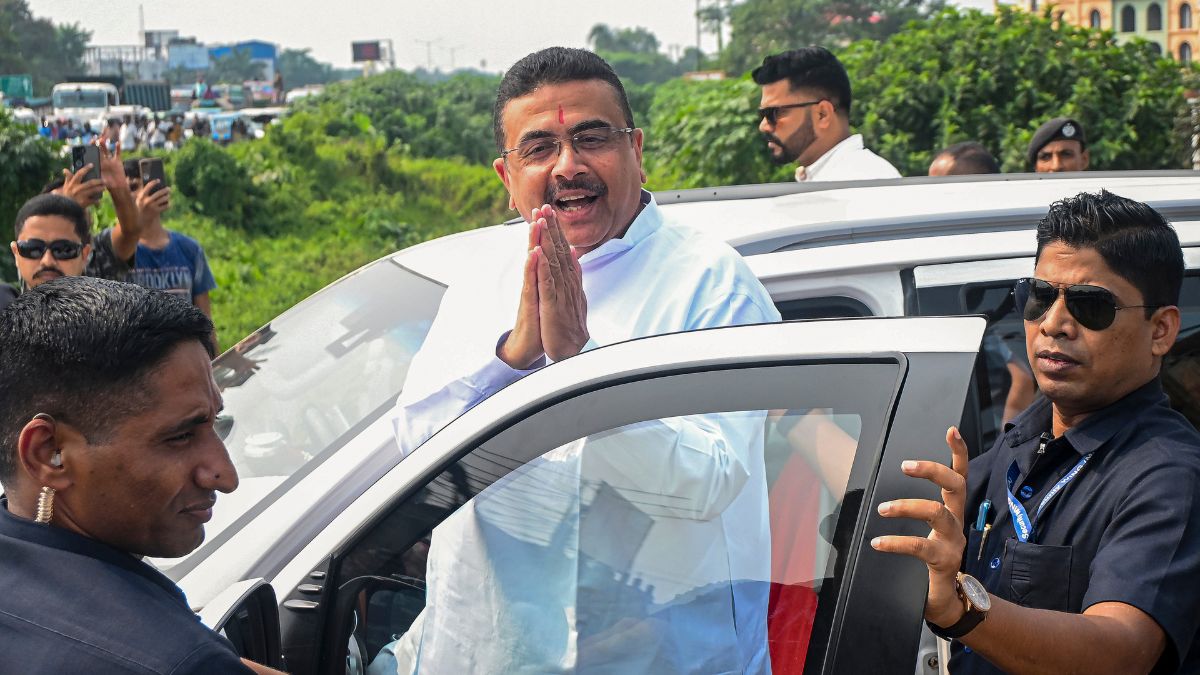
As political parties in West Bengal make a final push to woo voters in the Nandigram and Rejinagar Assembly constituencies, BJP’s strategy in Rejinagar has set tongues wagging. The party is leaving no stone unturned to wrest the Muslim-majority seat from Aam Janata Unnayan Party (AJUP).
The Rejinagar constituency in Murshidabad was initially expected to be a multi-pronged contest, with Trinamool battling Humayun Kabir’s AJUP, BJP and Congress. However, with a day left for the elections, the contest is now mainly between AJUP and the BJP.
Humayun, desperate to retain the Rejinagar seat, has fielded his son Ghulam Nabi Azad in the by-election. The BJP has nominated Shankharavh Sarkar, while Congress is represented by Mohd Abdullahil Kafi. The CPI(M) has fielded Syed Asad Ali, and the RSP is contesting separately with Bikash Chandra Misra.
The constituency itself has undergone a major shift over the last few years. While the Congress and the left once held dominance over the region, the Trinamool Congress emerged as a major force after the 202O. In 2021, TMC’s Rabiul Alam Chowdhury won the seat with more than 118,000 votes. However, Humayun left TMC to form his party and eventually wrested the seat in 2026. With the TMC split, the party no longer has any hold over the region.
This is where the BJP comes. The party, which suffered a crushing defeat in this constituency in the recent assembly elections, is bent on reversing the trend in this by-election.
BJP's strategy has shifted from ideology to development. Chief Minister Suvendu Adhikari and Bengal BJP President Samik Bhattacharya, who extensively campaigned in the constituency, have sought to appease Muslims. Bhattacharya, while addressing a rally in Rejinagar, appealed to them to vote for the BJP, which would transform the situation for Muslims in Bengal.
For a party facing criticism for stoking anti-minority sentiment, the narrative shift towards development is striking. “We have been in power in West Bengal for the last six months. Has there been a single riot? This is not the time to raise the issue of Babri Masjid and Ram Temple. We will be in power both at the Centre and the state for the next 20 years. You have to stay with us. You have to choose," he told voters.
Many think Bhattacharya’s mention of Babri Masjid isn’t a coincidence, considering how Humayun Kabir used it as a poll plank in the recent elections. He even laid the foundation stone for the construction of a replica of the Babri Masjid in this area. Kabir received 51.62% of the vote in that election. The BJP lost half of its share here, while Mamata Banerjee's TMC garnered only 17.43%.
Chief Minister Suvendu Adhikari too described the October 6 by-elections as a test for the minority community and urged them to support the BJP. In his speech, Bhattacharya also highlighted how 80 per cent of Muslims live in villages, and their monthly income is ₹5,000 or less. “Muslim representation in government jobs is also low. This situation needs to change," he added.
The BJP has also been actively engaging with the Muslim community, a move rarely seen in the state previously. The party is also actively targeting female voters, who amount to 47 per cent of the total voters. It has been urging the women to think about the men who have left the state as migrants. Many women from the minority community complain that during the Trinamool era, they were not considered for the allowance from the Awas Yojana.
Though Humayun is confident of his son’s win, he claims he is being targeted by the BJP. In a major development, both Humayun and his son Ghulam Nabi Azad have made it clear that their campaign will be limited to social media. “In addition to new cases against me, old cases against my party leaders are being reopened. Twenty-four of them have already been arrested. Twelve of us secured bail, but the police kept summoning me for questioning and harassing my supporters. That is why I have decided that neither my son nor I will campaign," he told reporters.
