



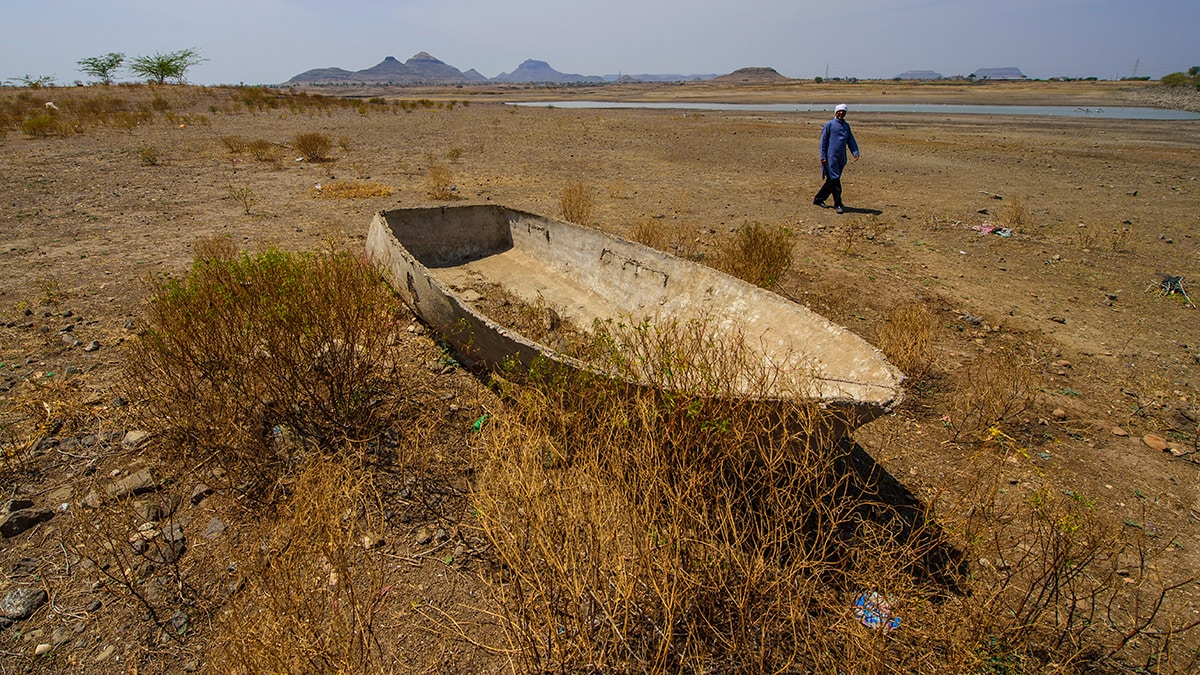
Karnataka has added another 40 taluks to its drought-hit list, taking the total number of drought-affected taluks to 217 out of 240. With the latest additions, 90.4 per cent of the state’s taluks are now officially classified as drought-hit, leaving just 23 outside the list.
The government had initially declared 101 taluks drought-hit on August 27. Another 23 were added on September 17, followed by 53 on September 22, taking the tally to 177. The addition of 40 more taluks on October 1 has now pushed the total to 217.
This is one of the worst drought conditions the state has witnessed in a century.
Deputy Chief Minister and Revenue Minister G. Parameshwara said loss assessments had been completed in the first 177 taluks, while assessment of the newly added 40 taluks was underway.
The state’s second memorandum submitted to the Centre estimated losses of around ₹46,000 crore across the 177 taluks. According to the government, crop damage in these areas has affected nearly 47.1 lakh hectares, with the estimated economic loss based on the cost of cultivation put at ₹46,324.5 crore.
Parameshwara said the total estimated loss could rise to between ₹50,000 crore and ₹60,000 crore once assessments covering all 217 drought-hit taluks are completed. “Once the losses across all these taluks are consolidated, the total estimated loss could range between ₹50,000 crore and ₹60,000 crore,” he said.
The state has already submitted two memorandums seeking drought relief from the Centre. After the assessment of the remaining 40 taluks and the Central teams’ field inspections are completed, Karnataka will submit a third and final memorandum covering all 217 taluks, Parameshwara said.
The minister was speaking after a meeting chaired by Chief Minister D.K. Shivakumar at his home office, Krishna in Bengaluru, with a high-level Central drought assessment team.
The government is yet to declare 22 taluks drought-hit. Parameshwara said ground-truthing would be conducted in these areas to establish whether they meet the criteria for drought. The assessment could show that one, two or three of these taluks are drought-hit, while some, particularly in the coastal region, may not be facing drought-like conditions. “Appropriate action will be taken based on the actual situation established after the assessment,” he said.
Parameshwara also said recent rainfall would not adversely affect the state’s drought assessment. While the rain could provide some relief in drinking-water availability, it was unlikely to significantly benefit crops that had already suffered during the agricultural season.
The state will explain to the Central teams the rainfall and crop conditions prevailing during May, June, July, August and September. These conditions have already been recorded in the memorandum submitted to the Centre. “The drought situation will not be determined solely based on recent rainfall,” Parameshwara said.
Three Central teams comprising Joint Secretaries and officials from various ministries, including Agriculture and Environment, have arrived in Karnataka to assess the ground situation. They will visit three regions of the state to assess rainfall, crop losses, drinking-water availability and fodder conditions. Separate teams have already begun inspections in some areas.
The 40 newly added taluks include Channapatna, Kanakapura, Harohalli, Jagalur, Piriyapatna, Kushtagi, Gokak, Ramdurg, Savadatti, Indi, Gadag, Mundargi, Ron, Dharwad, Kalghatgi, Kundgol, Shivamogga, Soraba, Thirthahalli, Chikkamagaluru, Kalasa, Madikeri, Kushalnagar, Belthangady, Bantwal, Ullal, Udupi, Byndoor, Ankola, Bhatkal, Haliyal and Sirsi.
The drought is also unfolding against the backdrop of an El Niño event, a climate phenomenon associated with changes in atmospheric circulation and monsoon rainfall patterns over India. The Centre has linked below-normal rainfall and emerging drought conditions in parts of the country to El Niño. However, meteorologists caution that El Niño is not the sole cause of drought, with regional rainfall patterns and other climate factors also influencing the outcome. In Karnataka, rainfall deficits and prolonged dry spells have particularly affected rain-fed agriculture, adding to crop and water stress across large parts of the state.
The Central teams’ assessment will help determine the final extent of crop losses and other drought-related impacts before the state submits its final memorandum seeking relief from the Centre.
The meeting was attended by Central drought assessment team head Ajit Kumar Sahu and members of the team, Chief Secretary Shalini Rajneesh, Additional Chief Secretaries Gaurav Gupta and Tushar Girinath, State Disaster Management Department Secretary Manoj Kumar Meena and Commissioner Honnamba, among other officials.
